


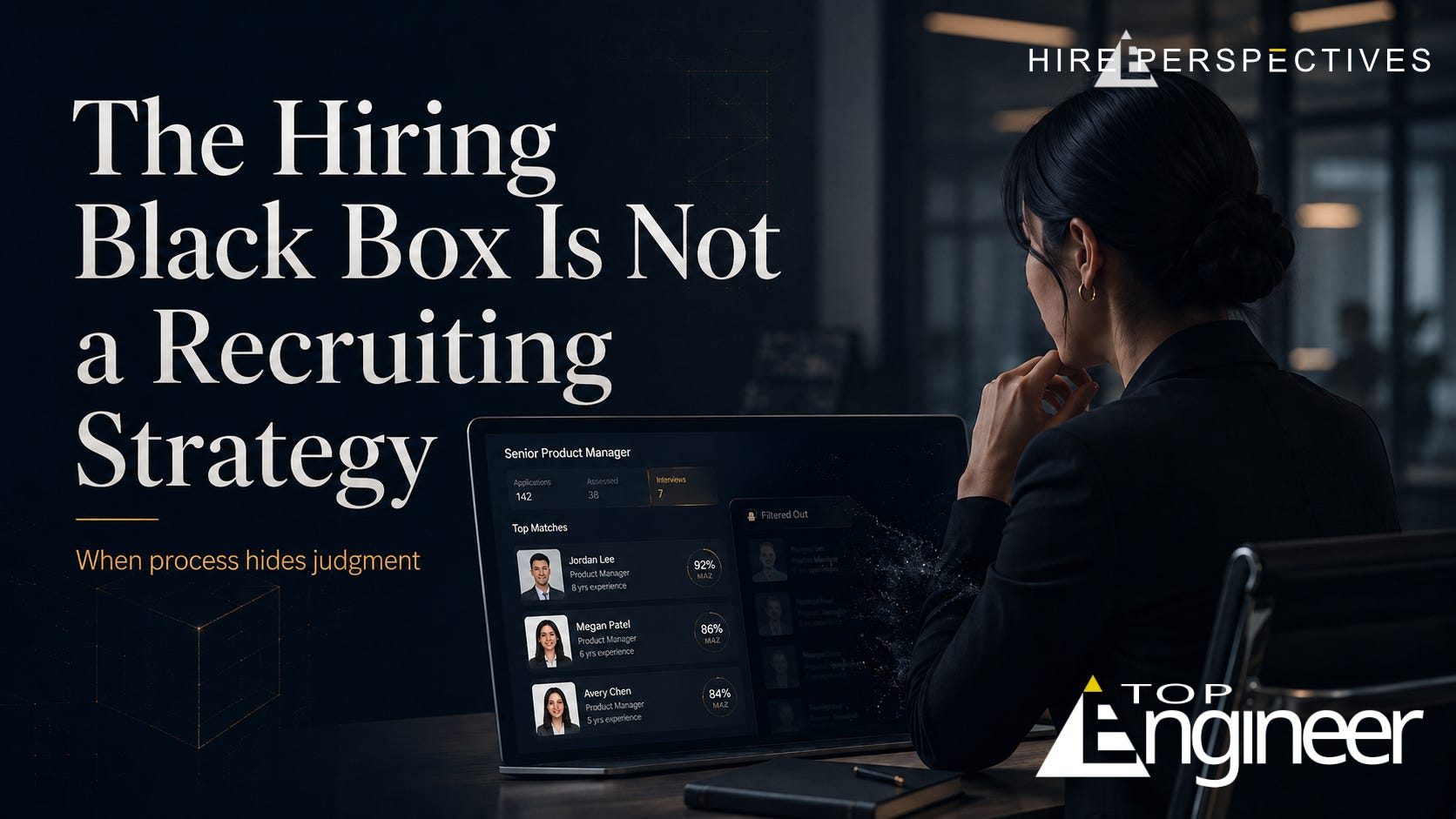
Do Not Let a Black Box Decide Which Top Engineers Are Worth Knowing
Sarah opened the candidate slate before her first intake call of the morning.
Her calendar had the familiar shape of an internal recruiter’s day. Two hiring managers wanted updates on searches that had been open longer than anyone liked. A finalist was still waiting for feedback after a panel interview. Another candidate had gone quiet after mentioning a competing offer. There were unread notes from the candidate recruiter, a compensation question from HR, and a senior engineering manager who wanted to know why a difficult search was not producing results.
None of this was unusual. It was the normal pressure of recruiting inside a company that needed talent faster than the market wanted to provide it.
Sarah understood the tension better than most people around her. Hiring managers wanted fewer interviews, but they did not want the company to miss the right person. HR leadership wanted lower agency spend, but the hardest searches still required a level of reach that internal job postings rarely produced. Procurement wanted cleaner vendor relationships, cleaner reporting, and cleaner costs. Executives wanted evidence that recruiting had become more scalable, more measurable, and more modern.
What everyone wanted, in one form or another, was control.
That was why “the new platform” had been attractive. It promised a way to reduce dependency on old school headhunters and outside recruiting agencies. It offered a cleaner process, a broader candidate view, structured screening, matching scores, and less reliance on individual recruiter judgment. Instead of paying a search fee and waiting for someone outside the company to produce a candidate, the internal team could use a system that appeared to bring the market closer.
Sarah was not naive for finding that appealing. A weak agency relationship can waste time. A recruiter who does not understand the role can turn a search into résumé traffic. A hiring manager who receives poorly matched profiles will quickly lose confidence in the entire process. There are real reasons companies look for something cleaner.
On the screen in front of her, the process looked clean.
The candidates were organized. The profiles were consistent. The summaries were easy to compare. Each person had been translated into the same basic set of fields: skills, years of experience, location, compensation range, work authorization, match percentage, risk indicators, and recommended next step. The slate looked disciplined in the way modern software often looks disciplined. It had the visual language of order.
Sarah reviewed the first candidate, then the second, then the third. Each profile gave her enough to understand why the person had made it to the list, but not enough to understand who had not. The platform showed her the surviving candidates. It did not show her the people removed before the slate reached her desk.
That was the part she could not stop thinking about.
A top engineer could have been filtered out because one field was misunderstood. A candidate with the right technical judgment could have been removed because a complex work history did not fit the system’s preferred pattern. Someone legally eligible to work could have been rejected because a visa status was treated as a problem instead of a question. The process gave Sarah a result, but it did not give her the reasoning underneath the result.
This is the point at which recruiting begins to change shape. It still looks like recruiting from the outside. There is a requisition, a workflow, a candidate slate, a recommendation, and a decision. But the actual judgment has moved somewhere harder to inspect.
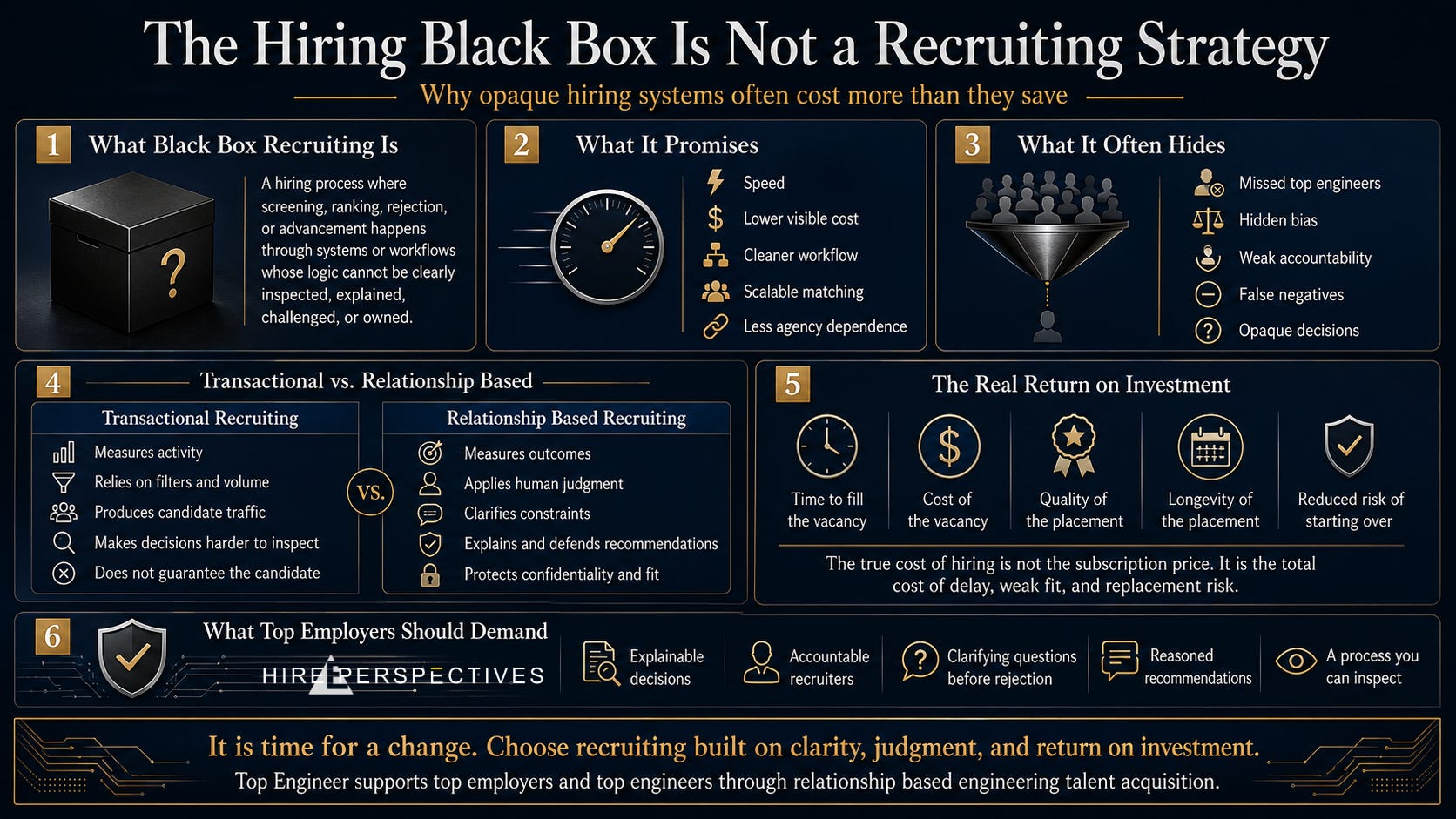
Black box recruiting is any hiring process where candidate screening, ranking, rejection, or advancement happens through systems, platforms, workflows, agencies, or third party intermediaries whose decision logic cannot be clearly inspected, explained, challenged, or owned by the employer, the recruiter, or the candidate.
That definition matters because the issue is not technology itself. Recruiting technology can be useful. A serious recruiting process should use tools to organize information, search the market, document communication, support collaboration, and reduce administrative drag. The problem begins when the tool becomes the place where judgment disappears.
Black box recruiting is not defined only by artificial intelligence. It can happen through an applicant tracking system, a scoring model, a screening vendor, a platform marketplace, an outsourced recruiting workflow, or an internal process that no one is willing to question. The defining feature is opacity. The hiring manager sees the slate, but not the judgment that shaped it. The internal recruiter sees the workflow, but not always the assumptions built into the filter. The candidate receives an outcome, but not an explanation. The company believes it has gained control, while the most important decisions may have simply moved into a part of the process no one understands well enough to defend.
This is why the promise is so seductive. Internal recruiting teams are under pressure to look efficient and be efficient, which are not always the same thing. Agency fees are easy to criticize because they appear as visible costs. A search firm’s invoice is concrete. The hours lost to weak screening, slow decisions, missed candidates, and poor fit are harder to measure, even when they cost far more.
A platform can walk into that environment with a very attractive story. It can promise speed, consistency, reduced agency dependence, cleaner screening, better visibility, and more control over the candidate pipeline. It can make the old headhunting model look expensive, informal, and difficult to manage. For a recruiting leader trying to satisfy hiring managers, HR leadership, finance, and procurement at the same time, the pitch has obvious appeal.
Sarah understood that appeal because she lived inside the pressure that created it. She did not want to defend agency fees for recruiters who sent generic profiles. She did not want hiring managers asking why the pipeline was thin after weeks of activity. She did not want to explain why a candidate had been missed, why feedback had stalled, or why a search had become dependent on one outside recruiter’s private network. A system that promised to bring structure to that disorder did not feel reckless. It felt responsible.
The trouble is that a structured process can still make poor decisions. It can even make them faster.
A polished slate does not prove that the right candidates were considered. A matching score does not prove that the candidate was understood. A rejection does not become sound simply because it happened inside a standardized workflow. The discipline of recruiting does not live in the appearance of process. It lives in the quality of judgment applied to the person, the role, and the context between them.
Sarah could see the candidates who remained, but she could not see the candidates who had been removed. She could not tell whether the platform had surfaced signal or merely enforced familiarity. She could not tell whether the system had widened the market or narrowed it around familiar patterns. The workflow gave her a sense of control, but it also created distance from the very people she was supposed to help the company understand.
That distance is the hidden cost.
A bad agency recruiter may waste a company’s time in a way the company can see. The wrong candidates arrive. The hiring manager complains. The recruiter is challenged. The relationship either improves or ends. The failure is visible enough to confront.
A black box process can fail more quietly. It can remove the unusual candidate before anyone asks whether unusual means risky or valuable. It can reject complexity before a recruiter has the chance to clarify it. It can give the internal team a cleaner day while keeping the best missed opportunity completely invisible.
Engineering teams understand this instinctively in their own work. A clean report is not enough if the test method is flawed. A supplier’s summary is not enough if the inspection process cannot be defended. A result is not rigorous simply because it is formatted well. Serious work requires traceability. It requires understanding how a conclusion was reached and whether that conclusion can survive scrutiny.
When a candidate is advanced, someone should be able to explain why. When a candidate is rejected, someone should be able to explain that too. The explanation cannot be a vague phrase about fit or a score produced by a system no one can interpret. It has to connect the actual person to the actual role and the actual constraint. Otherwise the company has not improved recruiting judgment. It has hidden the absence of it.
The claim of neutrality deserves the same examination. Companies often want to believe that abstracting the process makes it fairer. The human recruiter is messy, subjective, inconsistent, and relationship driven. The system appears cleaner. It uses categories, fields, scores, and rules. It does not sound emotional. It does not appear to have favorites.
But a process does not become neutral because it becomes technical.
Every system carries assumptions. The criteria matter. The data matters. The design choices matter. The filters matter. The historical hiring patterns that shaped the model matter. A process can look objective while still rewarding familiar backgrounds, familiar career paths, familiar keywords, and familiar forms of presentation. Bias does not disappear when it is converted into a field. It may become harder to see.
This is not primarily a political point. It is an operational one. If a company cannot inspect the logic by which candidates are being removed, it cannot know whether the process is protecting quality or excluding people who deserved a closer look. The danger is not only that bias may exist. The danger is that the company may no longer know where to find it.
Recently, a well known, VC backed agency filtered out a brilliant engineer over a visa status that was valid. That example should not be turned into a legal lecture or an immigration argument. Work authorization matters. Compliance matters. Employers should ask careful questions and make responsible decisions.
The failure was not that the process noticed the visa issue. The failure was that the process treated complexity as disqualification before anyone did the recruiting work.
A serious recruiter would have slowed down long enough to understand the facts. What is the current status? What does the employer actually need to know? Is sponsorship required now, later, or not at all? Is there a real barrier, or is there only unfamiliarity? What documentation would clarify the situation? Does the candidate deserve a conversation before being removed?
A black box can process a field. A recruiter has to understand what the field means. That difference is where judgment lives.
This is also where the old school headhunting model, when done properly, still has a serious place in engineering hiring. The value of a recruiter is not that the recruiter owns a private pile of résumés. It is not that the recruiter can send activity into an inbox. That version of agency recruiting deserves much of the criticism it receives.
A serious recruiter knows the candidate beyond the résumé. Capability matters, but so do direction, motivation, timing, constraints, compensation expectations, confidentiality, and fit. A top engineer may be qualified and still wrong for a particular employer. Another engineer may look unconventional on paper and be exactly the person the company needs once the actual problem is understood.
The recruiter also has to know the employer beyond the job description. A job description is often the official version of the need, not the full version. The real need may live in the pressure on the team, the manager’s expectations, the technical gap, the business timeline, the culture around decision making, or the consequences of getting the hire wrong. A recruiter who does not understand those realities is not recruiting. That recruiter is moving documents.
There is a meaningful difference between a submission and an endorsement.
A submission says a candidate appears to match the words on the page. An endorsement says the person has been understood in relation to the actual need, and the recommendation can be defended. That difference is why relationship based recruiting still matters. It is not sentimental. It is accountable.
Sarah eventually saw that her company had not been choosing between modern technology and old fashioned recruiting. That was the false frame. The real choice was between accountable recruiting and unaccountable recruiting.
She still wanted tools. She still wanted cleaner communication, better documentation, organized pipelines, and fewer wasted interviews. She still wanted to reduce dependency on weak agency relationships that did not earn their fees. But she no longer wanted to replace a visible recruiting problem with an invisible one.
She wanted a process she could inspect.
She wanted to know who had been considered and why. She wanted to know who had been removed and why. She wanted to know whether the process distinguished actual risk from unfamiliarity. She wanted to know whether a recruiter had asked the clarifying question before accepting the filter. Most of all, she wanted someone to own the recommendation.
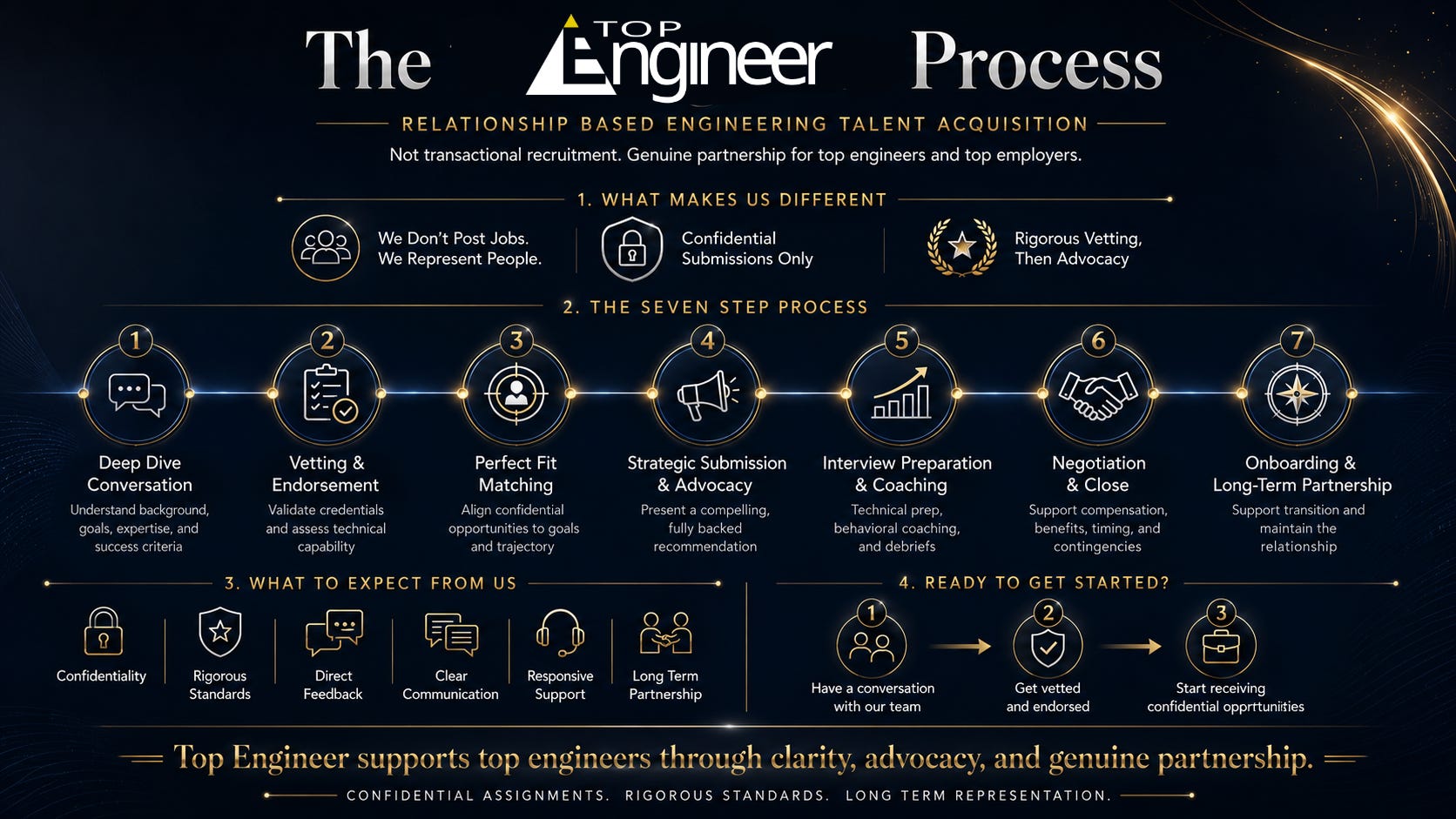
Top Engineer stands in direct opposition to the transactional model because our work is built around relationship based engineering talent acquisition. That phrase can sound old fashioned until the stakes become real. Then it becomes the entire point.
We do not believe a top engineer should be reduced to keywords, ATS scores, or a profile moving through hidden filters. We also do not believe a top employer should be handed a mystery box and told to trust the output. The hiring decision is too consequential for that. The work is too technical, too human, and too important to be hidden behind a system that cannot explain itself.
Our process begins with understanding the employer’s actual need. That means going beyond the job description into the business goal, the technical challenge, the team context, the expectations, the risk, and the kind of person who can create the outcome the employer needs. A job description may start the conversation, but it cannot be allowed to replace the conversation.
From there, the work moves into the market. Top Engineer does not wait passively for the right person to appear. Recruiting for top engineers requires market intelligence, direct outreach, confidential conversations, and enough industry understanding to recognize people who may not be actively looking. Many of the people worth knowing are not sitting in a public applicant pool waiting to be scored.
They have to be found, understood, and represented with care.
On the candidate side, the process begins with knowing the person. Capability matters, but so do direction, motivation, timing, compensation expectations, constraints, confidentiality, and fit. A top engineer deserves more than being dropped into a system and processed by assumption. A top employer deserves more than a short list no one can explain.
Top Engineer represents top engineers the way a serious sports agent represents an athlete. That does not mean hype. It means representation with judgment. It means we know who we are putting forward, why we are putting them forward, and what kind of opportunity actually makes sense. We do not submit people merely to create activity. A recommendation should carry the weight of the recruiter’s reputation and the candidate’s reputation at the same time.
That standard works both ways. We do not submit to just any company, and we do not work with just anyone. The fit has to be real. The opportunity has to make sense. The expectations have to be clear. The process has to protect confidentiality. When feedback comes back, it should be direct. When timelines shift, people should know where they stand. When a hard question appears, the answer should not be hidden behind a dashboard. It should be clarified.
This is not a rejection of technology. It is a rejection of hiding behind technology.
Top Engineer uses process, but we do not worship process. We use tools, but the tools do not replace the recruiter’s responsibility to understand the candidate, understand the employer, clarify the constraint, protect confidentiality, and stand behind the recommendation. Technology can support the work. It cannot become the conscience of the work.
Sarah’s morning did not end with a dramatic revelation. Most recruiting problems do not announce themselves that way. They appear in quieter forms: a candidate who never made the slate, a hiring manager who never saw the right profile, a valid complexity that became a rejection, a process that looked better than it actually was.
That is what makes black box recruiting so dangerous. It does not always fail loudly. Sometimes it fails by making the loss invisible.
Engineering leaders and internal recruiting teams should demand more. They should ask who owns rejection decisions, how candidates are evaluated before they reach the hiring manager, how complex profiles are handled, how confidentiality is protected, and whether the recruiter can explain why each person was advanced or rejected. Those questions are not obstacles to efficiency. They are the conditions of serious hiring.
The companies that win the future of engineering talent will not be the ones with the most automated process. They will be the ones that know when automation has reached its limit and judgment has to begin.
Transactional recruiting measures activity. Relationship based recruiting measures outcome.
That is the difference.
The transactional model wants the employer to believe that a cleaner workflow is the same thing as a better hire. It counts profiles, screens, scores, messages, applications, and movement through a funnel. It makes the process look busy, and sometimes it makes the process look modern, but activity is not the same as judgment. A company can process hundreds of candidates and still miss the one person who should have been understood.
Relationship based recruiting begins somewhere else. It begins with the actual need, the actual person, and the actual consequence of getting the hire right or wrong. It asks better questions before making faster decisions. It protects confidentiality. It clarifies constraints. It understands the employer beyond the job description and the engineer beyond the résumé. It does not treat a recommendation as a transaction. It treats a recommendation as an accountable act of judgment.
The cost of black box recruiting is not limited to the subscription, platform fee, or internal software budget. The real cost compounds across the entire hiring equation. It lives in time to fill, the cost of the open vacancy, the productivity lost while the seat remains empty, the management time spent reviewing weak matches, the quality of the eventual placement, the longevity of that placement, and the risk of starting over when the hire does not last.
A black box system can look cheaper while becoming more expensive.
It can reduce the visible cost of an agency relationship while increasing the hidden cost of vacancy, delay, false confidence, poor matching, and unguaranteed outcomes. It can make recruiting feel efficient while shifting the financial burden into places the budget does not always label as recruiting expense.
Where the return on investment changes.
A serious agency relationship is not merely a fee. It is a risk management function. It is market access, candidate understanding, employer understanding, confidentiality, advocacy, clarification, negotiation, and accountable recommendation. When the process shortens time to fill, protects the employer from weak fits, improves the quality of the placement, and supports a longer lasting hire, the return is not theoretical. It shows up in reduced vacancy cost, stronger team performance, lower replacement risk, and less executive distraction.
Black box systems do not guarantee the candidate. Top Engineer stands behind the process, the judgment, and the recommendation.
For top employers, that is the practical difference between buying recruiting activity and investing in recruiting outcomes. For top engineers, it is the difference between being processed by a system and being represented by someone who understands the value of the work.
The market has had enough mystery boxes dressed up as innovation. It is time for a recruiting process that can explain itself, defend its judgment, and produce a return that survives the full cost of the hire.
It is time for relationship based engineering talent acquisition.
Visit topengineer.us.
Have a blessed day!
James Beine
#TopEngineer #HirePerspectives #EngineeringRecruitment #TalentAcquisition #EngineeringLeadership #RecruitingStrategy #EngineeringTalent
