


My mentor could sit with a candidate file for a long time without saying much. He was not being slow. He was doing the work that much of the industry now tries to skip. The résumé might have looked good, the background might have been close, the job order might have been urgent, and the company might have been waiting, but none of that was enough for him. Before he put an engineer in front of an employer, he wanted to know whether the recommendation deserved his name behind it.
That was the part I learned from him that never left me. He practiced recruiting like an artisan. For more than 45 years, he has been building relationships with engineers and employers by refusing to treat either side casually. He does not send people around the market to see what might happen. He does not turn a candidate’s name into activity. He believes that a recommendation should carry weight, and that weight came from judgment. When he puts someone forward, the employer understands that the person was not simply been found. The person is been considered.
After almost 30 years in engineering talent acquisition, I have observed the profession becoming faster, more automated, and often less careful. There are more tools than ever to find people, sort people, tag people, rank people, parse résumés, and move names into systems. There is more activity, more motion, and more process, but the central question has not changed: does the recommendation mean anything?
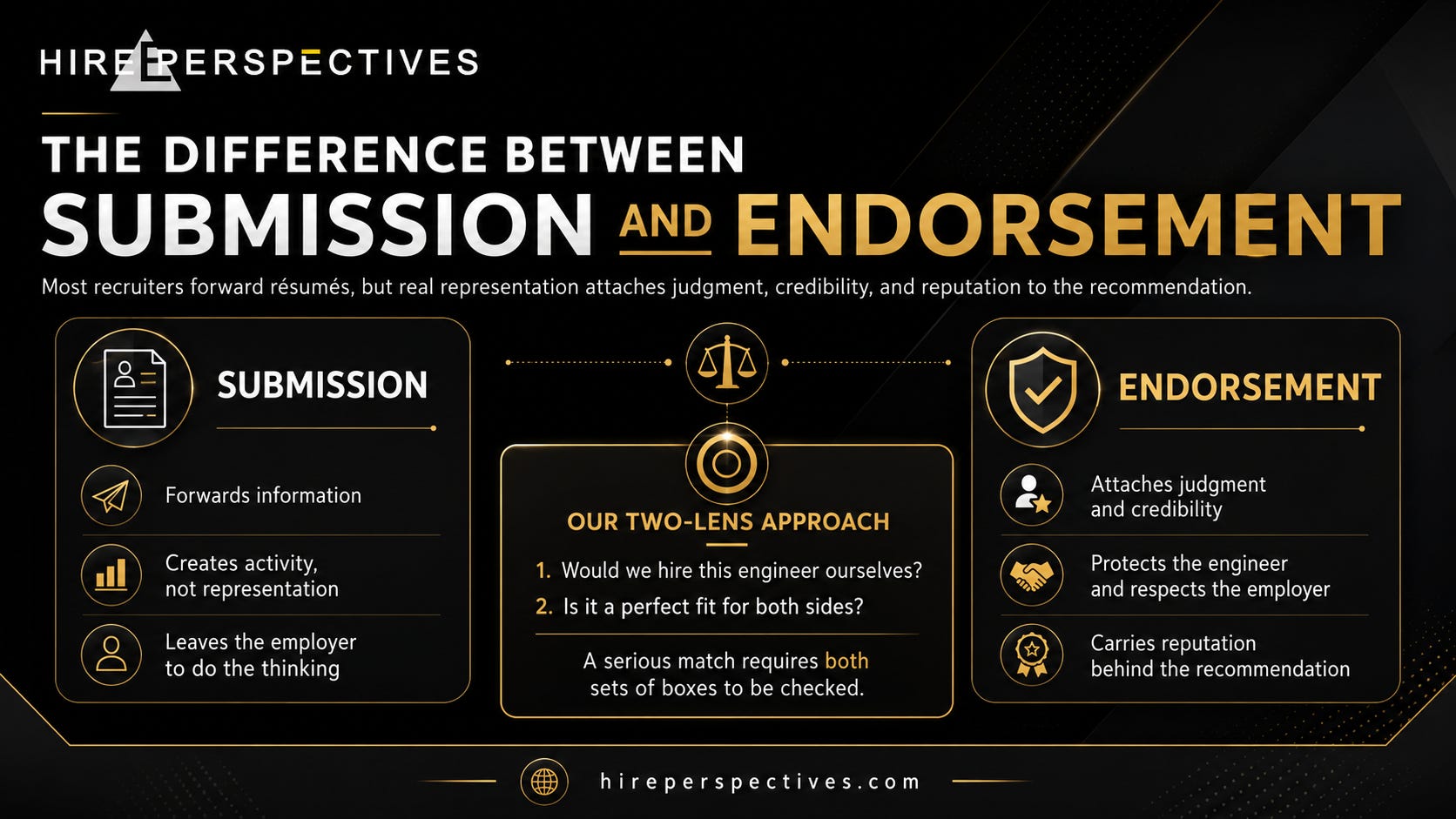
A submission can happen with very little understanding. A recruiter can find a résumé, see enough familiar language to justify sending it, and move it into the employer’s hands. The hiring manager receives another profile. The engineer is told they have been submitted. The recruiter can point to activity. On the surface, something has happened, but the deeper work may still be missing because sending a document is not the same as standing behind a person.
Endorsement carries a different weight. It requires the recruiter to attach credibility to the recommendation by saying, in effect, that the engineer has been understood, the opportunity has been considered, and the fit is being presented with purpose. It is not the same as asking the employer should to the engineer or skip its own evaluation. It means the recommendation has already passed through judgment before it reaches the employer.
This kind of recommendation is not mass produced. It requires discovery. It requires time. It requires understanding more than the job description and more than the résumé. We have to understand the engineer’s actual value, the direction of the career, and the conditions under which the engineer can create a meaningful return for the employer. We also has to understand the employer beyond the requisition, because a role is not merely a set of requirements.
When that work is not done, the hiring manager is forced to do the recruiter’s thinking. That is one of the quiet costs of submission culture. Employers receive candidates without context and then have to figure out why the person is there. They have to interpret the résumé, infer the fit, test the assumptions, and decide whether the recruiter had any real conviction behind the send. That may be normal now, but normal does not make it good. A top employer does not need more noise at the front of the process. A top employer needs better judgment before the profile arrives.
The engineer pays a cost too. A Top Engineer’s name should not be carried into the market casually. Confidentiality matters. Timing matters. Context matters. A career has a signal, and careless representation can weaken it. When an engineer’s information is sent without purpose, the recruiter is not merely moving a résumé. The recruiter is touching reputation, leverage, and future opportunity. That should be handled with more seriousness than most submission processes allow.
Endorsement changes the standard because it brings judgment back into the process. It does not guarantee that the employer will hire the engineer. It does not replace the interview. It does not remove the employer’s responsibility to evaluate. It simply means the recruiter has done enough work to explain why the engineer belongs in the conversation, what value is expected, what alignment appears to exist, and what should be explored further.
The best recruiting relationships are built on the weight of that judgment. My mentor understood that a recruiter’s reputation is either strengthened or weakened by every person put forward. If he sent someone who did not belong, the employer would remember. If he represented someone carefully and the recommendation proved sound, the employer would remember that too. Over time, his recommendations became valuable because he refused to cheapen them. He was not merely a source of candidates. He was a filter.
Top Engineer was built to recover that standard. We do not exist to move résumés through a system. We represent people. That means taking time to know the engineer before carrying their name into a conversation. It means vetting opportunities before creating exposure. It means matching with discipline. It means preparing the engineer, communicating clearly with the employer, and staying involved beyond the first introduction. The candidate is not inventory, and the employer is not merely placing an order. The relationship is the process.
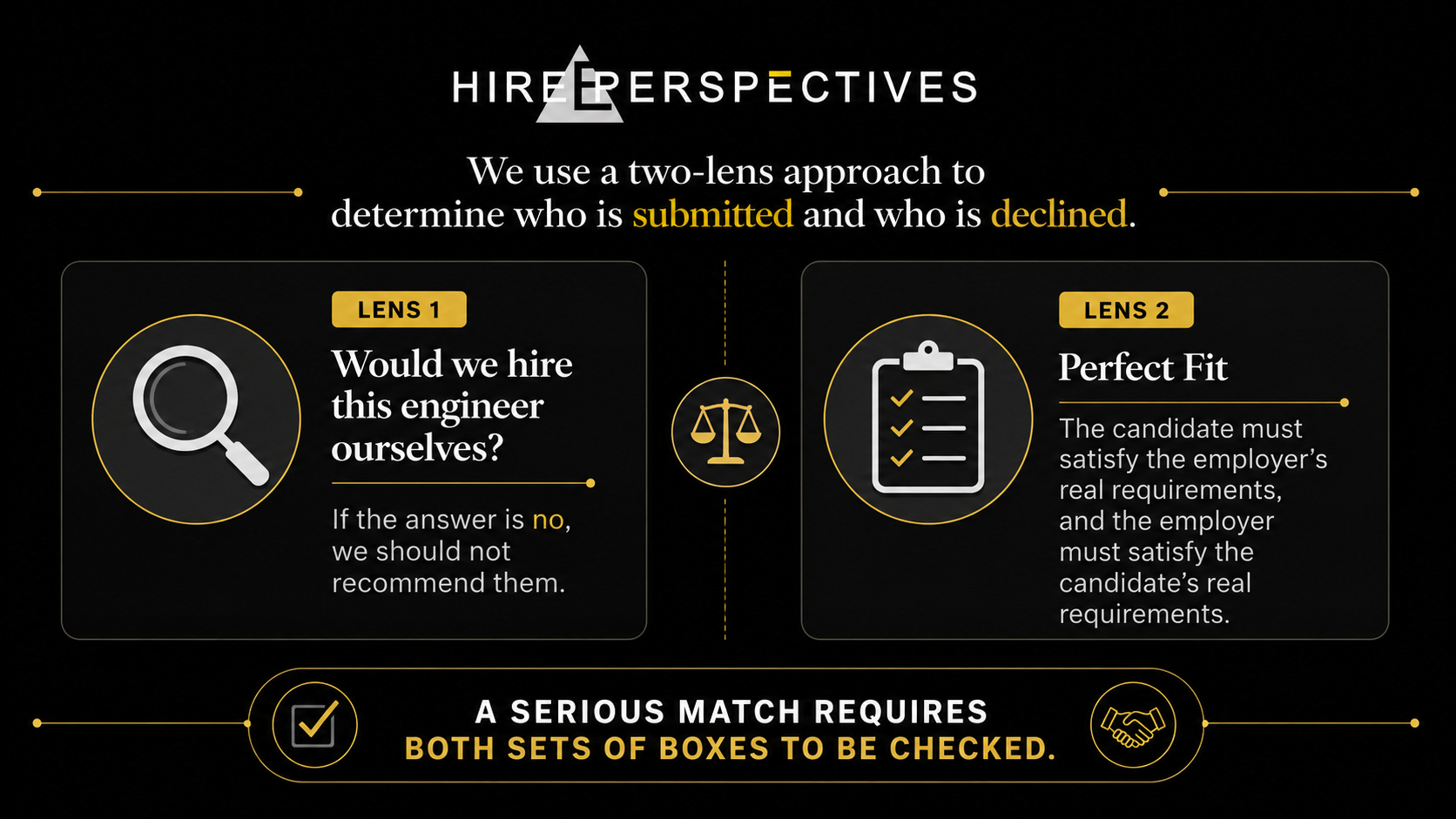
We use a two-lens approach to determine who is submitted and who is declined. The first lens is direct: would we hire this engineer ourselves if we were in the employer’s position? If the answer is no, we should not recommend them. The second lens is Perfect Fit. The candidate must satisfy the employer’s real requirements, and the employer must satisfy the candidate’s real requirements. Both sides have boxes that matter, and a serious match requires both sets to be checked.
These questions cannot be answered by automation alone. It requires discovery, relationship, discernment, and restraint. It requires enough discipline not to send someone simply because sending them is possible. It requires enough respect for the engineer not to expose them without purpose. It requires enough respect for the employer not to fill their process with noise.
This is why saying no matters. A recruiter who says yes to every candidate and every opening may seem helpful, but that kind of openness eventually destroys the meaning of representation. If everyone is represented, representation means very little. If every role is worth pursuing, alignment means very little. If every résumé is sent, endorsement means very little. The power of endorsement comes from the fact that it is selective.
Top Engineers should expect that. They should ask who is carrying their name, whether that person understands their value, whether the opportunity has been considered against the long arc of the career, and whether confidentiality is being protected. A recruiter who cannot explain why the opportunity is a fit should not be carrying the engineer into the conversation. Activity is not enough. Exposure is not enough. Submission is not enough.
Top employers should expect the same seriousness from the other side. When a recruiter presents an engineer, the employer should not have to guess why. The conversation should already have a point of view. Why this engineer. Why this role. Why now. What value appears to be present. What fit has been considered. What concerns should be explored. That does not mean the recruiter does the employer’s hiring work. It means the recruiter respects the employer enough to do real work before asking for attention.
My mentor understand that long before technology made it easy to confuse speed with value. When he puts someone forward, he knows his own credibility moves with the recommendation. That is why companies listen. They are not merely receiving another candidate. They are receiving judgment. The engineer earns the endorsement. The employer values the recommendation because it had not been cheapened by careless volume.
A résumé can be submitted by almost anyone, but endorsement has to be earned by the engineer. We source, recruit, vet, endorse, and guarantee the placement of Top Engineers in writing.
Learn more at https://topengineer.us
Have a blessed day!
James Beine
#TopEngineer #HirePerspectives #EngineeringRecruitment #TalentAcquisition #PerfectFit #EngineeringTalent #RelationshipDrivenRecruiting
