


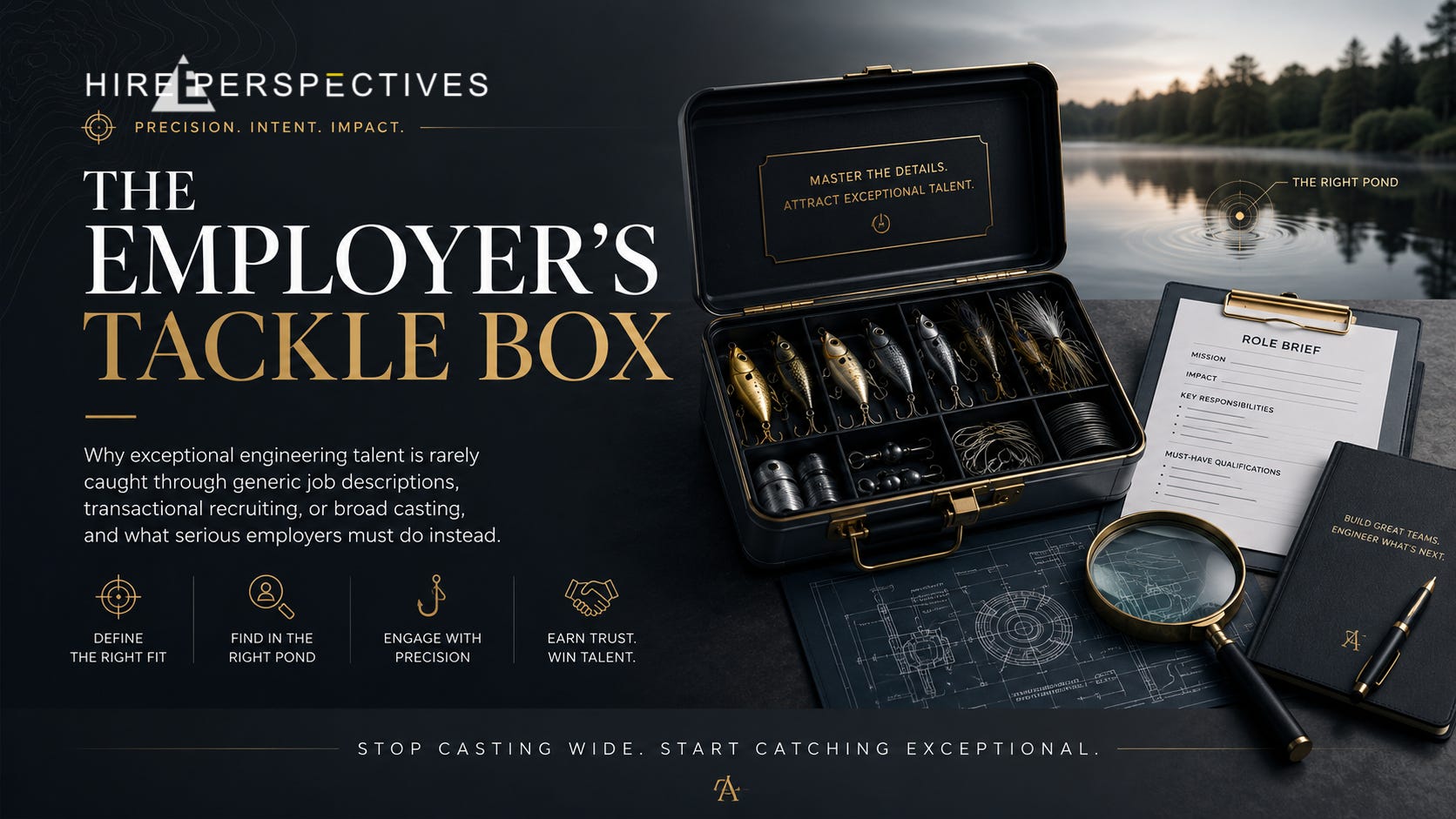
If you are responsible for hiring an engineer at your company, I would like to challenge you for a moment.
Almost every single day, I am working to change the way engineers think about their career. Most of them create a résumé that casts a wide net and then broadcast it to as many companies as possible, hoping that someone will take an interest. This is the wrong way to go about it. I often use a metaphor called the fisherman’s tackle box. I advise the engineer to get the right tackle, the right bait, go to the right place, and fish for the right fish. It is a simple metaphor, but it works because it describes reality. The engineer who wants the right opportunity cannot afford to communicate like someone willing to take anything that swims by.
The same principle applies to employers.
Many companies are still hiring like amateurs. They write a broad job description, list every imaginable requirement, add a stack of vague corporate language, and then release it into the market hoping that the right engineer will somehow self identify, self select, and self apply. In practice, that approach usually attracts a wide variety of engineers, experience levels, and intentions. It creates volume, not precision. It creates applicants, not alignment. It creates activity that can easily be mistaken for momentum. That is the first problem.
The second problem is more important. The fish you are actually trying to catch is usually not in the pond you are casting into. The engineer you really want is often already employed somewhere else, often reasonably happy, often not on the job boards, and often not thinking about your company at all. That engineer is not waiting around to discover a generic posting with a title that sounds vaguely relevant. That engineer is already in another pond.
This changes everything.
Once an employer accepts that reality, the whole recruiting posture has to change. The job description can no longer function as a static list of duties and requirements. It has to become a communication instrument. It has to communicate the opportunity itself, the real business case behind the role, the engineering environment, the problems worth solving, the quality of leadership, the team, the standard, and the experience of doing meaningful work at your company. In other words, it has to stop sounding like a filter and start sounding like an invitation to the right person.
That does not mean it should become soft or inflated. It means it should become clear. The strongest engineering talent does not respond well to vague corporate language, theatrical branding, or recycled hiring clichés. Serious engineers want to know what the problem is, why it matters, what kind of environment they would be entering, what standard they would be held to, and whether the company actually understands the value of the person it claims to be looking for. A job description that fails to answer those questions is not neutral. It is weak bait.
This is where many employers lose before the conversation even starts.
A top engineer is not generally drawn to a posting that reads like it was written by committee, designed to offend no one, and broad enough to catch everyone. A posting like that tells the market that the company itself may not really know who it needs. It signals uncertainty. It signals generic process. It signals that the company is hoping the right person will do the work of interpretation for them. That is not how great hiring works.
Great hiring begins with clarity.
What is the actual problem this engineer is being brought in to solve. What kind of engineer thrives in this environment. What kind of person would find this opportunity deeply compelling. What sort of mission, team, and leadership structure would make a passive engineer willing to move. What kind of standards, support, and trajectory would justify leaving one pond for another. Those are the right questions. A company that cannot answer them will usually default to transactional hiring because transaction is what fills the gap when strategy is missing.
That brings us to the deeper issue. Recruiting is becoming more and more transactional every day, and that trend is not making hiring better. It is making it thinner. Transactional recruiting tends to reduce the process to speed, volume, keyword matching, compensation bands, and short term fit. It often treats talent like inventory and hiring like throughput. The result is predictable. The wrong people get into the process. The right people never see the signal. The company interviews widely, learns slowly, hires imperfectly, and then hopes that through enough motion the right person eventually lands in the role.
That is not a strategy. That is trial and error with a payroll implication.
The cost of this is larger than most employers admit. A weak hiring process does not only waste time. It weakens teams. It frustrates managers. It erodes confidence in leadership. It delays progress. It often causes a company to settle for someone who can technically do the work without ever becoming the right long term fit for the role, the team, or the mission. Then the organization quietly tells itself the market is difficult, when in reality its own recruiting logic is too shallow for the quality of talent it claims to want.
A better approach requires a different mindset.
The employer has to think like a master angler. That means deciding with precision what kind of fish is actually worth catching. It means understanding that the right engineer is not simply the person who checks the most boxes. It means recognizing that the opportunity itself must be positioned properly. It means going where the right engineers are, speaking in language they respect, and presenting a role that feels real, serious, and worth their attention. It means accepting that the market for high value engineers is not a market of active shoppers. It is a market of selective, passive, highly evaluative people who need a compelling reason to listen.
The employer’s narrative has to move beyond the mechanics of the role and into the meaning of the work. What is being built here. Why is it worth joining. What can this engineer influence. What will they inherit. What will they improve. What challenge exists here that would make a strong engineer curious enough to have the conversation. Those are not cosmetic questions. They are the difference between attracting people who are merely available and attracting people who are actually valuable.
Many employers still think that if the compensation is good enough, the right engineer will simply show up. Compensation matters, but it is rarely the whole story. Strong engineers are often evaluating much more than salary. They are evaluating quality of leadership, seriousness of the work, technical standards, team quality, stability, trajectory, and whether the company itself seems to understand the importance of the role. A generic job description answers almost none of that.
The engineer must stop casting a wide net. The employer must stop doing the same.
The engineer needs the right tackle, the right bait, the right water, and the right target. So does the employer. The employer who wants exceptional talent must become more intentional, more precise, and more honest about what the role is and who it is really for. The company must stop writing for everyone and start communicating to the right person. It must stop hoping the market will solve its clarity problem. It must solve that problem itself.
The companies that understand this will hire better. They will have fewer, stronger conversations. They will spend less time sorting noise and more time building real alignment. They will be more attractive to passive talent because they will sound like they know what they are doing. They will not look like one more employer tossing another generic hook into a crowded pond. They will look like a serious place with a real opportunity, speaking clearly to the kind of engineer they actually want.
Stop recruiting transactionally.
Stop writing for volume.
Stop mistaking broad reach for strategic reach.
Stop hoping the right fish will somehow wander into the wrong water.
Instead..
Build the right message.
Frame the real opportunity.
Go where the right engineer actually is.
Speak with enough clarity that the right person knows you are talking to them.
That is how serious employers fish.
The next step is not more transactional recruiting. The next step is working with us to position, communicate, and pursue engineering talent at the level the market now demands. We are a relationship first agency.
Top Engineer exists for employers who are serious about attracting exceptional engineers and serious about doing it with greater clarity, precision, and strategic intent. We help companies move beyond generic job descriptions, broad casting, and hopeful hiring. We help define the real opportunity, sharpen the narrative, and connect it to the kind of engineer who is actually worth pursuing.
This is not about filling seats. It is about building stronger teams, making better matches, and reducing the waste that comes from shallow evaluation and transactional recruiting. If your company is ready to hire with more intelligence, more alignment, and a more disciplined view of engineering talent, start with Top Engineer.
Learn more at
https://www.topengineer.us
Serious inquiries only.
James Beine
#TopEngineer #HirePerspectives #EngineeringTalent #EngineeringRecruitment #TalentStrategy #HiringStrategy #EngineeringLeadership

Employers need to think twice before publishing a job ad. In many of them, if you remove the company name, you can't distinguish one company from another. It is possible to make an attractive job ad for the right candidate, filtering out people, but would take too much work for hiring managers to learn copywriting basics in order to write better job posts.