


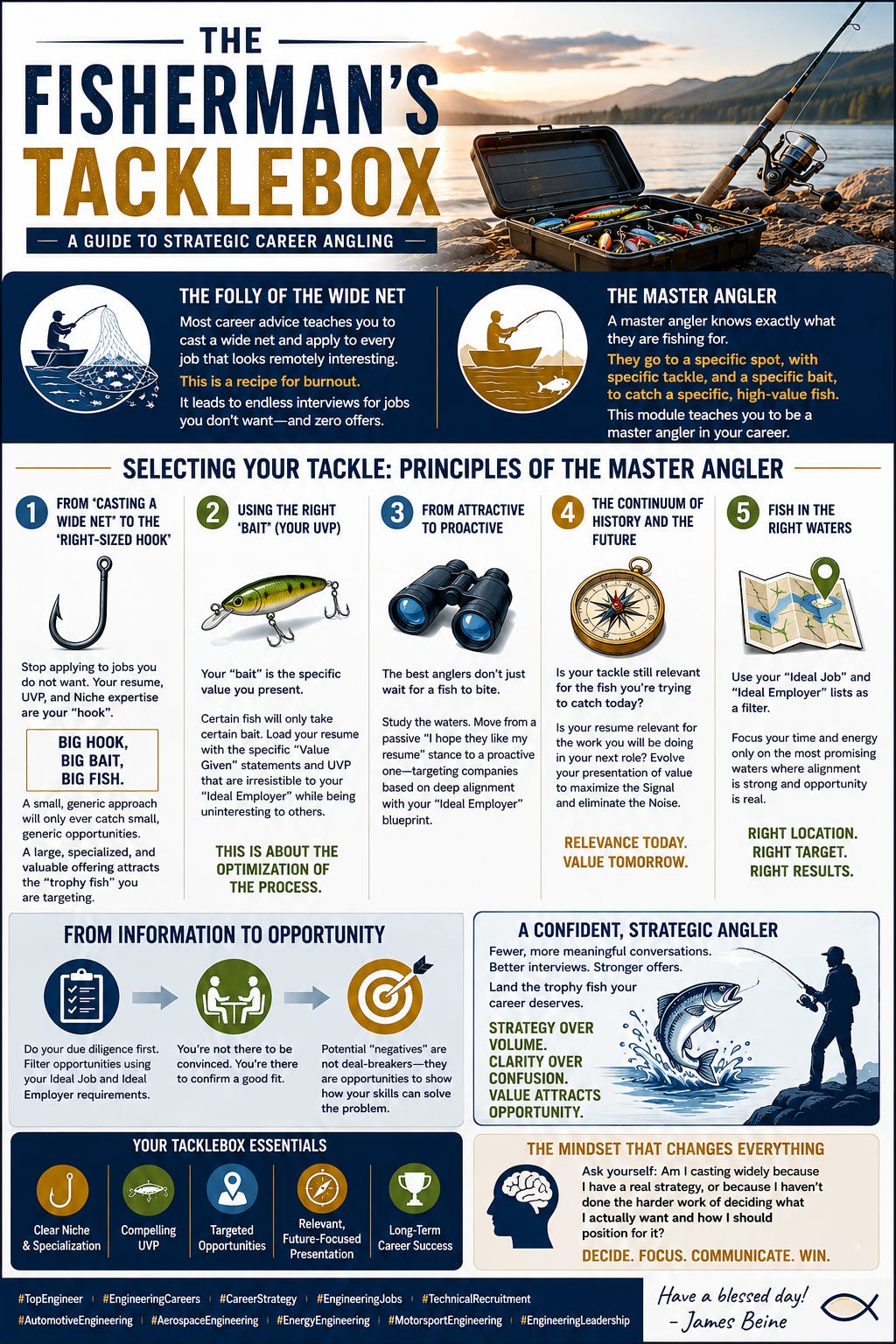
Most career advice teaches engineers to behave like amateur fishermen. Cast a wide net. Apply broadly. Keep options open. See what bites.
That sounds practical, but in reality it is one of the fastest ways to waste time, energy, and clarity. A wide net does not just catch opportunity. It also pulls in noise, poor fit, weak leads, and exhausting conversations that go nowhere. You end up working hard without getting closer to the outcome you actually want.
The master angler does something different.
A master angler knows exactly what kind of fish they are after. They choose the location carefully, use the right hook, bring the right bait, and fish with intention. That is the core lesson of the Fisherman’s Tacklebox. Serious career strategy is not about maximum volume. It is about precision.
Why the wide net fails
The wide net approach creates two problems immediately. First, it floods you with low quality signal. The more generic your positioning becomes, the more generic the opportunities you attract. You may get activity, but activity is not the same as progress.
Second, it changes your posture. When you chase too many possibilities, you start showing up as someone who is just exploring, just seeing what is out there, just trying things on. That uncertainty leaks through your communication. Employers can feel it. You stop sounding like a person with direction and start sounding like a person hoping something works out.
What the tackle-box really is
The Fisherman’s Tackle-box is a way of thinking about strategic career movement. It reminds you that every opportunity requires selection, not just effort.
Your hook is your specialization, your niche, and your immediate and unique value proposition. If the hook is too small, too vague, or too generic, you will not attract the right level of opportunity.
Your bait is the way you communicate that value. Different opportunities respond to different signals. The same engineer can look highly relevant in one context and almost invisible in another depending on how the message is framed.
Your fishing location is the set of employers, industries, and roles that actually align with your goals. If you are fishing in the wrong waters, it does not matter how talented you are. The environment itself is working against you.
That is why this concept matters. It turns career movement from random effort into deliberate targeting.
The right sized hook
A lot of people are afraid to become too specific because they think specificity will limit them. Usually the opposite is true. Specificity is what makes you legible.
A generic engineer attracts generic evaluation. A clear engineer attracts better questions and better fit.
This is what we mean by the right sized hook. The goal is not to appeal to everyone. The goal is to be compelling to the right employer for the right reason. Bigger hook, better bait, better fish. A stronger offering attracts stronger opportunity.
Using the right bait
The bait is not hype. It is not inflated language. It is not keyword stuffing. It is the disciplined presentation of value in a way that maps to what the target employer actually cares about.
Certain employers care most about speed. Others care about reliability. Others care about design judgment, systems thinking, regulatory discipline, launch execution, or cost reduction. The bait has to match the fish.
That means your resume, your story, and your interview posture should not be built as a generic broadcast. They should be built to communicate the parts of your value that matter most for the opportunity you actually want.
From attractive to proactive
The amateur fisherman waits. The master angler studies. That is another major shift inside this concept. Stop treating career movement like a passive hope that someone eventually notices you. Start acting like someone who knows what they are looking for and is willing to do the work to find it.
That means understanding your ideal job. Understanding your ideal employer. Understanding where your value maps naturally and where it does not. It also means entering conversations from a position of evaluation, not desperation.
You are not there to beg for a fit. You are there to determine whether one exists.
The continuity of history and future
One more question matters. Is your tackle still relevant for the fish you are trying to catch today.
A lot of engineers present history without translating it into future relevance. They describe what they did, but not why it matters now. The tackle may have worked for yesterday’s water, but the market is always moving.
That is why your positioning has to evolve. Your value should be communicated in a way that is relevant to the work you want next, not just the work you finished last.
The standard
The Fisherman’s Tacklebox is ultimately about discipline. It is about resisting the temptation to chase everything and instead building a process that attracts the right things.
A useful question is this. Am I casting widely because I have a real strategy, or because I have not done the harder work of deciding what I actually want and how I should position for it.
That question will expose a lot. Career strategy improves when random effort declines. The more precise you become, the less wasted motion you tolerate. Fewer conversations. Better conversations. Fewer interviews. Better interviews. Less noise. More signal.
That is how the master angler works. That is how serious engineers should move.
#TopEngineer #EngineeringCareers #CareerStrategy #EngineeringTalent #TechnicalRecruitment #EngineeringJobs #AutomotiveEngineering #AerospaceEngineering #EnergyEngineering #MotorsportEngineering #InterviewStrategy #CareerManagement #EngineeringLeadership
Have a blessed day!
-James Beine
