



Hire Perspectives helps top engineers and engineering employers understand the hidden signals behind hiring, career movement, technical credibility, and talent decisions across automotive, aerospace, energy, and motorsports.
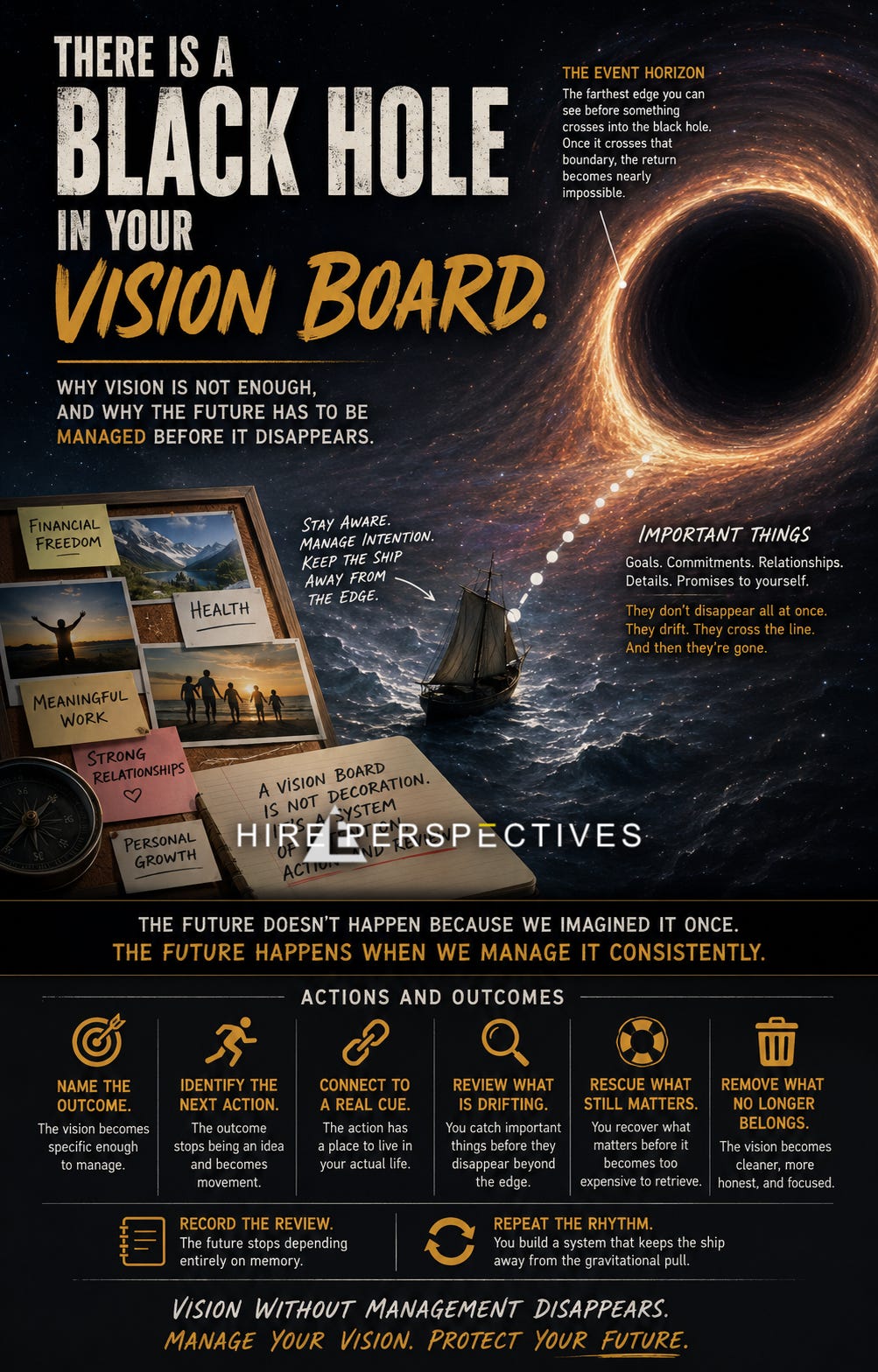
There is a black hole in your vision board.
Yes, you have a vision board. Even if you have never called it that.
And yes, there is a black hole in it. We all have one.
Some people call it a blind spot.
But I think black hole is closer.
Black holes consume space. Stuff falls in and does not come back. Or at least, it becomes really hard to recover once it is gone.
There is this thing called an event horizon. It is the farthest edge you can see before something crosses into the black hole. Once something gets too close, once it crosses that boundary, the return becomes nearly impossible.
I do not mean this as a cute metaphor. I mean it as an observation about the way our minds work.
Forgetfulness. Distraction. ADHD. Competing priorities. Avoidance. Poor planning. There are many reasons why important things fall into the black hole in your vision board.
A goal. A commitment. A relationship. A detail. A promise you made to yourself. A part of your future that mattered deeply at one point, but somehow slipped outside your active attention.
Here is the point.
Knowing about this black hole helps. It helps you keep the ship away from the gravitational pull. It helps you notice when something important is getting too close to the edge.
Some people call this focus. Okay, I get that. You have to have a name for it.
But focus alone is not enough.
Focus does not fully explain how to manage the part of your vision board that seems defective. Focus does not automatically manage the details of your life. Focus does not protect your goals from forgetfulness, distraction, avoidance, or the slow drift of competing priorities.
You have to be intentional. You have to manage your vision board. You have to manage the details. You have to plan for success before important things slip beyond the event horizon.
I am predominantly very guilty of not doing this. So I’m not writing this from theory. I am writing this from personal experience. This has been the single most important challenge and opportunity of my life.
What if your vision board was not linear?
What if there is more to having a vision for your life than putting the right things on the board?
What if part of the work is learning how to keep the important things from disappearing?
And what if this part of your mind, the part that keeps interfering with your vision for your life, could be mitigated?
Would you do it?
Would you manage the black hole in your vision board?
I think this is where the article moves from reflection to practice.
Because this is not only personal.
Psychology has language for some of this.
There is something called prospective memory. It is the part of memory that helps you remember to do something later. Call the client. Take the medicine. Send the note. Make the decision. Return to the thing you said mattered.
Prospective memory is the cognitive ability to remember to perform a planned action at a future point in time. Often described as "remembering to remember", it is essential for executing everyday intentions, from replying to an email to taking daily medication.
And this is where it gets uncomfortable.
People forget future intentions even when those intentions are important.
That means the problem is not always desire. It is not always character. It is not always discipline. Sometimes the problem is that the future depends on a mental system that is easier to interrupt than we want to admit.
That is where the black hole starts to make sense.
An intention can be real and still disappear.
A goal can matter and still drift.
A commitment can be sincere and still fall out of view.
Your mind is not a perfect filing cabinet. It is not a flawless command center. It is a living, distracted, overloaded, emotionally influenced system trying to manage the present while remembering the future.
And that system needs help.
This is also why focus is not enough.
Focus helps, but focus is fragile.
There is another idea from behavioral research called attention residue. The simple version is this: you move from one task to another, but part of your mind is still carrying the last thing.
Google says Attention residue is a cognitive phenomenon where your brain continues to subconsciously process a previous task when you switch to a new one. Coined by Dr. Sophie Leroy in 2009, this lingering focus effectively shrinks the working memory available for your current task, draining productivity and increasing the risk of making errors.
The meeting.
The message.
The problem.
The unfinished conversation.
The decision you have not made.
Then the next priority arrives.
Then the next one.
Then the next one.
And slowly, without any dramatic failure, part of your vision starts drifting toward the edge.
That is how things cross the event horizon.
Not usually through one dramatic failure.
Usually through a hundred tiny unmanaged moments.
A vision board by itself is passive. It sits there. It reminds you of what you wanted when you were clear, inspired, convicted, or desperate enough to name it.
But life does not care that you had a moment of clarity.
Life brings noise. Work. Fatigue. Appointments. Bills. Messages. Other people’s urgency. Your own bad habits. Your own resistance. Your own tendency to let the uncomfortable detail slip until it is easier to forget than confront.
So maybe the work is not just having a vision.
Maybe the work is returning to it.
Daily. Weekly. Hourly?
Not to admire it.
To manage it.
What is still alive?
What is drifting?
What needs action?
What needs a decision?
What needs to be removed because it no longer belongs?
What needs to be rescued before it disappears?
That is the part I am learning.
The vision board cannot just be a picture of desired outcomes. It has to become a living system of attention, action, and review.
Because the future does not happen because we imagined it clearly once.
The future happens when we keep bringing the right things back into view long enough to act on them.
The Opportunity
To stop treating forgetfulness, distraction, and competing priorities as personality traits.
To stop pretending that good intentions manage themselves.
To build a rhythm that keeps the ship away from the edge.
Actions and Outcomes
Action: Name the outcome.
Outcome: The vision becomes specific enough to manage.
This sounds simple, but it is not. Most people do not have outcomes. They have wishes, preferences, pressures, and vague pictures of a better future.
I want to be healthier.
I want to be more successful.
I want to build something meaningful.
I want a better relationship.
I want to be more organized.
That is not enough.
The black hole loves vague language.
A vague vision is easy to neglect because it does not ask for anything specific today. It can sit in the background for months or years while you tell yourself it still matters.
Naming the outcome changes that.
What does healthier mean?
What does successful mean?
What does meaningful mean?
What does better mean?
What would have to be true for me to say this actually moved forward?
The moment you name the outcome, the vision becomes more visible. It has shape. It has edges. It becomes something you can return to, measure, question, and manage.
Action: Identify the next action.
Outcome: The outcome stops being an idea and becomes movement.
This is where a lot of visions begin to die.
Not because the person does not care.
Because the next action is unclear.
The future stays large and inspiring, but today stays vague. And when today stays vague, the vision begins to drift.
The next action does not need to be dramatic.
Send the email.
Make the call.
Open the document.
Schedule the appointment.
Clean the room.
Write the paragraph.
Ask the question.
Make the decision.
Put the date on the calendar.
A vision without a next action is just a picture.
A next action gives the vision a handle.
Action: Connect the action to a real cue.
Outcome: The action has a place to live in your actual life.
This is where intention becomes practical.
It is not enough to say, “I need to work on this.”
When?
After what?
Before what?
Where will you be?
What will remind you?
What will trigger the action?
This matters because your mind is already full. The day is already crowded. You are already carrying unfinished loops, open tabs, unresolved conversations, obligations, impulses, interruptions, and emotional noise.
A good intention without a cue is easy prey for the black hole.
So the question becomes practical.
After my first cup of coffee, what do I review?
Before I open email, what outcome do I name?
At the end of the workday, what drifting item do I rescue?
On Sunday evening, what part of my vision board do I manage?
This is not glamorous.
It is better than glamorous.
It works.
Action: Review what is drifting.
Outcome: You catch important things before they disappear beyond the edge.
This may be the most important part.
You cannot manage what you never look at.
And you cannot rescue what you refuse to notice.
A drifting goal does not always feel dramatic. Sometimes it feels like mild discomfort. Sometimes it feels like procrastination. Sometimes it feels like “I’ll get back to that later.” Sometimes it feels like a task you keep moving from one list to another without ever confronting why.
That is the warning sign.
The thing is not gone yet.
But it is moving.
It is approaching the edge.
This is where review matters.
Not review as self-criticism.
Not review as shame.
Review as rescue.
What have I stopped looking at?
What have I let drift?
What important detail am I pretending is not important?
What promise to myself has become background noise?
What area of my life is getting closer to the event horizon?
Action: Rescue what still matters.
Outcome: You recover the goal, commitment, relationship, detail, or promise before it becomes too expensive to retrieve.
Not everything that drifts needs to be rescued.
Some things should be allowed to leave.
Some goals were inherited.
Some commitments were made from pressure.
Some ambitions belonged to an earlier version of you.
Some details are noise.
But some things still matter.
And those are the things that need intervention.
A conversation.
A calendar block.
A decision.
A plan.
A boundary.
A written commitment.
An apology.
A budget.
A checklist.
A difficult hour of honest work.
Rescue is not always emotional. It is often administrative.
That is not a small thing.
A lot of life is lost because people refuse to manage the administrative details of what they say they care about.
Action: Remove what no longer belongs.
Outcome: The vision board becomes cleaner, more honest, and less crowded with things you are no longer willing to carry.
This is part of managing the black hole too.
Sometimes the problem is not that your vision board has too little on it.
Sometimes the problem is that it has too much.
Too many goals.
Too many identities.
Too many open loops.
Too many outdated ambitions.
Too many obligations you never consciously chose.
Too many things you keep around because removing them would force you to admit they no longer belong.
A crowded vision board creates its own gravitational pull.
It becomes harder to tell what matters.
And when everything matters, the black hole gets stronger.
So part of the work is removal.
This no longer belongs.
This is not mine to carry.
This is not aligned with the outcome.
This was once important, but it is not important now.
This is a distraction wearing the clothes of responsibility.
This is not failure.
This is management.
Action: Record the review.
Outcome: The future stops depending entirely on memory.
This is where people fool themselves.
They think they will remember.
They think the important thing is too important to forget.
They think conviction will preserve the vision.
It will not.
Not reliably.
The future needs external memory.
A notebook.
A document.
A calendar.
A whiteboard.
A system.
A weekly review.
A written list of outcomes.
Something outside your head that can hold what your mind will eventually drop.
This is not weakness.
This is wisdom.
Your brain was never designed to perfectly carry every future intention without structure.
Action: Repeat the rhythm daily, weekly, or hourly when necessary.
Outcome: You build a system that keeps the ship away from the gravitational pull.
The rhythm does not have to be complicated.
Look at the vision.
Name the outcome.
Choose the next action.
Attach it to a cue.
Review what is drifting.
Rescue what still matters.
Remove what no longer belongs.
Record the review.
And do it again.
That is not inspiration.
That is management.
And maybe that is the part we keep missing.
We want vision to feel elevated. We want it to feel creative, spiritual, emotional, and expansive. And sometimes it is.
But vision also has a maintenance cost.
If you do not pay it, the black hole collects.
It collects the unmade decision.
It collects the uncomfortable detail.
It collects the half-finished plan.
It collects the promise you made to yourself.
It collects the relationship you meant to repair.
It collects the opportunity you meant to pursue.
It collects the part of your life you said mattered but did not manage.
I know this because I have lived it.
I have watched important things drift because I failed to keep them in view.
I have mistaken intention for action.
I have mistaken clarity for management.
I have mistaken thinking about something for actually moving it forward.
And I have paid for that.
This is why I am not interested in a vision board as decoration.
I am interested in a vision board as a living system.
A place where the future is not merely imagined, but managed.
A place where outcomes are named.
Actions are chosen.
Drifting things are noticed.
Important things are rescued.
Dead things are removed.
And the ship is kept, intentionally, away from the edge.
That may be the only practical way to manage the black hole in your vision board.
I am writing this because I am still living it. If this touched something familiar in your own life, reach out. I would welcome the conversation.
Have a blessed day!

James Beine
#IntentionalLiving #PersonalGrowth #ActionsAndOutcomes #AttentionManagement #HirePerspectives
