


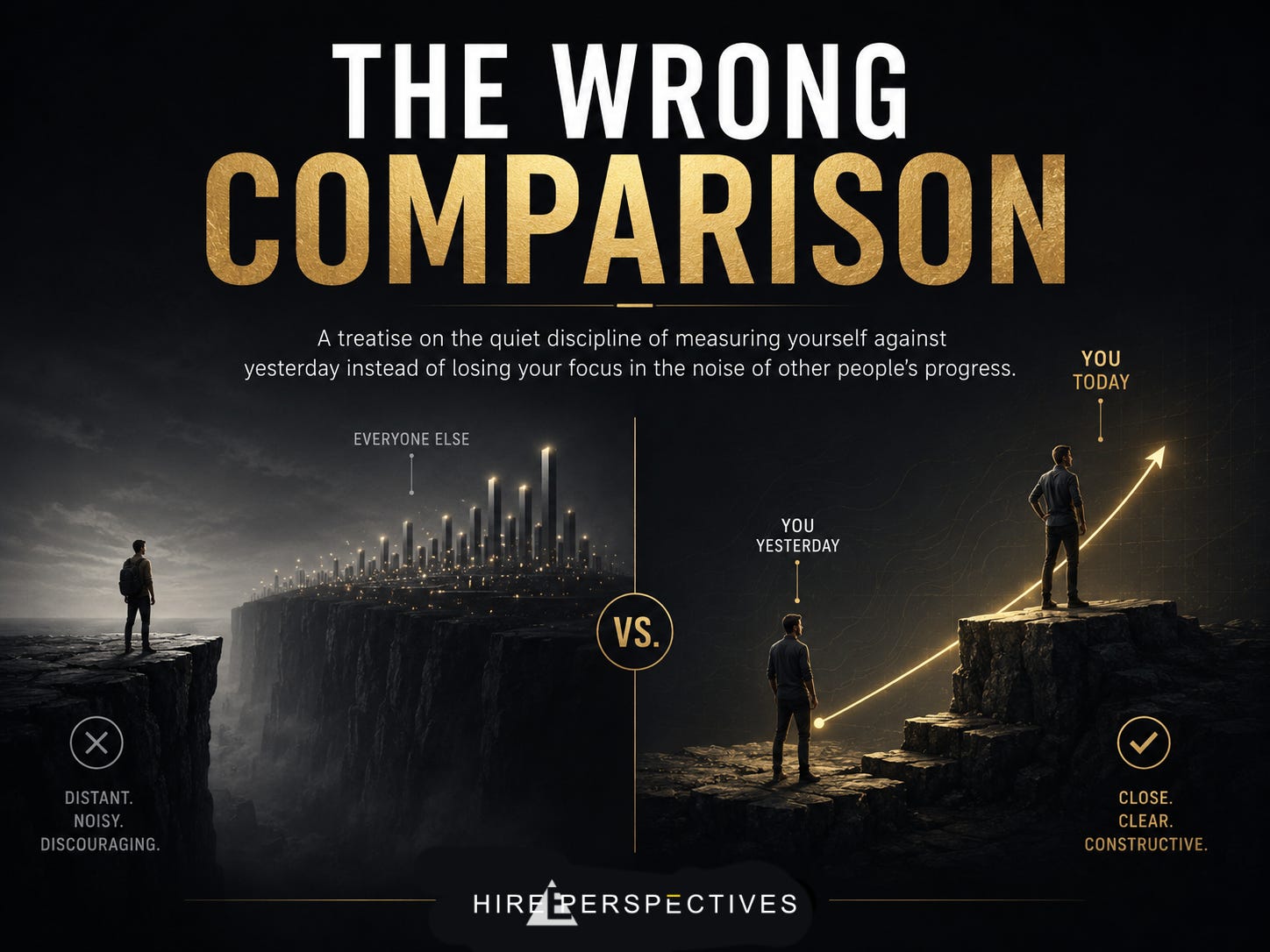
A great deal of professional frustration begins in the wrong comparison.
Engineers are trained to observe, measure, benchmark, and improve. That habit is one of the reasons they are so effective in technical environments. But the same instinct becomes destructive when it is applied carelessly to personal development. Too many engineers spend enormous energy comparing themselves to other applicants, other résumés, other titles, other salaries, and other people in their peer group. The result is usually not better performance. It is distraction, insecurity, and a steady loss of useful focus.
The comparison feels rational at first because the market is competitive. Hiring is comparative. Promotions are comparative. Compensation is comparative. It is easy to conclude that progress depends on constant measurement against the people around you. But this conclusion is shallow. You do not control the full history, network, timing, personality, opportunity set, or private struggles of the other engineer. You do control the discipline with which you improve your own capability, your own judgment, your own communication, and your own execution.
A serious engineer stops treating peers as the main measuring stick and begins comparing himself or herself to the person they were yesterday. That shift sounds simple, but it changes the emotional weather of a career. It replaces envy with responsibility. It replaces anxiety with direction. It replaces random emotional comparison with deliberate compounding. It trains the mind to look for progress instead of status.
This is where the one percent a day principle becomes powerful. Most people overestimate what they can change in a week and underestimate what they can become in a year. They want dramatic transformation, visible proof, immediate repositioning, and emotional certainty. Real development rarely works that way. It works through accumulated marginal gains. A little stronger today than yesterday. A little clearer. A little more disciplined. A little more precise. A little more stable under pressure. A little better at communication. A little better at judgment. A little more useful.
That kind of growth does not impress the crowd on day one. It changes a life over time.
Imagine two engineers at the same stage of their career. One wakes up every morning with half his attention fixed on everyone else. He checks titles, scans promotions, studies who moved faster, who got hired where, who seems more visible, who sounds more impressive, who appears to be winning. He tells himself this makes him more aware of the market. In reality, it makes him more reactive. His energy gets pulled sideways. He begins making decisions to keep up rather than decisions that actually fit his direction. His ambition becomes noisy.
The other engineer pays attention to the market, but he does not live inside it emotionally. He uses it as information, not identity. His real standard is closer and harder. He asks whether he is thinking more clearly than he was six months ago. Whether he is communicating better than he did last quarter. Whether he is recovering faster from difficulty. Whether he is more useful to the team. Whether he is more credible, more reliable, more capable, more composed. He is not passive. He is simply focused on the only comparison that can reliably build him.
By the end of a year, those two engineers will not be standing in the same place.
The first engineer may still be busy, alert, and intensely aware of what everyone else is doing. The second engineer is more likely to be quietly dangerous. His growth may have looked boring in real time, but boring compounds. This is one of the least glamorous and most important truths in professional life. A single dramatic leap gets attention. Repeated disciplined improvement creates leverage.
This matters especially in engineering because the profession rewards compounding more than it rewards flashes. A heroic burst may get noticed. Repeated disciplined improvement builds the kind of person who can be trusted with harder problems. The one percent engineer eventually becomes the engineer who gets the call, not because of noise, but because capability has become difficult to ignore. That capability is rarely the product of one course, one certification, one interview, one software tool, or one sudden breakthrough. It is the product of years of small refinements that were respected while others were looking sideways.
The one percent mindset also protects identity. Constant comparison to others invites a person to chase external shapes that were never theirs to begin with. Someone else’s style. Someone else’s career arc. Someone else’s brand. Someone else’s life. That is not growth. That is drift disguised as ambition. Comparing yourself to yesterday preserves identity while still demanding progress. It allows development without imitation. It respects the fact that the goal is not to become another engineer. The goal is to become a stronger version of the engineer you are actually capable of becoming.
This is one reason the mindset has to stay practical. The point is not to become abstractly self reflective. The point is to build a system. Study a little better than yesterday. Write a little more clearly than yesterday. Speak with more precision than yesterday. Stay calmer under pressure than yesterday. Finish what you start more consistently than yesterday. Improve the quality of your work product, your notes, your preparation, your questions, your leadership, your health, your habits, and your standards by just enough that the change is sustainable and real.
A great many careers stall because people want to feel transformed before they are willing to behave differently. The one percent approach reverses that order. It asks for disciplined behavior first. The feeling catches up later. Confidence, clarity, and strength often arrive after evidence, not before it.
This is also why comparison to others is such a poor master. It produces emotional spikes, not durable structure. It makes a person too sensitive to the wrong signals. It pushes them toward optics, speed, and positioning without first building enough actual substance underneath. The one percent mindset trains patience, seriousness, and internal accountability. It says that the right question is not whether someone else is ahead of you today. The right question is whether you are becoming more useful, more capable, more disciplined, and more difficult to dismiss than you were before.
A Top Engineer needs this tool because the engineering market is relentless. There will always be another résumé, another degree, another title, another specialist, another younger engineer, another better connected candidate, another person with more visible momentum. A mind that tries to absorb all of that and turn it into fuel usually burns itself out. A mind that returns to the daily standard of self comparison becomes calm enough to keep building.
That calm is not passivity. It is disciplined focus. The market is real. Competition is real. Peer awareness is useful. But comparison to others should never be granted more psychological authority than it deserves. The deeper work remains internal. The engineer who becomes one percent better today is better positioned for tomorrow than the engineer who spent today measuring the distance between themselves and everyone else.
This is only one mindset tool, but it reaches far. It changes how a person studies, how a person works, how a person measures progress, and how a person sustains momentum over long arcs of time. It lowers emotional noise and raises strategic clarity. It restores agency. It creates a healthier form of ambition, one rooted in stewardship rather than insecurity.
The strongest engineers are rarely the ones most preoccupied with the people around them. They are often the ones quietly building themselves with unusual consistency. They are not perfect. They are not passive. They are not casual. They simply understand that real advancement comes less from winning the daily comparison contest and more from respecting compounding enough to keep going.
A Top Engineer does not build a life by trying to be better than everyone else every day. A Top Engineer builds a life by becoming better than yesterday, and then doing it again tomorrow.
Have a blessed day!
James Beine
#HirePerspectives #TopEngineer #EngineeringMindset #ProfessionalGrowth #CareerStrategy #EngineeringCareers #Leadership
