


A hiring manager opens another résumé before sunrise. The role has been open for months, and everyone in the company agrees that it is important. The engineering team is busy. The project schedule is tight. The last candidate looked acceptable on paper, but something was missing. The recruiter keeps sending more profiles. Human resources keeps asking for feedback. The hiring manager keeps saying the same thing in different ways: “They are close, but they are not the one.”
The machine keeps moving.
Another résumé enters the system. Another phone screen is scheduled. Another engineer is reduced to a list of tools, titles, dates, and keywords. Another company pretends that hiring is a process of sorting documents when everyone involved knows that the real decision is much deeper than that. The company is not merely buying skill. It is inviting a human being into a system of pressure, expectations, relationships, culture, deadlines, and consequence.
Somewhere else, an engineer sits at a desk after work and wonders why the search feels so empty. He has done real work. He has solved real problems. He has given years of effort to difficult systems and serious employers. Yet every application seems to ask him to flatten himself into a format that barely resembles a person. He is told to optimize his résumé, update his keywords, adjust his profile, and apply again. The advice may be practical, but it is incomplete. It treats the market as a transaction and the engineer as an object moving through it.
Society as a whole is trying to take business and turn it into this transactional, impersonal, and homogenized thing. This, in turn, affects employees and jobs. I am not sure this even translates or is directly related to simple economics or economics at all. I think, though, that this transactional thinking, this cold and impersonal way to interact with the other humans on the planet is at the very heart, as a matter of fact, most of our societal problems. You may be asking, “What does this have to do with hiring and engineering or recruiting?” The answer is everything.
Hiring is one of the places where this disease becomes obvious.
A company says it needs talent. An engineer says he needs opportunity. A recruiter says there is a match. The software says there is alignment. The résumé says the experience is relevant. The interview says the person can communicate well enough. Yet somehow, even with all the process, everyone remains strangely dissatisfied. Employers keep saying they cannot find the right people. Engineers keep saying they cannot get seen correctly. Recruiters keep moving faster, platforms keep adding automation, and still the candidates are not properly engaged. There is a difference between a connection and a bond. Are you bonding with your candidates? Will they remember you a year later?
A transaction can move goods. It can process a payment. It can close a file. It can fill a requisition. It can schedule a call. But a transaction cannot understand a person. It cannot discern character. It cannot measure steadiness under pressure. It cannot see whether someone brings peace into a room or noise into a system. It cannot tell whether an engineer is merely capable or truly dependable. It cannot know whether an employer is merely offering compensation or creating a place where a serious engineer can do meaningful work.
The more hiring becomes transactional, the more it loses sight of what actually makes hiring work. Engineering is not an abstract profession. It is a human profession attached to systems, consequences, and outcomes. The bridge does not care about the résumé that designed it. The aircraft does not care about the job title. The manufacturing line does not care about the applicant tracking score. The race car does not care about the LinkedIn headline. Reality only cares whether the person making decisions has the heart, mind, soul, and strength to carry the responsibility.
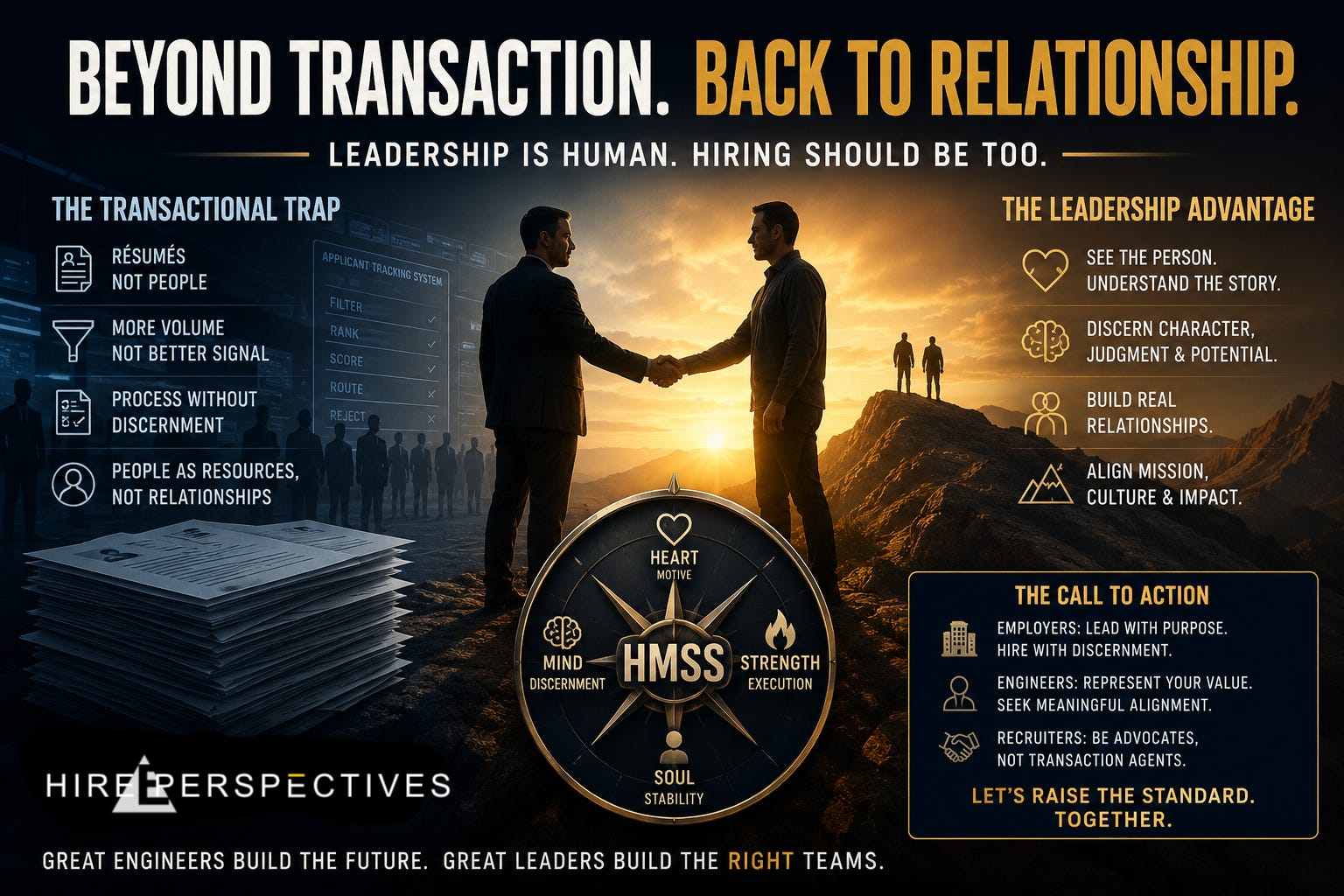
That is why HMSS sits at the heart of this conversation.
Heart matters because motive matters. An engineer with the right heart does not treat the work as a game of personal advantage. He understands that engineering serves people, even when the people affected by the work are far away from the room where the decision is made. The right heart brings integrity, service, and a serious relationship to responsibility. Without heart, talent becomes dangerous because it has no moral center.
Mind matters because judgment matters. A brilliant engineer with poor discernment can still create expensive problems. A strong mind separates signal from noise. It asks better questions. It sees beyond the immediate task. It understands the higher order consequence of a decision. It knows that the right answer is not always the loudest answer, the fastest answer, or the answer that makes the spreadsheet look clean this quarter. Without mind, intelligence becomes motion without wisdom.
Soul matters because stability matters. The modern workplace is full of pressure, ego, disappointment, ambition, and fear. An engineer without an anchored soul becomes fragile under those forces. He may be talented, but he is easily shaken. He may be skilled, but his identity is too dependent on title, praise, salary, or status. A steady soul allows a person to endure pressure without becoming distorted by it. Without soul, performance becomes volatile.
Strength matters because execution matters. Good intentions and sound judgment still have to become action. Strength is the disciplined application of energy to the right problem, at the right time, for the right reason. It is not brute force. It is not busyness. It is focused, purposeful execution. Without strength, values remain theoretical and plans remain unfinished.
Transactional hiring cannot see these things clearly because it was not built to see them. It was built to sort, filter, screen, rank, route, and process. Those functions have their place, but they are not enough. The danger begins when leaders start believing that because a system can process candidates, it can understand people. It cannot. It can only organize fragments of information. Discernment still belongs to human beings willing to do the harder work of relationship.
Relationship is not a soft idea here. It is the missing infrastructure. A real recruiting relationship changes the nature of the conversation. It asks who the engineer is, not only what the engineer has done. It asks what the employer truly needs, not only what the job description says. It asks whether the opportunity and the person are aligned in both directions. It asks whether the work, the culture, the leadership, the timing, the expectations, and the long term trajectory make sense. It slows the process down in the places where speed would cause error, and it accelerates the process where clarity has already been earned.
This is not old fashioned. It is more advanced than the transactional system pretending to replace it.
The transactional system keeps telling employers that hiring can be solved by more volume, more automation, more applications, more outreach, and more process. But the employer does not need more noise. The employer needs better signal. The employer needs someone who can understand the role beneath the title, the business case beneath the posting, and the human being behind the résumé. The employer needs the courage to stop treating hiring as a vending machine and start treating it as one of the most consequential leadership decisions it makes.
The engineer needs the same courage.
The engineer has to stop presenting himself as an interchangeable bundle of technical functions. He has to stop believing that the goal is to be broadly acceptable to as many companies as possible. That is how people become commodities. A serious engineer must learn to communicate value with clarity, conviction, and depth. He must understand who he is, what he represents, what kind of work he is built for, and what kind of employer can actually receive the value he brings.
This is where leadership enters the conversation. A leader who thinks transactionally will eventually treat people as replaceable units. He may not mean to. He may even consider himself fair and efficient. But over time, the language of the organization will reveal the truth. People become resources. Hiring becomes acquisition. Careers become headcount planning. Performance becomes metrics without soul. The company may still function, but it begins to lose the human intelligence that makes excellent work sustainable.
A true leader remembers that every business is still made of people. Every engineering department is made of people. Every project delay, every quality issue, every breakthrough, every failure, every recovery, every innovation, every act of excellence still passes through the hands, minds, hearts, and choices of human beings. The leader who forgets that may build a machine that runs for a while, but it will become increasingly cold, brittle, and is rarely sustainable .
Recruiting is merely one battlefield where the transactional lie shows itself. The same lie appears in management, customer service, education, health care, politics, and even family life. The lie says that human beings can be reduced to functions, preferences, profiles, and transactions. The lie says that efficiency can replace care. The lie says that scale can replace relationship. The lie says that systems can remove the need for moral responsibility.
Systems matter. Process matters. Economics matters. Technology matters. But none of them can replace the human obligation to see people clearly and deal with them rightly.
Hiring is spiritual before it is procedural. -James Beine
That is why hiring is spiritual before it is procedural. It reveals what an organization actually believes about people. It reveals whether the company sees the engineer as a person with a story, character, capability, and future, or as a unit to be acquired at the lowest acceptable cost. It reveals whether the engineer sees the employer as a place to serve and build, or merely as a compensation vehicle. It reveals whether both sides are willing to approach the relationship with seriousness.
The answer is not to reject process. The answer is to restore relationship to the center of the process.
A good hiring process should still be disciplined. It should still evaluate competence. It should still protect time. It should still clarify expectations. It should still move with urgency when the signal is clear. But it must also preserve the human center. It must make room for discernment. It must recognize that the best hiring decisions are rarely made by sorting résumés alone. They are made when the right people understand one another well enough to make a serious commitment.
Employers:
Stop pretending that generic process will consistently produce exceptional hires. Stop confusing applicant volume with talent access. Stop writing job descriptions that sound like legal documents and expecting Top Engineers to feel invited. Stop outsourcing discernment to platforms that cannot understand the human stakes of the decision. Start treating hiring as leadership. Start building relationships before urgency becomes desperation. Start communicating the opportunity as a real human and technical mission, not as a list of demands.
Engineers:
Stop reducing yourself to a résumé. Stop trying to be attractive to everyone. Stop letting transactional systems teach you to think of yourself transactionally. Build your narrative. Clarify your value. Examine your heart, mind, soul, and strength. Become the kind of engineer whose character supports the weight of the opportunities you want. Then communicate in a way that allows the right employer to recognize you.
Recruiters:
Stop acting like brokers of inventory. Stop measuring success only by movement. Stop hiding behind speed when the situation requires understanding. Stop calling yourself an advocate while treating candidates and clients as interchangeable sources of activity. The market does not need more transactional recruiting. It needs more serious representation, deeper evaluation, and stronger relationship.
Top Engineer - https://topengineer.us
We believe the right engineer in the right organization can change more than an organization, this is how companies change the world we live in. We believe a hiring process facilitates this change. We believe talent acquisition should be relational, not transactional. We believe the quality of the match matters because people are not parts on a shelf. We believe the whole person matters. Heart. Mind. Soul. Strength.
The future will have more technology, more automation, more platforms, more filtering, and more noise. That is not going away. But the organizations that win will still be the ones that like top engineers, remember who they are and what they represent.
People are not commodities. The Top Employers are people focussed and build relationships with the people they hire.
Have a blessed day!
James Beine
#HirePerspectives #TopEngineer #EngineeringLeadership #TalentAcquisition #EngineeringCareers #RelationshipDrivenRecruiting #HumanCenteredLeadership
