


Introduction
The hardest part of being a Top Engineer is often not the engineering.
That sounds strange because the work itself is serious. Engineers solve problems that carry real consequence. They design systems, correct failures, improve processes, protect quality, reduce risk, and make decisions that affect products, teams, companies, and sometimes human safety. Nobody needs to explain consequence to a Top Engineer. They already live with it.
The harder problem is the layer around the work.
It is the part of a career that rarely appears in engineering school and is often learned late, unevenly, or painfully. It includes understanding one’s market value, recognizing the right timing for a move, knowing what kind of work should come next, separating loyalty from stagnation, clarifying expectations before confusion becomes damage, managing emotion in major career decisions, and building options before they are urgently needed.
Many Top Engineers dislike this layer because it can feel artificial. They would rather let the work speak for itself. That instinct is understandable, and there is something honorable in it. A real engineer usually does not want to posture, perform, politic, or turn a career into theater. The problem is that silence does not keep the career pure. It only leaves more room for others to interpret it incompletely.
An engineer can ignore this layer for years and still look responsible while doing it. He keeps solving problems. She keeps delivering work. They keep earning trust inside the current environment. Then, at some point, the gap becomes visible. A promotion does not come. A role disappears. A market conversation feels colder than expected. A recruiter misunderstands the depth of the work. A hiring manager sees a title but misses the judgment behind it. The engineer realizes that the work was real, but it was not enough by itself to create the right options.
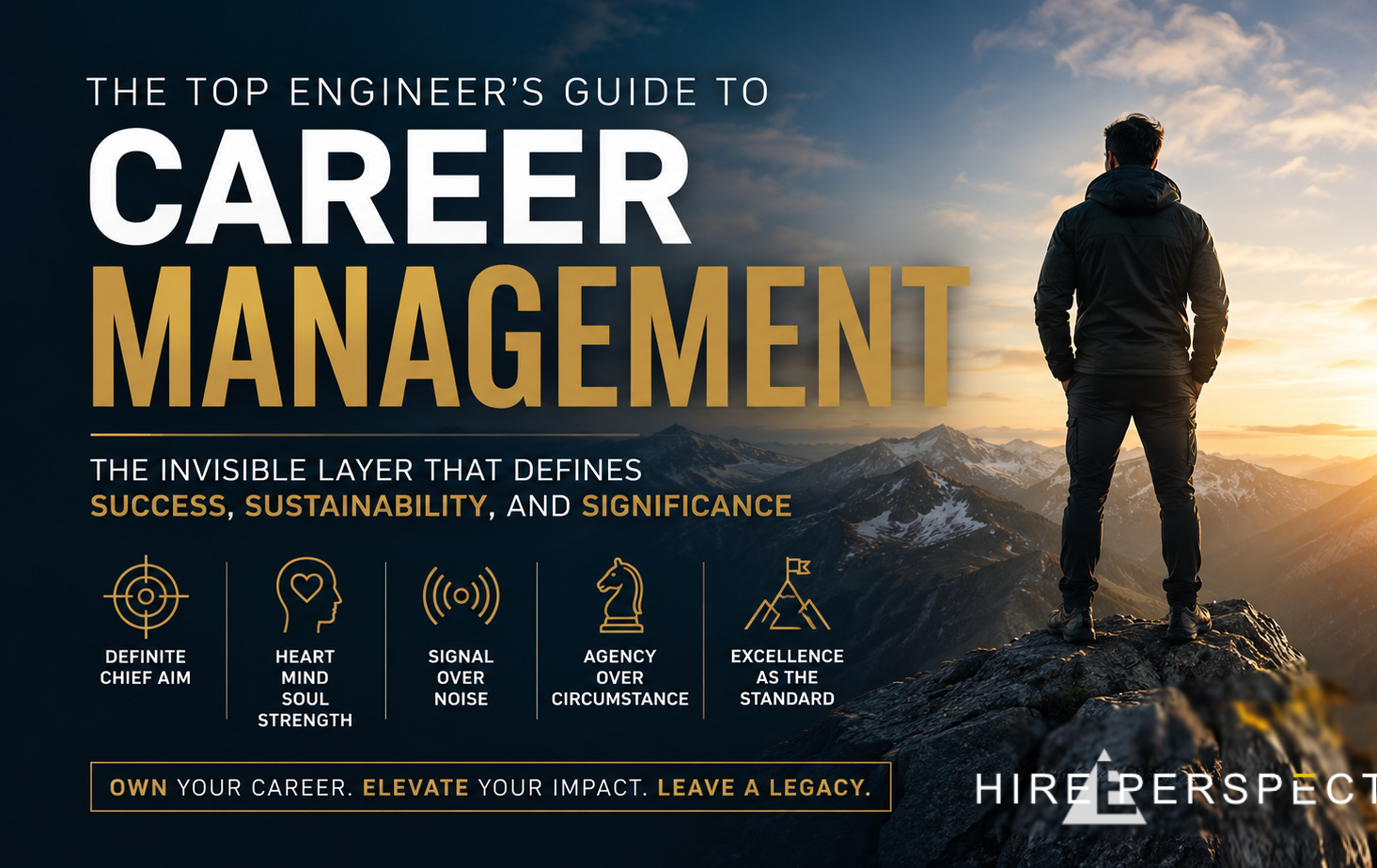
This guide is about that missing layer. 10 Chapters that inspire and ignite transformation of any engineering career at any level.
It is not a guide to becoming employable. It is not a résumé manual. It is not a collection of motivational ideas. It is written for Top Engineers who already know how to work, but want to stop being passive passengers in the larger system surrounding their careers. The central argument is simple: a career should not be allowed to drift merely because the engineer is good at the job.
Technical ability matters. It is the foundation. But technical ability alone does not automatically produce strong timing, accurate market value, better opportunities, wise transitions, or long-term leverage. Those things require attention. They require judgment of a different kind. They require the engineer to look at the career itself as a system worthy of serious management.
That does not mean becoming transactional. It means becoming aware.
A transactional career is driven by panic, vanity, reaction, and opportunism. A disciplined career is guided by clarity, timing, relationship, evidence, alignment, and stewardship. One is pulled by circumstance. The other is shaped by intention.
The chapters that follow address the difficulties many engineers face outside the technical work itself. Self valuation. Timing. Desire clarity. Identity attachment. Clarity around expectations. Emotional signal control. Knowing when to leave. Knowing when not to leave. Advocacy. Converting excellence into options. These are not side issues. They are often the difference between a skilled engineer who remains under-leveraged and a Top Engineer who moves with clarity over the long arc of a career.
The work begins by admitting something most engineers already know but do not always say clearly: doing valuable work and managing a valuable career are related, but they are not the same discipline.
Table of Contents
Chapter 1: Valuation
Valuation, addresses one of the hardest parts of career management for a Top Engineer: understanding value beyond salary, job titles, and market comparison. This chapter introduces the two fold value message of the immediate value proposition and the unique value proposition, helping engineers understand not only what they can contribute right now, but why their contribution is different from another engineer with similar credentials. It reframes market value as return on investment for a specific employer in a specific role, explores the difference between generalist and specialist value through the medical doctor analogy, and introduces the power of agency in elevating the engineer’s value rather than allowing available jobs, salary bands, or random market timing to define it.
Chapter 2: Timing
Timing addresses one of the most costly and misunderstood parts of career management: knowing when to move, when to stay, and when to begin preparing before either decision becomes urgent. Many engineers think about the market only after frustration, burnout, underpayment, uncertainty, or displacement has already narrowed their options, while others damage long-term credibility by moving too often, too quickly, and without enough continuity to show durable contribution. This chapter teaches that a Top Engineer manages timing with discipline, not panic, impatience, or vanity. The goal is to recognize the difference between a finished chapter and a difficult season, to prepare movement before need weakens leverage, and to avoid the career-destroying job hopper pattern that can make even a talented engineer look unstable before the right long-term opportunity ever has a chance to develop.
Chapter 3: Desire
Desire is the discipline of organizing every career decision around a Definite Chief Aim. This chapter is built on the Bookends framework: legacy as the destination and personal why as the fuel, with the Definite Chief Aim serving as the practical career rudder between them. The purpose is not merely to help a Top Engineer describe what kind of job sounds appealing. It is to help the engineer understand how the bookends should inform every decision, from the small daily choices that shape growth and discipline to the larger decisions about which opportunities to pursue, which employers to engage, which roles to reject, and which offer to accept. Without a Definite Chief Aim, effort becomes scattered, opportunity becomes reactive, and the career begins to drift with whatever the market presents. With one, the Top Engineer gains a governing filter strong enough to separate distraction from direction and movement from true advancement.
Chapter 4: Identity
Identity addresses one of the deepest questions in career management: who are you, and what do you represent. This chapter is not about a Unique Value Proposition, an immediate value proposition, a résumé narrative, or a better interview answer. Those things matter, but identity sits beneath them. Identity is the inner foundation from which a Top Engineer thinks, chooses, works, leads, and responds under pressure. It speaks to character, purpose, calling, discipline, and the internal dialogue that quietly governs every major career decision. Through the HMSS framework, this chapter explores how Heart, Mind, Soul, and Strength shape the engineer beneath the credentials, and why a career becomes unstable when identity is attached too tightly to title, employer, specialty, salary, past success, or external validation. The goal is to help the Top Engineer become rooted in who they are and what they represent, so that opportunity, disappointment, ambition, and change do not distort the person doing the work.
Chapter 5: Expectations
Expectations is about the Top Engineer’s responsibility to create clarity early and often, in every professional interaction. This chapter moves beyond vague assumptions and focuses on the discipline of setting, testing, and confirming expectations in the current role, in career conversations, in recruiter interactions, in interviews, after interviews, and across professional networks. The central idea is extreme ownership: a Top Engineer owns outcomes by making sure others understand what is possible, what is not possible, what tradeoffs exist, what decisions are required, what timeline is realistic, and what responsibility belongs to each person involved. Many career and workplace problems begin when people leave the same conversation with different expectations, such as the engineer who explains every moving part of a complex project while the manager walks away believing everything is handled, or the manager who assigns an unrealistic deadline without being told the cost of speed. This chapter teaches that clear expectations are not a courtesy. They are a leadership discipline. The Top Engineer does not merely communicate information. The Top Engineer creates shared understanding, and that shared understanding becomes the foundation for accountability.
Chapter 6: Signal
Signal is about the Top Engineer’s discipline of separating what matters from what merely creates noise. In career management, noise can appear as fear, ego, comparison, resentment, vague ambition, over-explanation, emotional reaction, or excessive detail that makes value harder to understand. Signal is the part that remains true, useful, and decision-ready after that noise has been removed. This chapter builds from two connected ideas: capability must be translated so others can evaluate it clearly, and the beginner’s mind must remain open enough to question assumptions before they harden into false certainty. The goal is not emotional suppression or mechanical communication. The goal is disciplined interpretation. A Top Engineer learns to recognize which information, emotion, opportunity, feedback, and career signal deserves attention, then acts from clarity rather than pressure.
Chapter 7: Exit
Exit is about learning when leaving is truly stewardship and when leaving is only escape wearing a better title. A Top Engineer does not treat difficulty, frustration, conflict, or discomfort as automatic evidence that it is time to move. Before an exit is wise, the engineer must first be showing up as a Top Engineer in the current role, giving his all and showing up every day in every way, in the best possible sense, regardless of the role he is in. Every challenge that people face in life, whether personally or professionally, is an opportunity to shine, and very few recognize this when they are actually facing the challenge. This chapter teaches that exit must be tested against the Definite Chief Aim, the Bookends, and the long arc of the career. The right exit moves the engineer toward purpose, subject matter expertise, specialization, and greater lifetime value. The wrong exit is driven by negative self-talk, resentment, impatience, or the illusion that the grass is greener somewhere else, and it often dilutes the career by scattering experience across industries, roles, or directions that do not compound.
Chapter 8: Stay
Stay is about the discipline of recognizing when remaining in the current season is not passivity, but stewardship. Not every better offer is a better career move, and not every season of frustration is evidence that it is time to leave. A Top Engineer understands that staying can be the stronger decision when the current role still serves the Definite Chief Aim, deepens subject matter expertise, strengthens relationships, clarifies expectations, and offers an opportunity to shine. This chapter challenges the engineer to separate relief from alignment, impatience from wisdom, and movement from true advancement. The right stay is not drift. It is intentional formation. It protects the long arc of the career, compounds value over time, and prevents the engineer from scattering hard-earned specialization for an opportunity that merely feels better in the moment.
Chapter 9: Agency
Agency is the discipline of refusing to become passive in one’s own career. It has two meanings in this chapter. First, it speaks to personal agency: the Top Engineer’s responsibility to understand value, make clear decisions, ask better questions, and stop allowing the market to define the entire career from the outside. Second, it speaks to professional agency: the sports agent model, where the right representative helps carry the engineer’s value into the right rooms with clarity, confidence, and accuracy. This chapter also teaches the Top Engineer to decouple confidence from competence. Competence is what the engineer can do. Agency is the ability to act, speak, choose, and be represented in a way that allows that competence to be properly understood.
Chapter 10: Excellence
Excellence is the final integration point of the Top Engineer career guide. Most Top Engineers already operate with a high standard, and many are actively pursuing lifelong learning, continuous improvement, professional development, new skills, and additional education. The challenge in this chapter is not whether they care about excellence. The challenge is whether excellence has become intentionally holistic. A Top Engineer may be technically excellent and still leave parts of the invisible career layer unmanaged. Excellence, in this chapter, is the full alignment of Heart, Mind, Soul, and Strength across work, career, relationships, decisions, service, and personal conduct. It is the standard that brings valuation, timing, desire clarity, identity, expectations, signal, exit, stay, and agency into one integrated way of living and working. Success is not chased directly. It is produced when holistic excellence becomes the ordinary operating standard of the whole person.
