



Most people do not fail because they lack effort.
They fail because they start moving before they have defined what success actually requires.
You can be motivated, disciplined, intelligent, and serious, and still waste enormous energy moving in the wrong direction. You can work hard toward a goal that has never been clearly defined. You can act quickly because the pressure feels urgent, only to discover later that the real problem was not speed. The real problem was that you began without enough clarity.
The Success Road Map is designed to correct that pattern.
It is a structured thinking framework that helps you move from vague intention to deliberate outcome. It slows you down at the exact place most people rush. Before you start acting, applying, building, launching, deciding, or committing, the framework asks you to define success, examine failure, identify requirements, expose gaps, and convert those gaps into action.
A goal that sounds clear in your head may become vague the moment you try to describe it. A plan that feels strong may depend on conditions that do not yet exist. A project that looks achievable may contain risks no one has named. A career move that feels exciting may require prerequisites you have not yet built. The Success Road Map brings those hidden realities into view before they become expensive.
The framework has five stages.
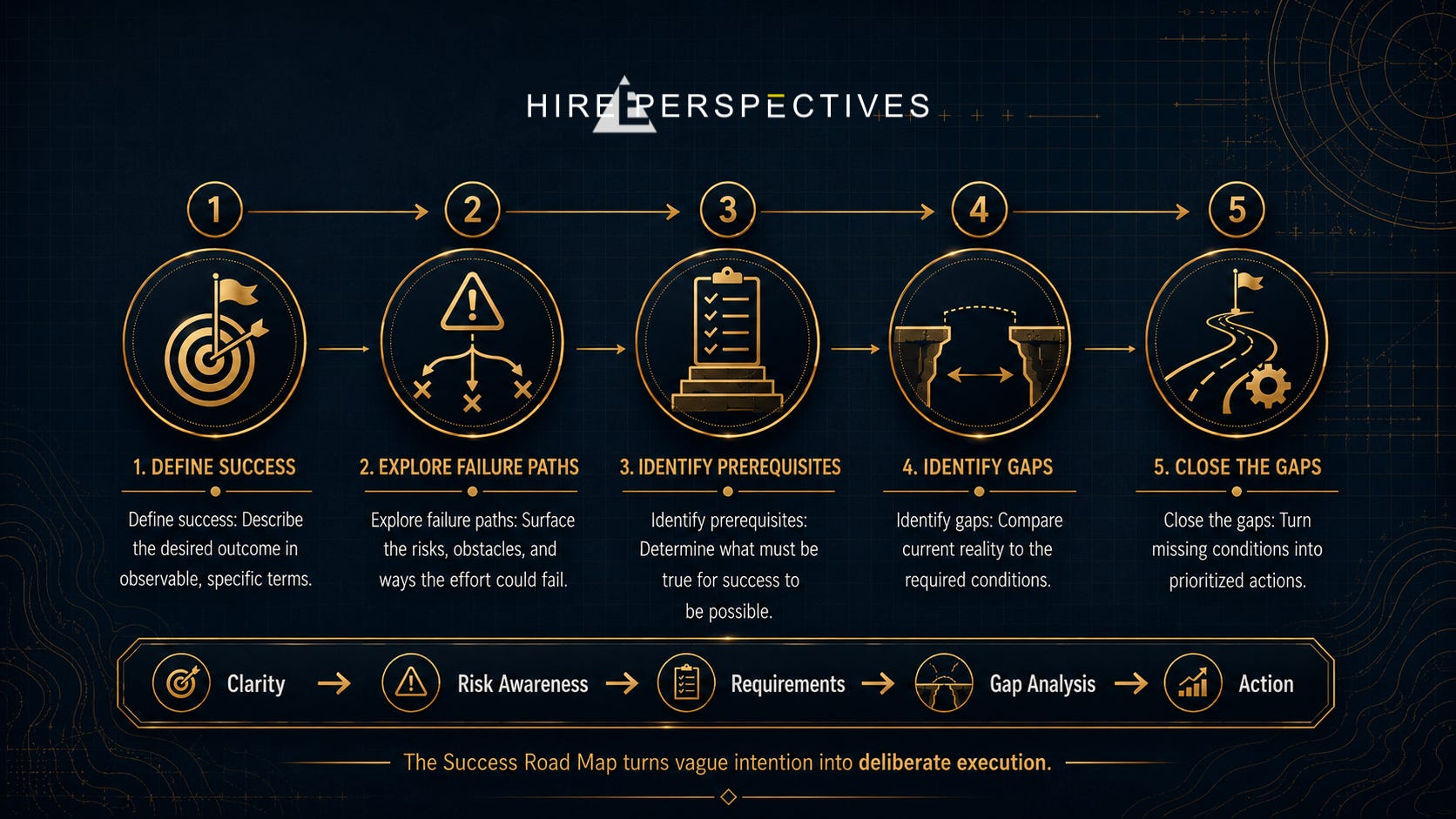
First, define success. Then explore failure paths. Then identify the prerequisites for success. Then expose the gaps between the current state and those required conditions. Then close the gaps with specific action.
That sequence matters. If you do not define success clearly, you will not know what failure means. If you do not examine failure, you will miss the conditions required for success. If you do not identify the prerequisites, you will not see the gaps. If you do not see the gaps, your action plan will be built on hope rather than reality.
Stage One: Define Success
Start by defining what success actually looks like.
Do not rush this step. Most people believe they know what they want until they are forced to describe it in concrete terms. “I want a better job” is not a clear definition of success. “I want to grow the business” is not enough. “I want this project to succeed” sounds reasonable, but it still leaves too much room for assumption.
A useful definition of success can be recognized when it occurs. It should describe the outcome in observable terms. It should make clear what will be true when the goal has been achieved. It should also explain why the outcome matters, because a goal without purpose often loses force when the work becomes difficult.
For a career goal, success might mean landing a role in a specific discipline, at a specific responsibility level, within a defined compensation range, in a company that supports the direction you are building. For a project, success might mean reaching a specific performance target, passing a test requirement, satisfying a customer condition, or delivering a working product by a meaningful deadline. For a personal goal, success might mean creating a repeatable habit, reaching a measurable health marker, or building a new capacity that changes daily life.
If your definition of success is vague, your roadmap will be weak. The first discipline is to name the destination clearly enough that you can tell whether you are moving toward it or merely moving.
Write your definition of success in one paragraph. Then read it back and ask whether someone else could recognize the outcome if it happened. If the answer is no, refine it.
Stage Two: Explore Failure Paths
Once success is defined, ask how the effort could fail. “What are all the ways I can mess this up?” - Then just don’t do those things.
This is not pessimism. It is awareness. Pretending failure paths do not exist does not make you positive. It makes you unprepared. What if you had a road map for every trip you went on, and it showed all the places where you might get a flat tire or have car trouble? What if the map showed you all the places where you might run out of gas with no service station in sight? This is the power of understanding the failure modes have on any given idea, project, or goal.
Most failures are not complete surprises. They often come from risks that were visible early but left unnamed because the team wanted momentum, the individual wanted confidence, or the goal felt too exciting to challenge. The Success Road Map forces you to do the uncomfortable work before the cost is real.
Ask what could prevent the outcome. The answer may involve missing skills, unrealistic timing, weak communication, lack of funding, unclear ownership, poor preparation, inadequate relationships, bad assumptions, market conditions, technical limitations, or personal discipline. Do not limit yourself to obvious risks. Some of the most dangerous failure paths are ordinary and quiet. People misunderstand expectations. A necessary approval is delayed. A key relationship is weak. A product team assumes demand that has not been validated.
The advanced question is this: how could this fail even if everyone involved thinks they are doing the right thing?
That question matters because many failures are not caused by laziness or bad intent. They are caused by ambiguity, overconfidence, misalignment, and missing information.
Write the failure paths without trying to solve them immediately. Your job in this stage is to see clearly. You are not predicting disaster. You are identifying the places where reality may push back.
Stage Three: Identify the Prerequisites for Success
After you understand what success looks like and how the effort could fail, identify what must be true for success to occur.
These are the prerequisites.
A prerequisite is not something that would be nice to have. It is a condition required for the outcome to become possible. This is where many people confuse desire with readiness. Wanting an outcome does not mean the conditions for that outcome exist.
If the goal is a career move, prerequisites may include a clear value proposition, a targeted search strategy, interview readiness, technical evidence, compensation clarity, professional relationships, or a stronger portfolio. If the goal is a product launch, prerequisites may include validated demand, engineering capacity, test infrastructure, regulatory approval, manufacturing readiness, customer support, or leadership alignment. If the goal is personal development, prerequisites may include time, structure, accountability, health, instruction, environment, or the removal of a competing habit.
This stage asks a blunt question: what must be true for this to work?
Do not answer with hope. Answer with conditions.
A good prerequisite statement is specific. “I need to be better prepared” is too vague. “I need to complete three mock interviews focused on technical tradeoff questions before applying to senior roles” is more useful. “We need more support” is vague. “We need one decision maker assigned, weekly review cadence, test access by Friday, and final sign-off criteria in writing” is more useful.
When the prerequisites are clear, the goal becomes less mysterious. You begin to see the architecture of success.
Stage Four: Expose the Gaps
Now compare the prerequisites with your current reality.
A gap is any required condition that does not yet exist.
This stage is where the roadmap becomes valuable because it transforms ambition into visible work. A gap is not an insult. It is an instruction. It shows you what must be built, learned, clarified, acquired, repaired, or decided before the outcome becomes realistic.
Do not minimize the gaps to protect your confidence. False confidence is expensive. If you need a stronger network, say so. If you need a specific skill, say so. If the timeline is unrealistic, say so. If the team lacks ownership, say so. If the goal requires a relationship, resource, approval, or level of discipline that is not currently present, name it.
The gap is not the enemy. The hidden gap is the enemy.
This stage should feel clarifying. You are no longer dealing with a vague goal. You are dealing with a specific difference between where you are and what success requires.
Some gaps will be practical. Some will be relational. Some will be technical. Some will be financial. Some will be personal. Some will be gaps of clarity, confidence, evidence, or timing. Treat them all seriously.
If a gap must close for success to occur, it belongs on the roadmap.
Stage Five: Close the Gaps
The final stage converts the roadmap into action.
Each gap should become a specific action or initiative. The action should be clear enough that you know what to do next, who is responsible, what resource is needed, and what completion looks like.
This is where many plans fail. People identify good insights and then create weak actions. “Improve my résumé” is not enough. “Rewrite the project section to show outcomes, decision impact, and technical ownership by Friday” is better. “Build the network” is not enough. “Identify ten target companies, find one relevant engineering leader at each, and send a focused introduction this week” is better.
Action should close a gap, not merely create more activity.
Prioritize the gaps. Some gaps block progress immediately. Some are important but not urgent. Some depend on other gaps being closed first. Some are symptoms of a deeper issue. Do not treat every action as equal. Build the roadmap in the order reality requires.
At the end of this stage, you should have a practical path from the current state to the desired outcome. Not a fantasy. Not a wish. A roadmap.
Using the Success Road Map in Career Decisions
The Success Road Map is especially useful in career management because many people confuse wanting change with being ready for change.
A vague career desire might sound like this: “I need a better job.”
The framework forces better thinking.
What does better mean? Better compensation, better technical work, better leadership, better location, better growth, better alignment, better stability, better long-term trajectory? If you cannot define “better,” you cannot evaluate opportunities clearly.
Failure paths might include applying to roles that do not fit, unclear career direction, weak interview preparation, poor timing, compensation mismatch, lack of evidence, or shallow networking. Prerequisites might include a refined résumé, a stronger value proposition, better search criteria, a target company list, interview preparation, and clarity around non-negotiables. Gaps reveal the real work.
That is how a reactive job search becomes a deliberate career plan.
Using the Success Road Map in Projects
The framework also works for project planning because technical execution often begins before success has been defined clearly enough.
A team may say the goal is to “launch successfully,” but that phrase can hide different assumptions. One person may define success by timing. Another may define it by performance. Another may define it by customer adoption. Another may define it by cost control or quality. If those definitions are not made visible, the team may appear aligned while quietly working toward different outcomes.
The Success Road Map forces the team to define success before committing to execution. It brings failure paths into the open. It identifies prerequisites such as technical capacity, testing, approvals, documentation, ownership, and customer readiness. Then it exposes gaps and turns them into work.
The value is not only the plan. The value is the shared understanding created by the process.
Using the Success Road Map With SWOT
SWOT analysis can help you understand the environment. It identifies strengths, weaknesses, opportunities, and threats.
The Success Road Map turns that awareness into execution.
A SWOT analysis might reveal that your team has strong technical expertise but weak market access. The roadmap then asks whether market access is a prerequisite for success. If it is, and the team does not have it, that becomes a gap. The action plan then needs to close the gap.
SWOT helps you see the landscape. The Success Road Map helps you move through it.
Common Mistakes
The first mistake is defining success too vaguely. If the destination is unclear, the roadmap cannot be strong.
The second mistake is avoiding failure paths because they feel negative. Unnamed risks do not disappear. They wait.
The third mistake is treating prerequisites like optional preferences. If a condition is required for success, it must be acknowledged.
The fourth mistake is minimizing gaps. A gap you refuse to name will still shape the outcome.
The fifth mistake is creating actions that do not actually close the gaps. Activity is not the same as progress.
The sixth mistake is failing to revisit the roadmap. New information changes reality. When reality changes, the roadmap should be updated.
A Simple Working Template
Use this template whenever you need to turn a vague goal into a practical path.
Define success. What does the finished outcome look like, and why does it matter?
Explore failure paths. How could this fail, even if everyone involved is trying to do the right thing? What are all the ways I can mess this up?
Identify prerequisites. What must be true for success to become possible?
Expose gaps. Which required conditions are not currently present?
Close the gaps. What actions will close those gaps, in what order, and by whom?
This template is simple on purpose. If you use it honestly, it will surface the work that most people skip.
Closing Perspective
The Success Road Map does not guarantee success. Nothing serious does.
It does something more useful. It improves the quality of your thinking before action begins. It helps you stop confusing motion with progress. It helps you define the destination, see the risk, name the requirements, confront the gaps, and act with purpose.
The next time you feel pressure to move quickly, pause long enough to build the map.
Action matters.
But action after clarity is different from action in place of clarity.
Have a blessed day!
James Beine
#TopEngineer #HirePerspectives #EngineeringRecruitment #TalentAcquisition #EngineeringLeadership #RecruitingStrategy #EngineeringTalent
