



Hire Perspectives helps top engineers and engineering employers understand the hidden signals behind hiring, career movement, technical credibility, and talent decisions across automotive, aerospace, energy, and motorsports.
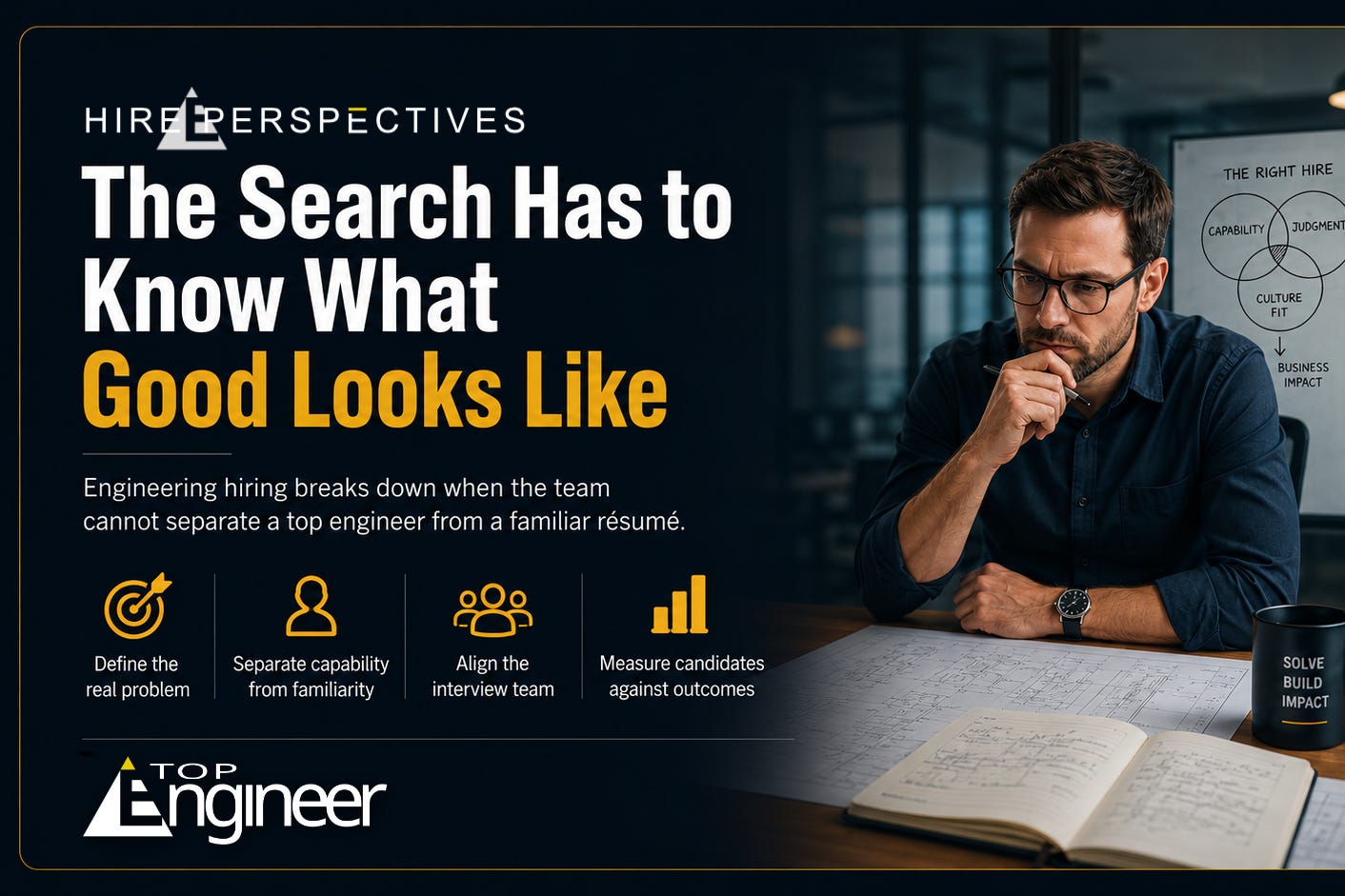
Natalie knew the interview had gone well before anyone said a word.
The candidate had not been flashy. He had not tried to dominate the room. He did not use dramatic language or turn every answer into a personal victory lap. He listened carefully, asked about the design history, and spent most of the technical discussion trying to understand why the same failure mode had survived two product revisions.
That caught her attention.
The company was hiring for a senior engineering role, but the real problem was not the open seat. The real problem was a product that kept moving through the organization with the same unresolved weakness. The team had learned to work around it. Manufacturing had adjusted. Quality had absorbed some of the pain. Customer support had learned how to explain it. Everyone had adapted just enough to keep the issue from forcing a reckoning.
Then Adrian sat in the conference room and asked a quiet question.
“Who owns the decision when design, manufacturing, and supplier feedback disagree?”
Nobody answered immediately.
That was the moment Natalie leaned forward.
He had found the pressure point. Not because he had memorized the right terminology. Not because his résumé was a perfect mirror of the job description. He found it because he understood that engineering problems are rarely isolated inside the drawing, the model, the simulation, or the test report. By the time a problem has repeated itself across teams, it is usually no longer just a technical issue. It has become a decision issue.
After the interview, the team gathered for the debrief.
One person liked him. One person was unsure. One person thought his background was adjacent but not exact. The hiring manager kept looking back at the job description, as though the document could settle the question.
Natalie finally said what the room was avoiding.
“We are not sure whether he is right because we have not agreed on what good looks like.”
That is where many engineering searches become expensive.
The company may have a job description. It may have a compensation range. It may have a list of required skills and preferred qualifications. It may have a recruiter working the market and a hiring manager ready to interview. On paper, the search is active.
But active is not the same as aligned.
A hiring team can spend weeks evaluating candidates without having a shared standard for the person they are trying to hire. Each interviewer brings a different expectation into the room. One listens for technical depth. Another listens for industry familiarity. Another wants confidence. Another wants cultural ease. Another wants someone who has already done the exact job somewhere else.
None of those instincts are automatically wrong. The problem is that they are often ungoverned. They operate separately. They compete quietly. They create a process where every candidate is measured against a moving target.
A top engineer does not always look obvious to every person in the process. Sometimes the person who can solve the problem does not have the most familiar résumé. Sometimes the candidate with the cleanest résumé has only lived near the problem, not inside it. Sometimes the best signal in the interview is not the answer itself, but the way the candidate thinks before answering.
That is hard to evaluate when the company has not defined the work clearly.
The search has to know what good looks like before it meets the market.
This is not a slogan. It is an operating requirement.
Good cannot simply mean “qualified.” Qualified is too broad. Many candidates can be qualified and still be wrong for the moment. Good also cannot mean “similar to the last person who held the role.” That may feel safe, but it can trap the company inside the same limitations it is trying to outgrow.
Good has to be connected to the business problem, the engineering burden, the team’s limitations, and the outcome the company needs after the hire is made.
In Natalie’s case, the company did not merely need another senior engineer. It needed someone who could bring clarity to a recurring technical problem that had become organizationally tolerated. The person had to understand design decisions, supplier realities, manufacturing feedback, and the cost of delay. The role required engineering judgment, but it also required enough agency to challenge the way the team had learned to live with the problem.
That is a very different search. Once the team saw that, Adrian looked different.
His résumé was still not perfect. That did not change. He had not worked on the exact product category. He did not carry every preferred keyword. He would need time to learn some of the company’s internal systems.
But the interview had revealed something more important. He knew how to find the decision path behind the technical pain. He knew how to ask questions that exposed ownership gaps. He understood that a repeated problem usually has a history, and that history matters.
Signal vs. Noise
The team had been treating some of that signal as noise because they were still attached to the original profile.
This is one of the most common failures in engineering hiring. The team confuses familiarity with fit. A familiar résumé feels safer because it is easier to explain. The candidate came from the expected company, used the expected tools, held the expected title, and followed the expected path. No one has to fight very hard to justify the interview.
Perfect Fit is not about finding a person who matches every line of a posting. It is about understanding where the person’s capability, desire, judgment, and working style meet the company’s actual need. That requires a clearer standard than most hiring processes are willing to build.
A top engineer cannot rely on employers to recognize value automatically. That is a passive strategy. It assumes the room knows how to read the signal. Many rooms do not. Many interview teams are tired, misaligned, or still negotiating what they want while the candidate is sitting in front of them.
That means the engineer has a responsibility too.
Not to perform. Not to exaggerate. Not to turn the interview into theater. The responsibility is to create clarity around actions and outcomes.
What problems have you actually solved?
What decisions did you influence?
What changed because of your work?
Where did your judgment reduce risk, improve quality, shorten delay, protect margin, or create a better engineering result?
Top engineers often undersell this because they assume the work should speak for itself. That sounds noble, but it is naïve. Work does not speak clearly in a noisy process. The engineer has to help the room understand what happened, what was at stake, what action was taken, and what changed as a result.
Natalie’s team eventually rewrote the evaluation standard before making the final decision. They stopped asking whether Adrian matched the original profile and started asking whether he could solve the real problem. That did not make the decision automatic, but it made the decision honest.
They compared him against the work, not against a vague image of the ideal candidate.
Before the search goes live, the hiring team should be able to describe the difference between a candidate who looks right and a candidate who is right. They should know which parts of the background are required and which parts are only comforting. They should know what evidence they need to hear in the interview. They should know what tradeoffs they are willing to make and which ones they are not.
Without that clarity, the company does not have a hiring process. It has a series of professional conversations loosely organized around a vacancy.
For engineering leaders, this is not a small matter. Every unclear search taxes the organization. It consumes the hiring manager’s attention. It weakens recruiter confidence. It frustrates candidates. It teaches the team to become skeptical of the market when the real problem may be internal alignment.
For engineers, the lesson is just as direct. Do not assume the market knows how to evaluate you. Bring the evidence. Connect your actions to outcomes. Make your judgment visible without turning yourself into a salesman. A top engineer should be able to explain the value of the work without cheapening the work.
HMSS Framework
Heart, Mind, Soul, and Strength all show up in the search, whether anyone names them or not. Heart shows up in what the person cares enough to own. Mind shows up in how they think through uncertainty. Soul shows up in the standards they carry when no one is watching closely. Strength shows up in whether they can move through pressure without becoming careless, defensive, or passive.
A résumé rarely captures all of that.
A good interview can.
A clear search will.
That is why the search has to know what good looks like. Not a fantasy candidate. Not a recycled version of the last person. Not a list of preferences disguised as requirements. Good means the person can meet the moment the company is actually facing.
When that standard is clear, the process changes. Recruiters represent the role with more precision. Hiring managers listen for better evidence. Interview teams stop evaluating from separate private scorecards. Candidates understand the opportunity with less confusion.
Actions and Outcomes
Action: Before launching the search, write one plain sentence explaining why the role exists.
Outcome: The team stops hiring against a title and starts hiring against a real business and engineering need.
Action: Separate required capability from familiar background.
Outcome: The company becomes less likely to reject a top engineer simply because the résumé does not look exactly as expected.
Action: Ask every interviewer what evidence they are responsible for finding.
Outcome: The interview process becomes aligned instead of becoming a collection of private opinions.
Action: Evaluate candidates against the problem they must solve, not just the language in the job description.
Outcome: The company makes better decisions and reduces the noise that slows engineering searches down.
Action: As an engineer, explain your work through actions and outcomes.
Outcome: The hiring team can see not only what you touched, but what changed because you were involved.
Action: Replace vague confidence with clarity.
Outcome: Both sides leave the conversation with a better understanding of fit, risk, expectation, and next steps.
If your engineering search feels active but not aligned, slow down before you speed up.
Clarify the problem. Define what good looks like. Separate familiar background from actual capability. Make sure every person in the process understands what evidence they are responsible for finding.
And if you need help seeing where the search is losing signal, that is exactly the work we do at Top Engineer.
We help employers clarify the role, understand the market, and connect with the kind of top engineer who can solve the problem in front of them.
Have a blessed day!

James Beine
#TopEngineer #HirePerspectives #EngineeringRecruitment #TalentAcquisition #EngineeringLeadership #RecruitingStrategy #EngineeringTalent
