


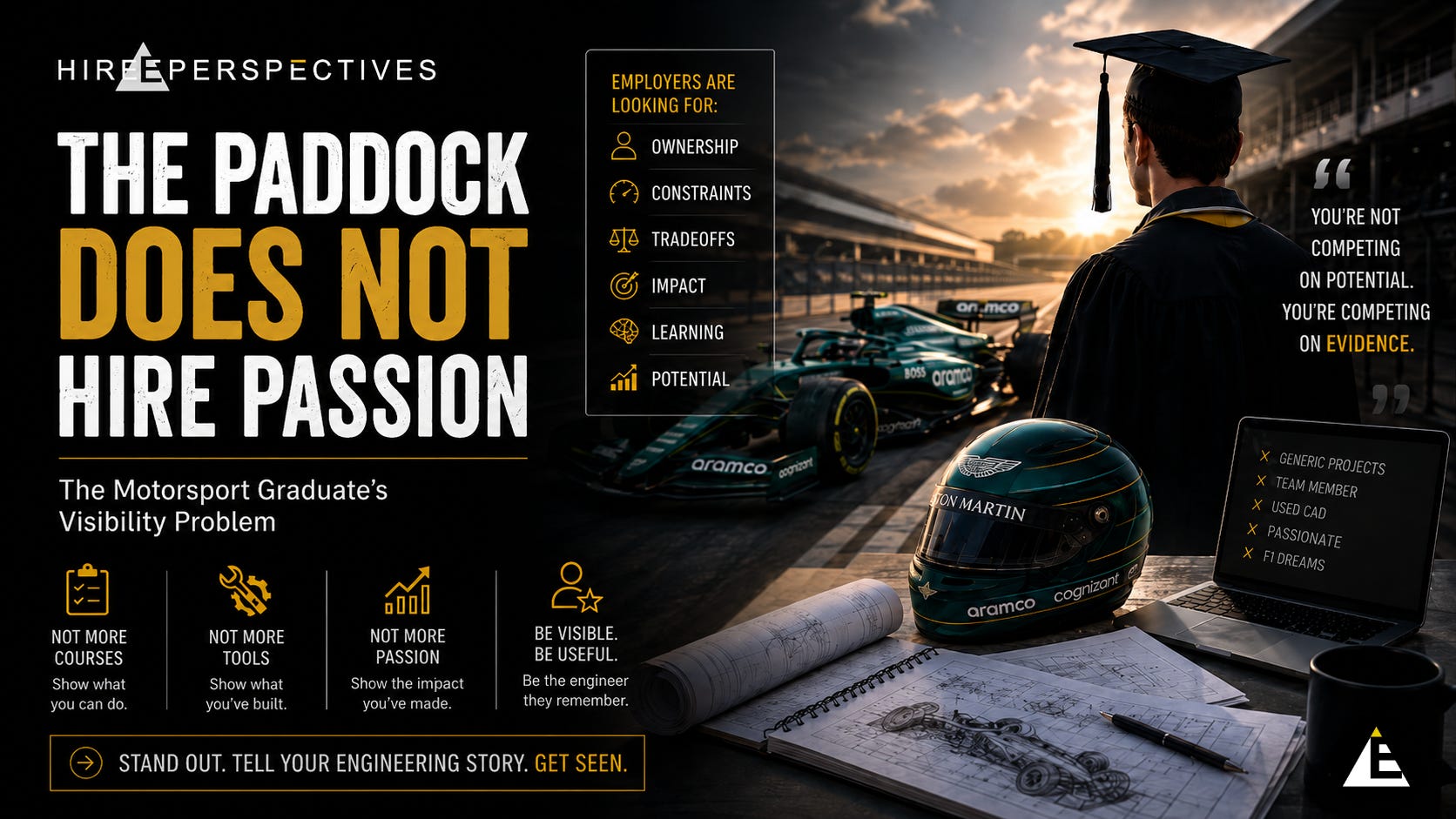
This is an unpopular observation. Yes, passion matters. But it’s not the distinguishing trait that lands roles in motorsport engineering.
An aspiring engineer finishes a motorsport engineering degree with real ambition. The work has been serious. The hours have been long. The projects have mattered. The dream is not vague. Formula One, WEC, GT3, IndyCar, NASCAR, IMSA, Formula E, race teams, performance groups, simulation, aerodynamics, vehicle dynamics, data, composites, controls, powertrain, trackside engineering. The names change, but the desire is clear. This person wants to build a life close to performance.
They build a résumé enter the market and become nearly invisible.
Not because the engineer has no value. Not because the degree was meaningless. Not because Formula Student, university projects, simulations, CAD models, CFD Methods Design, race strategy tools, wind tunnel reports, or lap time studies were useless. The problem is subtler and more dangerous. The résumé looks too much like every other résumé around it.
The motorsport graduate’s visibility problem.
Many graduates coming out of motorsport engineering programs look similar on paper. Similar modules. Similar final year projects. Similar Formula Student exposure. Similar software keywords. Similar enthusiasm for Formula One. Similar language about passion, performance, innovation, and working under pressure. The individual may be capable, serious, and deeply motivated, but the market does not see that clearly because the signal is buried inside sameness.
Motorsport is not short on ambition. It is not short on young people who love racing. It is not short on graduates who say they are passionate about performance. The market has heard all of that before. Serious employers are not moved by passion in the abstract. They are moved by evidence. They want to know what you owned, what you understood, what you changed, what you learned, what you can now do better, and whether your experience translates into usable contribution.
The graduate often thinks the degree is the proof. The employer sees the degree as the starting point.
The hiring manager is not asking whether you enjoyed motorsport. The hiring manager is asking whether you can reduce risk, solve problems, communicate clearly, work under constraint, understand tradeoffs, and become useful inside an environment where time, money, quality, and performance all matter at once. Your degree may get you into the category of possible candidates, but it does not automatically make you visible as the right candidate.
This is where many graduates make the mistake of listing experience instead of translating it.
They write that they worked on aerodynamics. They say they were part of the Formula Student team. They list SolidWorks, MATLAB, Simulink, Python, CFD, CAD, data analysis, manufacturing, vehicle dynamics, or telemetry. That may be accurate, but accuracy is not enough. A list tells the employer what you were near. It does not tell the employer what you owned.
Ownership is the beginning of visibility. What did you actually own. A component. A model. A test plan. A manufacturing issue. A data process. A supplier conversation. A design decision. A validation method. A cost constraint. A failure investigation. A packaging problem. A setup change. A communication breakdown. A deadline. A risk.
A graduate who can answer that clearly becomes easier to evaluate.
The point is not to inflate your experience. That is amateur and dangerous. The point is to make the experience you actually have more legible. Employers do not need you to pretend you were a chief aerodynamicist if you were not. They need you to explain what part of the work you touched, what constraints shaped it, what decisions you made, what evidence you used, and what changed because of your contribution.
Formula Student is a good example because it can be either powerful or nearly useless depending on how it is presented. Many graduates write about Formula Student as membership. They were on the team. They contributed to a subsystem. They helped with design or analysis. That is not enough. Membership does not communicate value. Contribution does.
A stronger graduate explains the actual problem. The team was trying to reduce weight without compromising stiffness. The aerodynamic package needed improvement within manufacturing and cost limits. The suspension geometry had to be adjusted after testing exposed a behavior that did not match the original assumption. The data logging process was inconsistent, so the team lacked reliable evidence for setup decisions. The design looked promising, but manufacturing realities forced a tradeoff. The car had to pass scrutineering, not just look impressive in CAD.
Every useful engineering narrative contains constraints. Without constraints, experience sounds like classroom activity. With constraints, it becomes more believable. Time pressure matters. Budget matters. limited tooling matters. data quality matters. manufacturing capability matters. rule compliance matters. team skill level matters. test access matters. supplier availability matters. packaging matters. reliability matters. Weight, stiffness, cost, performance, serviceability, and schedule often fight each other. Employers want to know whether you have started learning how to think inside that fight.
A motorsport graduate who can describe tradeoffs is far more visible than one who only describes tasks.
This is why sameness is so costly. The generic graduate says, “I am passionate about motorsport and have experience in CAD and simulation.” The stronger graduate says, “I worked on a design problem where the technically attractive solution created manufacturing and packaging issues, so I helped evaluate the tradeoff and supported the decision to choose a more practical design that could actually be built and tested within the team’s constraints.”
The second statement may be less glamorous, but it is far more valuable.
It shows judgment.
Motorsport employers care deeply about judgment because the environment punishes shallow thinking. The best answer on paper may fail on the car. The fastest theoretical solution may be impossible to implement before the next event. A design may improve one variable while damaging another. A setup change may make sense in isolation and still be wrong for the driver, tire, track, weather, or session objective. Motorsport is a world where engineering is always being disciplined by reality.
Failure also matters, and most young engineers underuse it. A graduate who only talks about success often sounds immature. Not because success is bad, but because real engineering growth usually comes through friction. Something failed to correlate. A part broke. A model was wrong. A manufacturing method did not work. A test produced messy data. A design was too ambitious. Communication broke down. A deadline exposed a weakness in planning. A car did not perform the way the team expected.
The question is not whether something failed. The question is what the graduate learned from the failure and how that changed future behavior. Did the failure improve the model. Did it change the test method. Did it sharpen the design review. Did it expose an assumption. Did it improve communication between subteams. Did it teach the engineer to verify earlier, document better, simplify faster, or listen more carefully.
A graduate who can explain failure without defensiveness becomes more credible.
This is one of the great missed opportunities in early career engineering communication. Young engineers often try to look polished, but employers are not always looking for polish. They are looking for evidence of learning velocity. They want to know whether the person can absorb correction, adapt to evidence, and improve. A graduate who presents only polished outcomes may look thinner than a graduate who can explain a messy problem with clarity and maturity.
A motorsport graduate needs a narrative that says more than, “I studied motorsport engineering and want to work in racing.” That is not enough. The narrative should explain what kind of engineer is emerging. Analytical. Hands-on. Calm under pressure. Strong in data. Strong in design. Strong in test. Strong in manufacturing reality. Strong in communication. Strong in systems thinking. Strong in translating driver feedback into engineering questions. Strong in connecting simulation to physical behavior. Strong in making practical decisions under limited time and imperfect information.
The exact narrative will vary. The key is that it must be specific. A graduate who tries to look broadly suitable for every motorsport role may become forgettable. A graduate who can clearly show a developing technical identity becomes easier to remember. This does not mean becoming narrow too early. It means becoming legible. Employers need to understand what kind of value you are most likely to bring first.
That is especially important because motorsport entry points are broader than many graduates realize. Too many graduates say they want Formula One, but they do not understand the wider ecosystem well enough. Formula One may be the dream, but there are serious pathways through GT3, WEC, Le Mans, IMSA, IndyCar, NASCAR, Formula E, rally, suppliers, simulation firms, composites companies, data groups, test teams, performance engineering support, manufacturing, controls, quality, and advanced automotive programs adjacent to racing. A graduate who only knows how to say “F1” may miss the opportunity that actually builds the capability to get there.
The motorsport graduate needs to think like a builder of proximity. The first role may not be the dream role. It may be a role that builds useful skills, credible references, technical maturity, and industry adjacency. The correct question is not always whether the job title sounds glamorous. The correct question is whether the role places you closer to the work, the standards, the people, and the problems that will compound into future opportunity.
This is also where humility matters. Motorsport is full of high ambition, and some of it turns into entitlement. Employers can feel that quickly. The graduate who believes the degree should open the door by itself is not as attractive as the graduate who understands that the degree is a foundation and that credibility must now be earned through contribution. The paddock is small. Reputations travel. How a young engineer communicates, follows up, receives feedback, handles rejection, asks for advice, and describes prior work all begin shaping reputation before the first full-time race engineering role ever arrives.
The graduate who wants to stand out should not try to sound like a senior engineer. That is the wrong move. They should sound like a serious junior engineer with evidence. They should be honest about what they have done, clear about what they have learned, specific about what they can contribute, and humble enough to keep growing. That combination is far more compelling than overclaiming.
A strong early career narrative does not need exaggeration. It needs structure.
The structure is simple.
What did you own?
What constraints did you face?
What tradeoffs did you evaluate?
What failed?
What did you learn?
What can you now do better than before?
How does that make you useful to the employer?
This is not merely a résumé exercise. It is a thinking exercise. The graduate who can answer those questions clearly is already becoming stronger because the act of answering forces better reflection. It turns activity into evidence. It turns experience into signal. It turns a generic motorsport graduate into a candidate with shape.
The motorsport graduate’s visibility problem is not solved by louder enthusiasm. It is not solved by more generic applications. It is not solved by adding more software keywords without context. It is solved by building a clearer engineering career narrative around specific evidence of ownership, constraint, tradeoff, failure, learning, and present usefulness.
A motorsport degree is valuable. Formula Student is valuable. A master’s focus in motorsport engineering is valuable. But none of it communicates enough on its own. The market needs translation. Employers need clarity. The graduate needs a narrative that makes real capability visible before the opportunity disappears into the noise.
The degree is not the finish line. The résumé is not the story. Passion is not the proof. The work now is to become legible, useful, and specific enough that the right people can see what you are becoming.
Graduating with a motorsport engineering degree is a strong start, but it is not the same as being visible to the right teams. If you are serious about translating your education, Formula Student experience, projects, and technical interests into a clearer engineering career narrative, let’s have a conversation.
Schedule a discovery call here:
https://calendar.app.google/ALSYcZ8jLLbcM89s9
Serious inquiries only.
Have a blessed day!
James Beine
#HirePerspectives #TopEngineer #MotorsportEngineering #EngineeringGraduates #FormulaStudent #EngineeringCareers #CareerStrategy
