



Hire Perspectives helps top engineers and engineering employers understand the hidden signals behind hiring, career movement, technical credibility, and talent decisions across automotive, aerospace, energy, and motorsports.

Lena was at her desk late on a Tuesday morning, moving between a supplier email, a validation spreadsheet, and the kind of internal meeting invite that had already been rescheduled twice. The work was familiar enough that she could keep one eye on the screen and one ear on the conversation happening over the low wall beside her. She had been in the role long enough to know the program, the people, and the problems that would probably still be there by the end of the week.
Her phone lit up with a number she did not recognize.
She almost let it go to voicemail, then answered.
It was not an unusual call. Another headhunter. The role was with an OEM, the title was a little stronger than the one she had, and the work sounded close enough to her background to justify a conversation. The recruiter asked about her current position, her experience in electrification, and whether she was still interested in vehicle-level responsibility. Lena answered easily as she walked into the other room for privacy. She had been through enough of these conversations to know how to explain her background.
“Send me your résumé while we’re talking,” he said. “I’ll take a quick look.”
Lena attached the file and kept talking while he opened it.
The silence came a few seconds later.
“Lena, I’m going to be direct,” he said. “There is a lot to explain here.”
She stopped.
“What do you mean?”
“I mean this résumé has a job-hopper problem. I’m not saying every move was wrong. I’m saying the pattern is visible, and an employer is going to see the pattern before they hear the explanation.”
She did not answer right away. None of the moves had felt careless when she made them. The first had been easy to explain. Her supplier program was unstable, the customer kept changing launch dates, and the engineering manager who had hired her left before the first design review was complete. The second move made sense too. An OEM had called, the title was better, the work was closer to vehicle-level systems, and the compensation increase was hard to ignore. The third move had been into electrification, which seemed like the right direction at the time. The fourth came after a reorganization, when her responsibilities narrowed and she felt herself becoming less technical than she wanted to be.
Each decision had a reason. Each one could be defended in a conversation. But now the recruiter was not asking about one decision. He was looking at the pattern.
Two years here. Eighteen months there. Twenty-six months in the next role. Another short stay after that. The dates were not extreme, but they formed a pattern. What had once looked like advancement now looked unfinished. There were responsibilities listed under each employer, but very few full arcs. She had supported programs, contributed to launches, worked on validation plans, helped solve supplier issues, and participated in cross-functional reviews. Still, the résumé did not clearly show where she had stayed long enough to own the consequences of her decisions, work through the hard middle of a role, or become one of the people an organization depended on when the easy phase was over.
Background
Over the past fifteen years, many engineers have absorbed a career-market idea that sounds practical and often proves useful in the beginning. Do not stay too long. Move every two or three years. Take the title. Chase the compensation increase. Go where the market rewards you. If your current employer will not promote you, find one that will. If the work becomes stale, leave. If someone else sees your value more clearly, accept the offer and keep climbing.
There is a reason this advice became popular. For many engineers, staying loyal to one employer did not produce the financial or professional return they expected. Companies flattened organizations, slowed promotions, merged teams, froze compensation, outsourced work, shifted strategy, and asked employees to be patient while the external market paid more. In that environment, movement became a rational response. Engineers learned that the fastest way to correct underpayment or escape a narrow role was often to leave.
That part is not imaginary. A well-timed move can change the slope of a career. It can place an engineer closer to better technology, stronger leadership, cleaner technical standards, more serious programs, or a company with deeper investment in the work. A controls engineer stuck maintaining old equipment may need to move into a more modern manufacturing environment. A systems engineer trapped in documentation support may need a role with real architecture responsibility.
The problem begins when movement stops being a response to a real professional constraint and becomes the strategy itself. At that point, the next move is no longer a decision made in service of deeper work. It becomes the default answer to discomfort, impatience, boredom, stalled recognition, or the first sign that the role has become difficult in a less visible way.
It is tempting to dismiss the label as outdated employer thinking, and sometimes it is applied unfairly. Employers can be lazy in their interpretation of résumés. They can overlook layoffs, acquisitions, relocations, leadership changes, project cancellations, personal constraints, and the reality that many companies no longer offer the kind of stability they expect from candidates. A short stay does not automatically mean poor judgment. Several short stays do not automatically mean weak commitment. Good engineers sometimes end up with complicated timelines for reasons outside their control.
But the fact that a label can be unfair does not make it powerless.
The résumé problem often grows because two different forces begin to look like one pattern. Some moves were forced by downsizing, family matters, company instability, or circumstances outside the engineer’s control. Others were voluntary moves made for title, compensation, visibility, or better technical exposure. On paper, the employer may not separate those categories unless the engineer gives them a reason to.
In hiring, perception often forms before explanation. An employer reviewing a résumé is not only asking whether the candidate has changed jobs. The deeper questions are more practical. Will this person stay long enough for our investment to matter? Has this person worked through the hard middle of a role, after the onboarding period ended and the problems became less exciting? Has this person been accountable after decisions produced consequences? Has this person built anything durable? Has this person stayed long enough to see whether their judgment held up?
Those questions are not moral judgments. They are business judgments. Engineering employers know that the cost of hiring is not limited to recruiting fees, relocation, sign-on bonuses, onboarding, or training. The greater cost is the time it takes for a technical professional to understand the product, the system, the customer, the plant, the safety culture, the supplier base, the design history, the test standards, and the informal knowledge that does not appear in procedures. When an engineer leaves before that investment matures, the employer does not merely lose a person. It loses continuity.
This is especially important in engineering because technical work has long tails. A design decision may look reasonable during concept review and reveal its weakness after validation. A controls strategy may work during commissioning and create maintenance problems six months later. A supplier decision may look efficient during sourcing and become expensive during launch. A manufacturing process change may improve throughput but create quality drift that does not show up until production volume increases. A test standard may pass internal review and still fail to catch the condition that appears in the field.
Careers built only from short stays can create a real question in the employer’s mind: has this engineer seen the downstream consequences of their own work?
That question matters in automotive, aerospace, energy, motorsports, manufacturing, controls, systems, quality, and technical leadership because the most valuable engineers are rarely valued only for what they can start. They are valued for what they can carry. They understand how decisions age. They know what happens when the first version of the plan meets production reality, customer pressure, supply constraints, regulatory requirements, warranty exposure, safety concerns, budget pressure, and fatigue inside the team. They have seen enough cycles to know that early confidence is not the same as mature judgment.
Moving up is visible. It shows in the title, the compensation band, the company name, the scope written into the job description, and the way the new role sounds when described to others. Becoming more valuable is less visible at first. It happens when an engineer stays close enough to hard work to understand cause and effect. It happens when a person has to defend a decision months after making it. It happens when the engineer inherits a problem, studies the history, works through competing priorities, and produces a result that others can build on. It happens when leaders begin to rely on the person not merely because they are capable, but because they have become steady under real pressure.
Résumé value is what looks impressive at a glance. Titles. Tools. Keywords. Company names. Product categories. Compensation progression. Industry language. A résumé can be rich with these signals and still leave an employer unsure whether the engineer has completed meaningful work through a full cycle.
Career value is what survives scrutiny. Judgment. Ownership. Technical maturity. Problem-solving depth. Leadership under constraint. A record of staying with difficult work long enough to produce outcomes that matter. The résumé gets someone into the conversation. Career value determines whether the story holds up once the conversation becomes serious.
The false promise of the “move every few years” rule is that it often works before it starts working against the person. The first move may correct compensation. The second may broaden experience. The third may bring a stronger brand or a better technical platform. For a while, the pattern can look like momentum. The engineer may feel sharper because each move produces a visible reward.
But repeated without a deeper purpose, the same strategy begins to reverse its value. What once looked ambitious begins to look unstable. What once looked strategic begins to look transactional. What once looked like growth begins to look like an inability to stay long enough for depth to form.
This is not about staying forever. That argument is too simple, and it ignores how damaging the wrong environment can be. Staying too long under weak leadership, obsolete technology, political dysfunction, unsafe practices, or chronic underutilization can damage a career as much as moving too often. An engineer can become stale, narrow, resentful, or invisible by remaining in a role that no longer develops judgment or capability.
The better question is not whether movement is good or bad. The better question is whether movement strengthens the professional arc.
A justified move has a reason that becomes more credible under inspection. The company was unstable. The technical fit was wrong. The role became narrower than promised. The engineer relocated. A family constraint required a change. The leadership culture was unethical. The person was underused. A stronger opportunity created access to deeper work, better systems, or a more serious technical environment.
Patterned hopping is different. It is movement without accumulated responsibility. It is leaving each role before the work matures. It is treating every inconvenience as evidence that the next employer will solve the problem. It is a career built around arrival, not contribution. The engineer becomes skilled at entering new organizations, learning enough to sound current, and moving before the weight of long-term ownership arrives.
Employers notice that pattern because they have lived with its cost. They have seen candidates arrive with strong language and leave before the launch. They have watched engineers accept responsibility during the exciting stage and disappear before the corrective action work becomes tedious. They have hired people who were excellent in interviews but unavailable, emotionally or professionally, for the unglamorous middle of the assignment.
The employer does not need to be right about every concern for the stigma to affect the candidate. Once the pattern is visible, the engineer has to explain the logic behind the movement. If the explanation is specific, grounded, and connected to professional growth, the concern can be reduced. But if you have to have an explanation for every single role, there’s a larger problem. I often tell engineers that when the going gets tough or when the difficulties arise, that these are generally an opportunity to shine. But human nature, in general, is to take the path of least resistance. And more and more of the resumes I see indicate this. So when you look at your resume, do you find yourself having to ultimately justify every job change? Or is it obvious that it was a good move without explanation? If the explanation sounds generic, repetitive, or evasive, the label becomes harder to remove.
This is where many engineers underestimate the burden they have created for themselves. They assume each move will be judged separately because each move had its own reason. Employers usually read the pattern first. They do not begin with the engineer’s internal history. They begin with dates, titles, employers, and duration. Then they decide whether the pattern deserves more time.
That does not mean the engineer is trapped. It does mean the story has to become more disciplined.
An engineer who has moved frequently needs to show why the movement produced stronger capability, not just better packaging. The résumé and interview need to make the arc visible. What responsibility increased? What technical depth was added? What problems became harder? What decisions did the engineer own? What outcomes followed? What was carried from one environment into the next? What pattern of contribution can be seen across the movement?
Without that connective tissue, the résumé becomes a list of exits.
The same standard applies before the next move. Engineers should be more careful about leaving a role simply because the next offer looks better. A title increase can be real and still be a poor career decision. A compensation increase can be meaningful and still not compensate for the loss of continuity. A recognizable company name can improve the résumé while placing the engineer in work that is thinner than what they already had.
The harder question is whether the move will make the engineer more credible three years from now. Not more marketable next month. More credible. There is a difference.
A strong move should add responsibility the engineer can carry. It should expose the person to better problems, not just better branding. It should place the engineer closer to serious consequences, better standards, stronger technical leadership, or a scope of work that produces maturity. It should make the next version of the résumé easier to defend, not harder.
For employers, the lesson is also more precise than simply rejecting candidates with movement. Some of the strongest engineers have changed jobs for serious reasons, and some of the weakest careers are hidden behind long tenure. Duration alone does not prove depth. A person can stay ten years and repeat the same year ten times. Another person can move three times and build a coherent progression through increasingly serious work.
The job hopper stigma should be treated as a signal, not a verdict. It should prompt better questions. What caused the movement? Did each move increase responsibility? Did the candidate leave before consequences arrived? Is there evidence of full-cycle ownership anywhere in the record? Can the candidate explain the professional logic without sounding rehearsed? Has the person learned from the movement, or are they likely to repeat it?
For engineers, the risk is pretending the signal does not exist.
The market may reward motion early, but serious employers still look for accumulated responsibility. They want evidence that an engineer can stay with difficult work, carry decisions beyond the exciting beginning, and become more useful as complexity increases. They want people who can learn a system deeply enough to improve it, not merely pass through it.
A career does not have to be stationary to be strong. It does need coherence.
The lesson is not that engineers should avoid movement. Strong careers sometimes require a change of employer, a change of technical environment, or a move into work that offers greater responsibility. But the modern market has become too casual about assuming that movement itself is evidence of growth.
Some of the strongest engineering careers are built inside a single company, across many years, because tenure can create forms of value that are difficult to reproduce quickly somewhere else. An engineer who stays long enough to understand a product line, a process, a plant, a customer, a supplier base, a regulatory environment, and the history behind past decisions may become far more valuable than someone who has collected more titles across more employers. That kind of depth does not appear overnight. It is earned through repetition, consequence, correction, and accumulated judgment.
There is also a point where long tenure makes movement more complex, not less. The engineer may no longer be able to change employers and instantly receive the same professional acceleration that seemed possible earlier in the career. A major compensation increase or title bump can still happen, but it may come at the cost of leaving behind years of embedded credibility, product familiarity, internal influence, and technical context. The new employer may pay for experience, but it cannot immediately recreate the value that came from knowing a system deeply.
That is the part many engineers underestimate. Frequent movement does not merely change the employer name on a résumé. It can change the venue, the product, the process, the industry, the technical focus, and the professional identity all at once. Done carefully, that can broaden a career. Done repeatedly, it can dilute one. The engineer may become widely exposed but not deeply formed, familiar with many environments but fully seasoned in none.
The goal, then, is not constant movement, and it is not blind staying. The goal is to build a career in which time, responsibility, and technical focus compound. Every move should strengthen that compounding effect, not interrupt it.
A move should not merely improve the next line on the résumé.
A move should not merely improve the next line on the résumé. It should carry the engineer further in the direction of a defined professional aim. Napoleon Hill’s old phrase, “definite chief aim,” is useful here because it separates motion from direction. An engineer who knows the kind of work, responsibility, product line, technical environment, and professional contribution they are building toward can evaluate movement with more discipline. This is how subject matter expertise is built: through sustained focus toward a definite chief aim, not through repeated changes of venue that restart the clock before depth has time to compound.
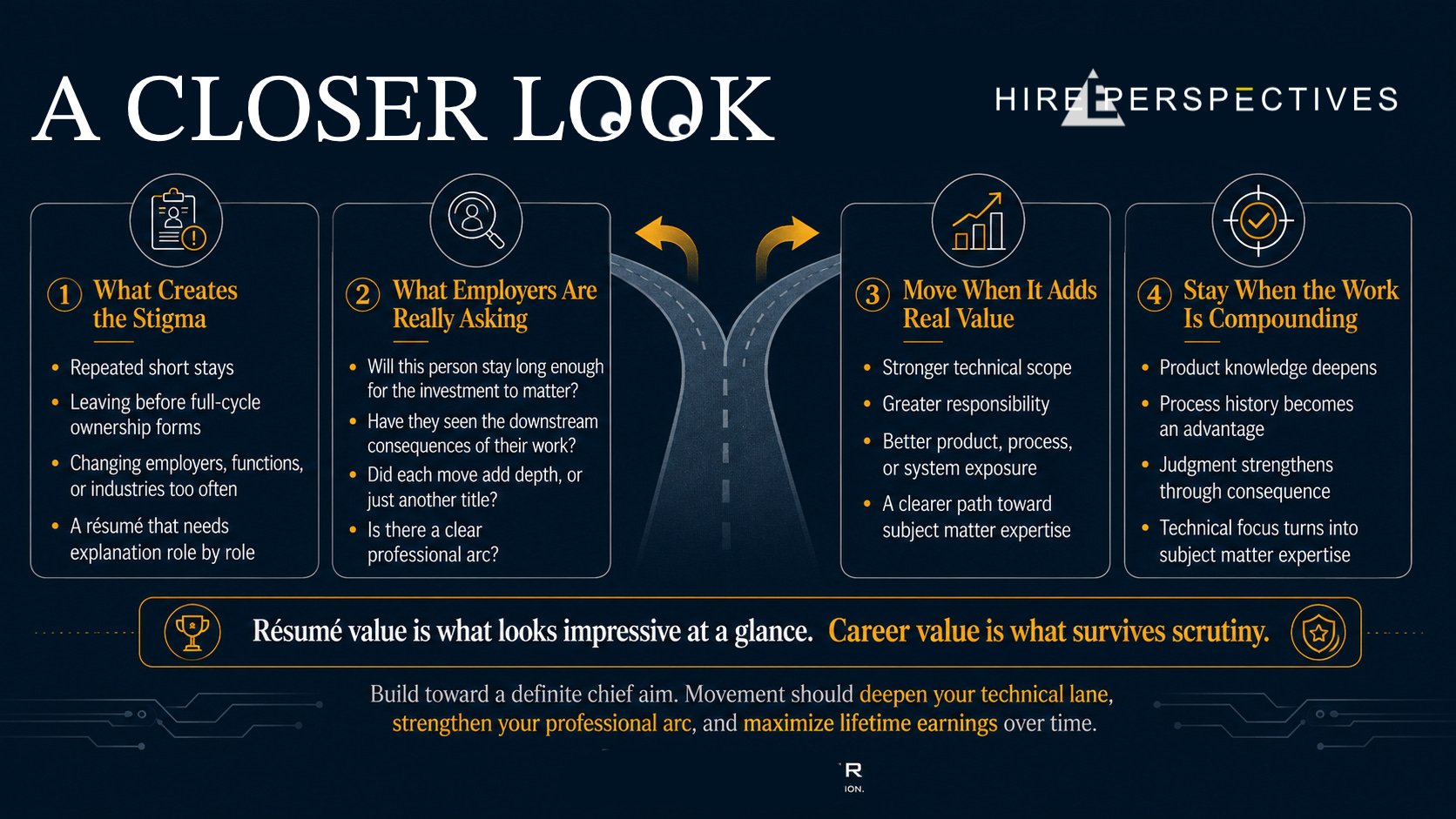
That is why subject matter expertise carries such unusual economic force. The engineer who has spent years inside a product line, process, system, or technical category does not merely become more experienced. They become faster, sharper, and more valuable because they have accumulated the judgment that only sustained focus can produce.
This is the engineer who can make 10 times more money, do the job in half the time, become known by everyone who matters in that technical lane, and never want for a job in their life.
Not because they changed venues often enough to look ambitious, but because they stayed with a definite chief aim long enough for the market to know exactly what kind of problem belongs to them.
Actions and Outcomes
Action: Before making the next move, decide whether the role holistically advances your career or simply changes the employer name on the résumé.
Outcome: The engineer stops treating movement as automatic progress. A better title, better compensation, or stronger company name may still matter, but the decision is measured against the deeper career question: does this move add responsibility, technical depth, product knowledge, process knowledge, or stronger long-term positioning?
Action: Separate forced moves from chosen moves before explaining the résumé to a recruiter or employer.
Outcome: The conversation becomes clearer because downsizing, relocation, family matters, acquisition, project cancellation, and unstable leadership are not treated the same as voluntary moves made for title, compensation, visibility, or technical exposure. The engineer can explain the timeline without sounding defensive, and the listener can see the difference between circumstance and pattern.
Action: Rebuild the résumé around accumulated responsibility rather than employer sequence alone.
Outcome: The résumé stops reading like a list of exits. Instead of presenting each role as a disconnected chapter, the engineer shows what carried forward: harder systems, larger problems, deeper product knowledge, stronger customer exposure, greater launch responsibility, better process ownership, or more meaningful technical decisions.
Action: Prepare the job-change explanation before the recruiter has to ask for it.
Outcome: The engineer controls the difficult part of the conversation. Weak explanations sound repetitive: better opportunity, more growth, time for a change. Strong explanations are specific: the program was cancelled, the technical scope changed, the new role moved the engineer closer to vehicle-level validation, or the move created access to a more serious product, process, or system.
Action: Stop measuring every opportunity by the immediate increase.
Outcome: The engineer becomes less vulnerable to short-term offers that look attractive but interrupt long-term value. A salary increase can be useful and still be too small to justify leaving behind product knowledge, process history, internal influence, or a technical lane that is beginning to compound.
Action: Choose moves that deepen a technical lane instead of repeatedly restarting one.
Outcome: The engineer builds subject matter expertise rather than broad but shallow exposure. Over time, sustained focus inside an industry, product line, process, system, or technical category creates the kind of value that changes the entire career equation.
Action: Use Napoleon Hill’s idea of a “definite chief aim” as a filter for career movement.
Outcome: The engineer separates motion from direction. Each move is judged by whether it carries the career closer to a defined professional aim, not merely whether it offers a better line on the résumé. This is how serious technical depth forms: through sustained focus toward a clear aim, not through repeated changes of venue that restart the clock before expertise has time to compound.
Action: Build toward the kind of subject matter expertise that changes market value.
Outcome: The engineer becomes faster, sharper, and more economically valuable because the work is no longer general. This is the engineer who can make 10 times more money, do the job in half the time, become known by everyone who matters in that technical lane, and never want for a job in their life. That outcome is not created by frequent movement alone. It is created when movement, staying power, technical focus, and accumulated responsibility all point in the same direction.
Impact
Every engineer will face difficulty. Sometimes it is a company in the position of downsizing. Sometimes it is a difficult circumstance in life, personally or professionally. In every one of those moments, we have two options.
The first option is to become completely captivated by the difficulty and focus on the difficulty itself rather than the opportunity it proposes. That is where victim mentality begins to take over. The second option is to reframe the difficulty as an opportunity to shine.
When we do this, something amazing happens. We show up to work with our best self in the face of adversity and we give ourselves the chance to overcome the difficulty. That does not mean we will always be successful in the endeavor. But we will leave the experience with growth, new perspective, and experience we would not otherwise have had.
This is one of the core value propositions of the Top Engineer Advisory service. We help engineers with the narrative, the framing, and the new perspectives required to manage a career with greater clarity. Sometimes that means preparing for a move. Sometimes it means understanding how to stay, how to lead through difficulty, and how to turn a hard season into part of a stronger career story.
Every day, Top Engineer connects the brightest minds in engineering with the companies shaping the future of automotive, aerospace, energy, and motorsports. This work is not simply about filling jobs. It is about helping serious engineers and serious employers build the kind of partnerships that move critical industries forward.
That means helping you make better decisions about when to move, when to stay, and how each decision affects the long arc of your career. It means helping you cultivate your definite chief aim, strengthen your positioning, and maximize lifetime earnings by applying a disciplined framework for career success.
Register with Top Engineer and become part of a network built around engineering excellence, long-term career value, and the technical partnerships that shape what comes next.
Have a blessed day!

James Beine
#TopEngineer #HirePerspectives #EngineeringRecruitment #TalentAcquisition #EngineeringLeadership #RecruitingStrategy #EngineeringTalent
