



Hire Perspectives helps top engineers and engineering employers understand the hidden signals behind hiring, career movement, technical credibility, and talent decisions across automotive, aerospace, energy, and motorsports.

From Generalist to Subject Matter Expert
When I worked at Halliburton, I developed a deep understanding of Siemens S7 PLC architecture. I knew how the control systems were structured, how the components communicated, how the logic moved through the equipment, and where to begin looking when something stopped behaving the way it should. Over time, that knowledge became one of the clearest strengths I brought to the organization.
The people around me knew it. They saw how I approached problems, how quickly I could understand what was happening, and how comfortably I could explain the system to someone else. It was not hidden inside the workplace. My capability was visible, and it played a meaningful role in how quickly I moved through the ranks. What I did not understand at the time was that…..
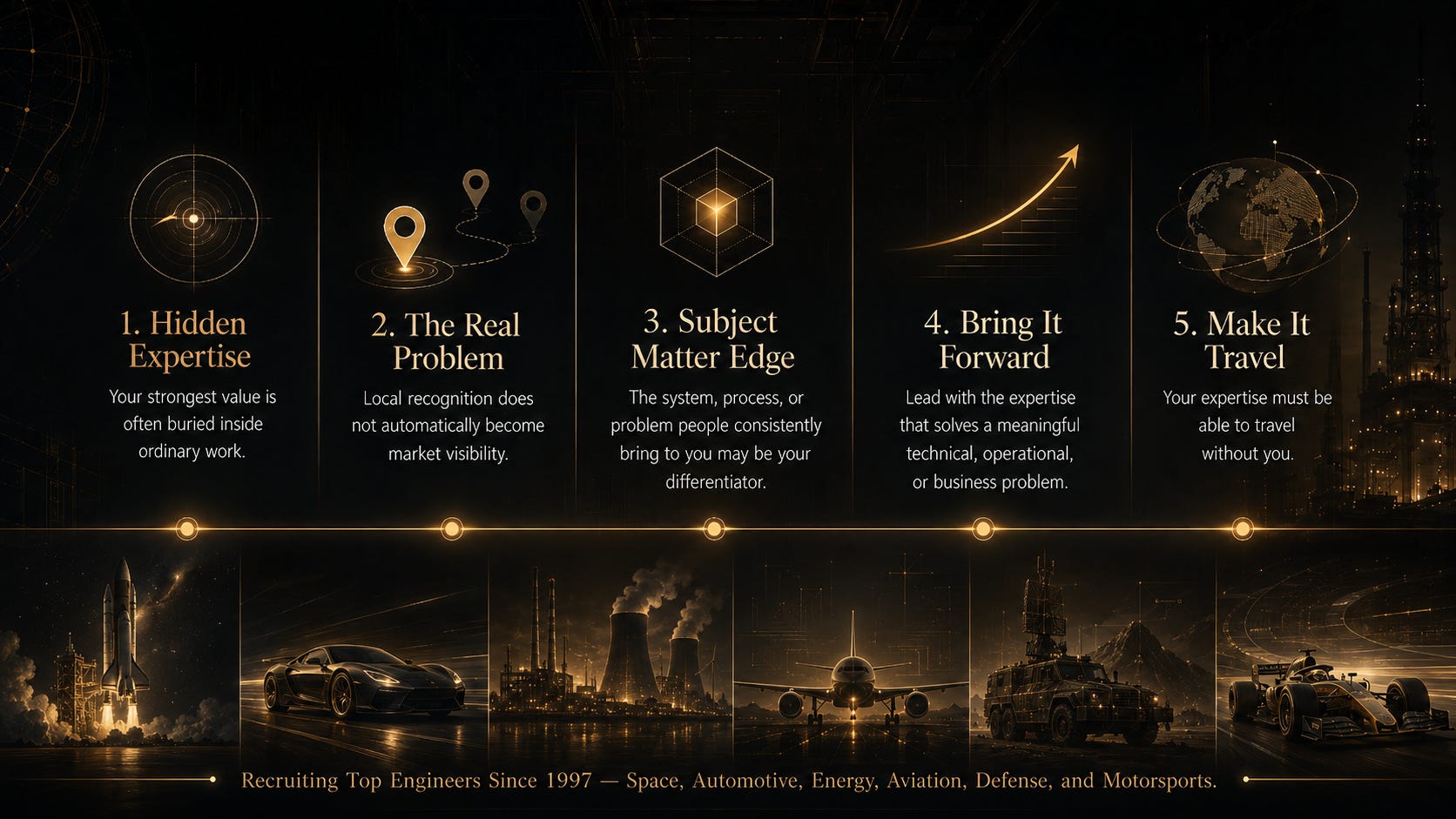
“professional recognition has a limited range”
Inside Halliburton, my reputation traveled through direct experience. People had worked beside me, watched me solve problems, or heard about my work from someone they trusted. They understood what I knew because they had enough proximity to see it.
Outside that environment, none of that context existed.
When I described my background, I usually led with the broad story. I talked about field operations, technical work, equipment, leadership, and the responsibilities I had carried. Everything I said was accurate, but the strongest and most distinctive part of my experience remained buried inside the larger account.
I knew Siemens S7 PLC architecture exceptionally well, yet I did not bring that expertise to the front of the conversation.
I had assumed that good work would explain itself. Inside the company, it often did. Outside the company, it could not. The market did not see the years of accumulated judgment behind the job title. It did not see the problems I could recognize quickly or the systems I understood at a deeper level. It saw only the information I chose to present.
That experience has shaped how I think about engineering careers today.
Many engineers have already developed subject matter expertise, but they do not recognize it because the knowledge has become ordinary to them. They have worked with a technology, process, system, or class of problem for so long that they no longer remember what it felt like not to understand it. What once required intense concentration now feels routine.
Familiarity can conceal professional value.
An engineer may be the person everyone calls when a certain machine begins producing inconsistent results. Another may understand a legacy software architecture well enough to modernize it without disrupting the operation. Someone else may recognize the early signs of a reliability problem before the data becomes obvious to the rest of the team.
Inside the organization, these abilities may be widely known. Outside it, they often disappear behind titles such as mechanical engineer, controls engineer, manufacturing engineer, or software engineer.
Employers do not simply hire categories of engineers. They hire people who can solve particular problems under particular conditions. The engineer who can make that value clear has an advantage over the engineer who leaves the reader to infer it.
This does not mean inventing a personal brand or exaggerating the depth of your knowledge. It means examining your own work and asking where your capability has become unusually strong.
What problems repeatedly find their way to you? What systems do you understand better than the people around you? Where does your judgment prevent wasted time, unnecessary risk, or expensive mistakes? What can you now see quickly that once took years to learn?
The answers may reveal that you are already functioning as a subject matter expert.
The next step is to change the way you introduce yourself.
At Halliburton, I could have brought my knowledge of Siemens S7 PLC architecture forward much earlier. That expertise would not have replaced the rest of my experience. It would have given the broader story a sharper point of entry.
Someone could understand immediately where I was strongest, and then discover the larger range of my background from there.
That is how professional positioning should work. It should not attempt to tell everything at once. It should make the most valuable and relevant part of the story visible first.
Engineers often resist this because they do not want to appear self-promotional. That concern is understandable, but accurate communication is not arrogance. There is nothing excessive about explaining clearly what you know, what you have done, and where your experience creates value.
The alternative is to remain dependent on proximity.
People must work with you before they understand you. They must watch you perform before they appreciate your ability. They must somehow discover, through time and accident, what could have been communicated directly at the beginning.
That approach may work inside a familiar organization. It performs poorly in the larger market, where decisions are often made from a resume, a profile, a brief introduction, or a short conversation.
Your expertise must be able to travel without you.
A strong professional narrative allows it to do that. It carries the clearest expression of your value into places where your reputation has not yet arrived.
Looking back, I did not need more expertise before I could distinguish myself. I needed to understand the expertise I already had and place it at the center of the conversation.
Many engineers are in the same position now. They are waiting for another promotion, another credential, or another project to make them more valuable. In reality, they may already possess a body of knowledge that could change the direction of their career.
The work is to recognize it, define it, and explain why it matters. You may not need to reinvent your career. You may simply need to stop burying the strongest part of it.
Actions and Outcomes
Action: Identify the technical problem, system, process, or decision that people consistently bring to you.
Outcome: You begin to see the expertise that has been hiding inside your ordinary work.
Action: Ask colleagues, former managers, and trusted peers what they believe you understand better than most engineers around you.
Outcome: You gain an outside view of strengths that familiarity may have caused you to undervalue.
Action: Separate your job title from your actual area of expertise.
Outcome: You stop describing yourself only by professional category and begin defining the specific value you create.
Action: Write one sentence that connects your expertise to a business, operational, technical, or safety outcome.
Outcome: Your knowledge becomes easier for employers, recruiters, and decision-makers to evaluate.
Action: Move your strongest differentiator to the front of your resume, LinkedIn profile, professional introduction, and interview narrative.
Outcome: The market encounters your most valuable capability before it gets lost inside a broader career history.
Action: Replace general skill claims with evidence from real projects, decisions, failures prevented, systems improved, or problems solved.
Outcome: Your expertise becomes credible because it is supported by observable results rather than self-description.
Action: Create visible proof of your expertise through technical writing, case studies, presentations, diagrams, mentoring, or public analysis.
Outcome: Your reputation begins to travel beyond the people who have worked directly with you.
Action: Test your career narrative on people outside your immediate field or organization and ask what they believe you are known for.
Outcome: You learn whether your message is clear enough to survive without insider knowledge or workplace proximity.
Action: Revisit your positioning as your experience deepens and your strongest contribution changes.
Outcome: Your professional narrative continues to reflect your current value instead of trapping you inside an outdated version of your career.
Action: Stop waiting for a title, promotion, or employer to formally name your expertise.
Outcome: You take responsibility for making your value visible before the market discovers it by accident.
Take the Next Step
You may already possess the expertise that could distinguish your career. The harder question is whether you have identified it clearly, positioned it, and built the evidence required for the market to recognize it.
Top Engineer Advisory is designed for serious engineers who want to manage that work deliberately. We help you clarify your next move, define your immediate and unique value, strengthen your resume and LinkedIn presence, identify the right employers, and prepare for the conversations ahead.
We do not manufacture expertise, and we do not promise to get you a job. You still win the opportunity through talent, character, preparation, and performance. Our role is to help ensure that the right people can see the right signal when the opportunity appears.
Your strongest capability should not remain known only to the people who already work beside you.
Engage Top Engineer for advisory services and begin bringing your real value to the front of the conversation. This will enhance not only your career satisfaction, but improve your opportunity to maximize your lifetime earnings.
https://topengineerglobal.com/engineer.html
Have a blessed day!

James Beine
#TopEngineer #EngineeringCareers #SubjectMatterExpert #ProfessionalPositioning #EngineeringLeadership #CareerStrategy #TechnicalExpertise #EngineeringGrowth #CareerVisibility
