


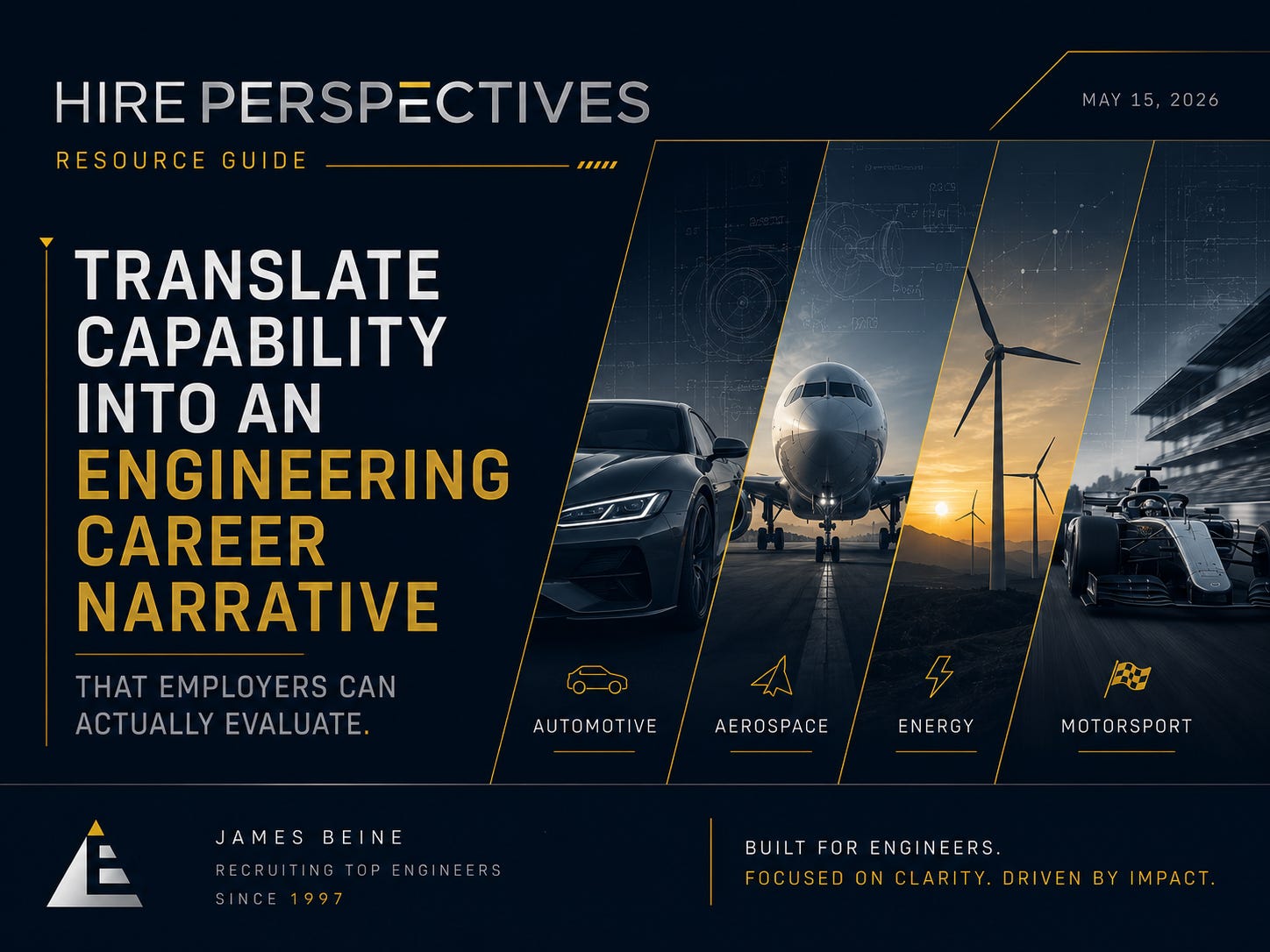
James Beine
Recruiting Top Engineers Since 1997
May 15, 2026
Introduction
Engineering hiring fails at two points simultaneously. Employers work to evaluate engineers while operating under time pressure, performance risk, and incomplete information. Engineers work to articulate their immediate and unique value proposition in a way that maps clearly to real business needs. Both usually fail to do this well.
Most engineers understand their own capability and how it relates to the systems they work within. And yet they fail to articulate that capability as an immediate and unique value proposition that decision makers can quickly evaluate in a competitive environment. Employers, meanwhile, cannot afford ambiguity. They must make high consequence decisions based on the information given to them by the engineer.
Engineers who learn to translate their capability into an engineering career narrative that employers can actually evaluate significantly improve their probability of being understood and selected. Top Engineer operates in this translation layer, helping engineers convert technical capability into a complete, immediate, and unique value proposition.
Employers are not buying potential in the abstract. They are selecting a person to carry immediate responsibility inside a system where errors propagate, tradeoffs matter, and outcomes affect cost, safety, schedule, performance, reliability, and growth. In automotive that may mean launch execution, manufacturing readiness, quality, or product performance. In aerospace it may mean mission assurance, systems integrity, certification discipline, or reliability under extreme operating conditions. In energy it may mean uptime, safety, efficiency, asset longevity, and operational continuity. In motorsport it may mean race performance, repeatability, and rapid decision making under public scrutiny. Even when an employer wants to bet on growth, it still needs evidence that the engineer can contribute without creating hidden failure modes.
The central problem is not an engineer’s capability in most cases. Typically, evaluation happens through both perception and correlation through technical examination. Perception is shaped by whatever signal the engineer provides. Technical examination only provides part of the picture. In fact, we have seen engineers perform only modestly in technical evaluation and still win the role. The Top Engineer gains an advantage not rooted in hype, but rooted in clarity.
The Engineering Career Narrative
An engineering career narrative is not a motivational story. It is not a biography. It is not a chronological account of everything a person has done. It is not a list of credentials. Nor is it merely a list of technical accomplishments. It is a structured argument that answers an employer’s real questions in the fewest, clearest steps possible. Anyone who has ever spoken to me has heard me say that engineers do not get hired based on passion alone or how fast they might learn a new concept. Literally every engineering role on the planet has a business case attached to it. So when your unique value proposition satisfies the business case of the employer, you become easier to evaluate as the right person for the job.
The most important questions are usually simple, even when the work is complex. Can this engineer reduce uncertainty. Can this engineer execute under constraint. Can this engineer integrate into our operating system without slowing it down. Can this engineer be trusted with meaningful variables inside the system. Does this engineer have staying power. Real stamina. Is the engineer holistically ready for this opportunity. Will this person help us achieve the business case attached to the role.
The process of building this narrative begins by accepting an uncomfortable truth. Most engineers communicate in a way that is optimized for completeness. Employers evaluate in a way that is optimized for risk reduction. Completeness increases cognitive load. Risk reduction requires fast pattern recognition. The problem with fast pattern recognition is that it is vulnerable to hallucination. Human beings make interpretation errors constantly, especially under pressure. These errors are often the errors that lead to the wrong hiring decision.
If you want to be evaluated accurately, you must make evaluation easy.
This is not about dumbing anything down. It is about compressing complexity into a form that retains technical truth while becoming readable to a decision maker operating under time pressure. The goal is legibility.
An employer needs to look at your profile, experience, credentials, and core skills to quickly understand what you bring to the table on day one. This is why we say immediate in the phrase immediate and unique value proposition. When your messaging forces the employer to guess, guessing becomes perceived risk. Perceived risk disqualifies you. This is why I say so often that many candidates self disqualify long before the final decision point. Sometimes they never even reach the interview because the resume itself disqualifies them.
Your messaging needs to provide evidence that maps cleanly to the role’s real constraints. I teach signal to noise ratio thinking here. Most engineers understand signal and noise well. The signal is your message. Noise is everything that feels impressive but does not help an employer decide. No hype. No fluff. No uncertain statements. No declarative statements that are not factual.
The first principle of translation is audience reality.
We are not communicating to an abstract market. We are communicating to specific technical leadership, engineering managers, hiring managers, program leaders, systems owners, operations leaders, and business stakeholders who own real outcomes. Each person evaluates through a different lens, but the shared requirement is the same. They must decide whether you can contribute positively to the system they are accountable for.
This is why generic engineering language fails across industries. Generic language does not map cleanly to a production line, a flight critical system, an energy asset, or a race operation. If your resume reads like everyone else’s resume, it requires too much cognitive effort to interpret. Resume speak is infected with rules that came out of human resources orthodoxy, not real engineering evaluation. Real experience tells us the actual hiring leader is not concerned with fashionable resume language. They are concerned with the immediate and unique value proposition of the candidate.
The second principle of translation is constraint mapping.
A resume often contains references to previous projects, roles, and responsibilities. But employers care about the constraints under which you operated. The same technical achievement can be either relevant or irrelevant depending on the forces that shaped it.
An engineering career narrative becomes evaluable when it makes constraints explicit.
What matters here is that these constraints are not framed as preferences. They are operational forces such as time, reliability, safety, performance, limited data, budget pressure, changing requirements, certification demands, manufacturing realities, test limitations, stakeholder coordination, and the need to operate within systems larger than yourself. When you show that you have operated within these forces, you become easier to evaluate.
The third principle of translation is ownership clarity.
This is one of the key ideas we teach at Top Engineer. It has always been a mystery to me why so much resume guidance tells people not to use pronouns while asking them to communicate their value. The document is supposed to be about the person. Many engineers describe what they contributed in incomplete summaries, vague fragments, or team level abstractions. Employers need to know what you owned, not merely what the company you worked for does. Ownership indicates where you made decisions. Decisions reveal judgment. Judgment is one of the few traits employers cannot train quickly.
Ownership is not title. Ownership is responsibility for a bounded system, a deliverable, or a measurable outcome. We teach actions and outcomes. So when communicating your immediate and unique value proposition, you should communicate what actions you specifically took and the outcomes resulting from your decisions.
When engineers fail to communicate ownership, employers assume the engineer worked inside someone else’s decision frame. That may still be valuable, but it is harder to place, harder to trust, and harder to evaluate.
The fourth principle of translation is outcome defensibility.
Employers do not need inflated numbers. They need defensible signals grounded in qualitative and quantitative metrics. A modest improvement that is clearly explained is worth more than a dramatic claim that cannot be interrogated.
Outcomes that become evaluable are usually framed in terms of measurable performance, measurable reliability, measurable efficiency, measurable cycle time, measurable stability, measurable quality, measurable safety improvement, or measurable reduction of risk.
If the outcome cannot be measured directly, it can still be evaluated if it is anchored in a clear before and after. Before, the system behaved this way. After, the system behaved that way. The engineer’s decision produced the change. The mechanism makes sense.
The mechanism is critical. Technical leadership tends to distrust claims that do not include a reason why the result occurred.
The fifth principle of translation is tradeoff literacy.
Engineering is a continuous trade space. Weight, stiffness, thermal margin, energy use, aerodynamic efficiency, manufacturability, maintainability, cost, schedule, serviceability, quality, reliability, packaging, safety, and performance are constantly in tension. Engineers are evaluated by how they choose, not only by what they build.
If your narrative does not show tradeoffs, it reads like execution without judgment. Employers may still hire for execution roles, but the highest leverage roles demand tradeoff competence.
Tradeoff literacy can be communicated without grand statements. It can be shown through one example. You had two options. Each had costs. You chose one because it optimized the variable that mattered under the constraint you were operating inside. You tracked the effect. You adapted. Top Engineers use higher order thinking to determine how actions create outcomes without creating unacceptable damage elsewhere in the system. Today’s solution can become tomorrow’s failure mode.
The sixth principle of translation is proximity.
Employers often prefer evidence that is close to their world. Close can mean the same domain, but it can also mean the same constraint patterns.
An engineer coming from aerospace controls, defense systems, embedded systems, energy infrastructure, advanced manufacturing, robotics, high performance automotive, or test environments may be highly relevant if the constraints match. An engineer coming from a role with long cycles, low urgency, weak accountability, and soft consequences may still be competent, but the employer will struggle to predict performance in a more demanding environment.
Translation does not require you to pretend your background is something it is not. It requires you to show which parts of your background behave like the environment you are trying to enter.
This is how an engineering career narrative avoids exaggeration while still becoming compelling.
The seventh principle of translation is ordering.
If your strongest evidence is buried under weaker content, you reduce your own probability. Ordering is strategic. This is why we teach that you should lead with your immediate and unique value proposition and close with the same. The sequence should move from the most relevant signal to supporting context. It should begin with what makes evaluation easier and only then expand into details. This is not manipulation. It is respect for decision making constraints.
One practical way to order experiences is the value given and value received lens. For every experience you include, you are implicitly answering two questions. What value did you receive that made you more capable. What value did you give that made the system better. University often reads primarily as value received. A project, competition, or cross functional initiative can read as both. Employment should read primarily as value given. Internships often include both, and that is acceptable when made explicit.
This lens prevents two common problems. The first is presenting learning as contribution. The second is presenting contribution without showing what was actually delivered. When each experience is framed as value received, value given, or both, employers can evaluate progression and usefulness without guessing. Many engineers default to chronology and responsibilities. Chronology describes activity, but it does not automatically communicate relevance. Ordering through value given and value received helps the employer see capability development and contribution in a sequence that supports evaluation.
The eighth principle of translation is compression.
Compression is the discipline of expressing complex capability in a form that remains technically accurate while becoming easy to evaluate. It is not the removal of substance. It is the removal of excess. Engineers often default to accumulation. They add detail, context, and explanation in the belief that more information will produce more understanding. In practice, excess information obscures signal. When everything is emphasized, nothing is clear.
Effective compression preserves what matters and removes what does not. It forces prioritization. It asks a simple question of every statement, project, and claim. Does this help an employer evaluate my immediate and unique value proposition.
Compression also reveals maturity. When an engineer can describe a system, decision, or outcome with precision and economy, it signals technical understanding rather than superficial familiarity. When explanation requires excessive language, employers often infer uncertainty, not depth.
Across engineering contexts, compression allows employers to see capability without decoding it. Systems, constraints, decisions, and outcomes become visible without unnecessary narrative. The engineer does not disappear behind detail. The value becomes legible.
Compression is not about saying less. It is about saying only what matters.
The ninth principle of translation is language discipline.
Language is not decoration. It is signal. In engineering contexts, the words an engineer chooses shape how capability is interpreted. Many engineers adopt generic professional language that sounds impressive but communicates little. Terms such as world class, cutting edge, innovative, and similar expressions are difficult to evaluate because they are not anchored in systems, constraints, or outcomes. They describe aspiration rather than evidence.
Language that supports evaluation is concrete without being verbose. It describes what was built, what constraints existed, what decisions were made, and what changed as a result. It avoids exaggeration and avoids ambiguity.
Language discipline also means minimizing cognitive load. Every unnecessary word, abstraction, or layered sentence increases the effort required to understand what is being communicated. Employers do not evaluate engineers in ideal conditions. They evaluate under time pressure, competing priorities, and incomplete attention. When language is simple, precise, and intentional, capability becomes easier to recognize and harder to misinterpret.
This is where intentional audience level matters. Writing at an accessible level is not a concession to intelligence. It is a strategic choice. Engineers who communicate at an appropriate audience level reduce friction between signal and understanding. Clarity improves comprehension. Comprehension improves retention. Retention improves evaluation.
The objective is not to sound sophisticated. It is to be understood with minimal effort while preserving technical accuracy. When language is disciplined in this way, employers spend less energy decoding phrasing and more energy assessing fit. The engineer’s value becomes visible not through adjectives, but through structure and clarity.
The tenth principle of translation is consistency.
Employers rarely evaluate engineers based on isolated moments. They look for patterns that suggest how an engineer is likely to operate under recurring pressure. Consistency is not repetition of the same task. It is repetition of a way of thinking and acting. When an engineer consistently demonstrates ownership, operates within constraints, articulates outcomes, and explains tradeoffs, employers begin to see a stable operating model rather than a collection of unrelated experiences.
A single strong project can matter. Repeated evidence of judgment, accountability, and technical clarity matters more. Consistency reduces uncertainty because it allows employers to extrapolate future performance from past behavior.
Consistency also strengthens narrative coherence. When the same core themes appear across different environments, experiences stop looking accidental and start looking intentional. Capability is no longer inferred from isolated achievements, but observed across contexts. When consistency is visible, evaluation becomes simpler. Employers do not need to speculate about how an engineer might behave. They can observe how the engineer has already behaved across multiple systems and conditions.
From Principles to Practice
These principles only matter if they change how your capability is perceived. Translation is not an abstract exercise in self expression. It is a disciplined process of making technical value legible to people who must decide under constraint. When an engineer learns to ask the right questions about their own work, experience stops being a collection of activities and begins to function as evaluable signal. The purpose of this section is not reflection. It is alignment. Ask yourself the following questions and see how well you are aligned.
The first question an engineer must confront is whether their communication reflects the reality of the audience evaluating it. It is not enough to know what you did. You must understand how your work appears through the lens of technical leadership, engineering managers, systems owners, hiring authorities, and business operators who are responsible for outcomes rather than effort. When an engineer frames contribution in terms that map to the mental models of decision makers, capability becomes easier to place within a team’s operating logic. Alignment emerges not from simplification, but from relevance.
A second question follows naturally. Under what constraints did this work actually occur. Technical achievements do not exist in isolation. They are shaped by time pressure, safety requirements, reliability expectations, limited data, budget limits, integration complexity, compliance realities, production constraints, and organizational dependencies. When an engineer makes these constraints visible, the work becomes interpretable rather than abstract. A result that appears ordinary in one context can become significant in another. Constraint mapping turns experience into comparable evidence.
The next question is more personal and often more difficult. What did I actually own. Many engineers describe projects as collective achievements, but employers evaluate individuals. Ownership is not ego. It is clarity about responsibility, decision authority, and the boundaries of influence. When an engineer can explain what they personally decided, changed, or delivered, the narrative shifts from participation to accountability. Accountability is one of the few signals employers consistently look for.
From ownership, attention moves to outcomes. An engineer must ask whether their results can be defended rather than merely stated. Outcomes do not need to be dramatic to be credible. They need to be explainable. When an engineer can describe what changed, why it changed, and how decisions produced that change, contribution becomes intelligible to technical evaluators. Defensible outcomes transform claims into evidence.
Another question arises at the level of judgment. What tradeoffs did I face, and how did I navigate them. Engineering is rarely about perfect solutions. It is about choosing between competing variables under imperfect conditions. When an engineer articulates the trade space they operated within, the work begins to reveal not only competence, but reasoning. Reasoning is what allows employers to predict future performance, not just past success.
At this point, a deeper form of alignment becomes possible. An engineer must ask how close their experience is to the environment they are attempting to enter. Proximity does not require identical domains. It requires recognizable patterns of constraint, urgency, accountability, and system interaction. When an engineer can show which aspects of their background behave like automotive, aerospace, energy, or motorsport environments, relevance becomes visible without exaggeration. Translation here is not about pretending. It is about mapping.
If relevance exists, the next question concerns ordering. If your strongest evidence is buried beneath secondary detail, you reduce your own probability of being understood. Ordering is not cosmetic. It is strategic. When an engineer leads with the immediate and unique value proposition and then expands into context, they respect the way decisions are actually made. Alignment occurs when the most important signal appears before supporting detail, not after it.
Capability does not fail in silence. It fails when it is presented in a form that cannot be evaluated.
Compression follows naturally from ordering. An engineer must ask whether communication preserves technical truth while minimizing unnecessary detail. Compression is not reduction of meaning. It is refinement of signal. When complexity is expressed with precision rather than volume, it becomes easier to grasp, easier to retain, and easier to trust. This is also where intentional language discipline matters. Writing that reduces cognitive load, calibrated to an appropriate audience level, does not diminish sophistication. It increases impact.
Language itself becomes a test. An engineer must ask whether the words describe systems, decisions, constraints, and outcomes, or drift into abstract claims that cannot be interrogated. Language that creates alignment is concrete without being cluttered. It makes evaluation possible without demanding excessive interpretation. In this sense, writing becomes an engineering problem of its own. Optimizing clarity under constraint.
Finally, an engineer must ask whether the narrative reveals a pattern rather than a single moment. Consistency is not repetition. It is coherence across experiences. When an engineer repeatedly demonstrates ownership, constraint navigation, measurable outcomes, and tradeoff awareness across different contexts, the profile begins to resemble an operating model rather than a resume. At that point, the narrative stops being descriptive and becomes predictive.
When these elements are present but scattered, the challenge is structural. When they are absent, the challenge is evidential. Translation does not create capability. It exposes it. This is why clarity is not merely a communication skill. It is a strategic advantage.
The application of these principles is not about performance or persuasion. It is about making capability visible in a form that employers can actually evaluate. When an engineer achieves that, ambiguity is reduced for decision makers and agency increases for the engineer. The narrative becomes not a story about effort, but a system of signals about value.
Your Engineering Career Narrative
From this point forward, the problem is no longer technical capability. It is translation. Engineering value does not fail because it is insufficient. It fails because it is not legible. Employers must evaluate under pressure. Engineers must articulate under constraint. Between those two realities, misunderstanding becomes the default outcome unless someone deliberately bridges the gap.
That bridge is not built by chance. It is built through disciplined thinking, structured communication, and a clear understanding of how technical capability becomes evaluable signal.
Top Engineer is not simply a recruiting firm. It is an engineering talent acquisition agency and a translation system. It exists to convert real capability into a form that technical leaders can accurately interpret, trust, and act upon. The work is not persuasion. The work is clarity.
Top Engineer is a global engineering talent acquisition agency that has served the engineering community since 1997. The agency is niche by design and works exclusively with Top Engineers and Top Engineering organizations. All placements originate from confidential assignments with top employers. Role details are not disclosed until an engineer has been evaluated and a decision has been made to submit them for consideration. That decision follows a structured process in which the engineer is vetted, endorsed, and represented as a fit for the role.
Top Engineer does not represent everyone. Representation begins with a simple internal question. Would we hire this engineer to work inside our own organization. If the answer is no, representation does not proceed. The second question is equally decisive. Is this a perfect fit in both directions. The engineer must meet the non-negotiables of the employer, and the employer must meet the non-negotiables of the engineer. Without this alignment, it does not work.
Beyond traditional recruiting, Top Engineer also operates an engineering career management model. In this model, engineers retain the agency not only for access to opportunities, but for structured guidance in how their capability is understood by the market. The work includes defining technical direction, clarifying value propositions, shaping professional narratives, and building evaluable evidence over time. The objective is not to help engineers look impressive. The objective is to help engineers become legible.
Employers do not select engineers based on potential alone. Again, selection is primarily determined by the immediate and unique value proposition of the candidate.
They select engineers based on perceived risk, operational fit, and the clarity of evidence presented to them. Engineers who learn to translate their capability into an evaluable narrative reduce ambiguity for employers.
Capability wins roles. Translation determines whether capability is recognized.
We help engineers articulate their immediate and unique value proposition with precision. This helps employers evaluate engineers with greater confidence and connects disciplined technical profiles to confidential opportunities with top employers.
When translation is done well, engineering hiring becomes less speculative and more structural. Engineers are evaluated for what they can actually contribute. Employers make decisions based on signal rather than assumption.
In environments where performance is unforgiving and decisions are costly, having a narrative that clearly communicates your immediate and unique value proposition becomes one of the most important factors for success.
There is one final dimension that matters and is often overlooked.
Top Engineer does not engage engineers only at moments of transition. The work continues while engineers are already performing inside their roles. Many of the engineers we represent are not actively searching for opportunities. They are already employed, already contributing, already operating at a high level. In this sense, they are passive candidates. Not disengaged. Not stagnant. Simply not focused on navigating the market while they focus on execution.
Elite performers in other domains do not stop having representation once they secure a contract. Top athletes do not release their agents once they are signed. Their agent continues to monitor the market, advise on timing, protect long term positioning, and identify opportunities that improve the trajectory of the career as a whole. Engineering operates under the same logic, even if it is rarely treated that way.
Top Engineer walks with engineers across the full arc of their careers. From students and graduates to early career engineers, senior engineers, Top Engineers, and even those approaching or operating in retirement. The relationship is not episodic. It is longitudinal.
The narrative described in this document is not static. It is a living structure that evolves with experience, decisions, and outcomes. It exists in three places simultaneously. It exists in how your work is documented and structured across your professional record. It exists in your ability to articulate your immediate and unique value proposition under pressure. It exists in your mindset, discipline, and orientation toward your work and your life.
When these three dimensions align, capability becomes durable, visible, and transferable across contexts. Engineers are no longer evaluated only on past achievements, but on a coherent trajectory of judgment, contribution, and growth. Over time, this coherence directly influences opportunity access, role quality, negotiation leverage, stability, and ultimately lifetime earning potential.
This is the level at which Top Engineer operates. Not only to secure opportunities, but to shape long term positioning, provide external strategic counsel, and protect the trajectory of an engineering career across decades.
When your technical capability is real but your engineering career narrative is not yet evaluable, opportunity will remain inconsistent regardless of effort.
Top Engineer exists to build, refine, and represent that engineering career narrative.
We do not represent everyone. Representation is selective by design. The first conversation is not about vacancies or placements. It is about whether your current narrative accurately reflects your capability and whether it can withstand the level of scrutiny required in elite engineering environments.
Each Top Engineer Success Plan provides structured access to a tiered set of strategic career services designed to translate technical capability into an evaluable engineering career narrative and sustained market positioning. Depending on the level of engagement, this may include career blueprinting, narrative and portfolio reconstruction, formal endorsement, and direct market representation. The objective is not transactional placement, but disciplined career management. Aligning technical strengths with real market demand, clarifying immediate and unique value, and making sure the engineer is positioned, represented, and advocated for at the right moments across the full career trajectory. Rather than offering a generic coaching program or resume service, the Success Plans function as an ongoing agency relationship that manages both present opportunities and long term career leverage.
Depending on the plan, services may include strategic career mapping, technical narrative development, resume and LinkedIn reconstruction, project and portfolio articulation, formal written endorsement, targeted employer positioning, confidential opportunity access, direct advocacy with hiring decision makers, interview and technical evaluation preparation, long term career strategy, and ongoing representation as an engineering agent.
To learn more about our Success Plans, visit topengineer.us/engineers.
I sincerely hope that this resource guide helps you improve your engineering career narrative.
Very respectfully,
James Beine
Principal Recruiter, Founder
Top Engineer
About the Author
James Beine is the founder of Top Engineer, a global engineering talent acquisition agency focused on representing exceptional engineering talent across automotive, aerospace, energy, and motorsport. His philosophy is that recruiting should not be transactional but relational, rooted in deep understanding, long term strategy, and disciplined evaluation of capability. James specializes in translating technical excellence into clear market signal, helping engineers articulate their immediate and unique value proposition while connecting them to confidential opportunities with top employers worldwide.
#TopEngineer #EngineeringCareers #EngineeringNarrative #EngineeringTalent #EngineeringTalentAcquisition #TechnicalRecruitment #CareerManagement #CareerStrategy #AutomotiveEngineering #AerospaceEngineering #EnergyEngineering #MotorsportEngineering #SystemsEngineering #ControlsEngineering #MechanicalEngineering #ElectricalEngineering #ManufacturingEngineering #DesignEngineering #ReliabilityEngineering #ProjectEngineering #EngineeringLeadership #TechnicalTalent #EngineeringJobs #EngineeringRecruiter #CareerPositioning
