


When I worked for Halliburton in Saudi Arabia, I reported directly to the country manager. His name was Kyle.
That sentence by itself probably sounds cleaner than the experience actually was. In the field, nothing stays clean for long. Tools wear out. Equipment fails. Parts disappear into sand, heat, pressure, vibration, and the unforgiving rhythm of real work in a hostile environment. You do not learn about a person, a crew, a tool, or a process by looking at it on paper. You learn as the job is moving, the customer is waiting, the weather is wrong, the equipment is tired, and something that was supposed to work no longer works.
I would go to Kyle when tools or equipment were no longer operational. At first, I expected the conversation to carry a certain tone. Maybe frustration. Maybe suspicion. Maybe the kind of management response that makes a person feel like they needed to own and be personally accountable for natural failure. I often felt real pressure. At least in my head. It’s more than just the fact that there was a broken tool, or resource. We often spoke about capital budgets. So I knew there was more at stake than just the logistics of getting replacements.
Kyle did something different.
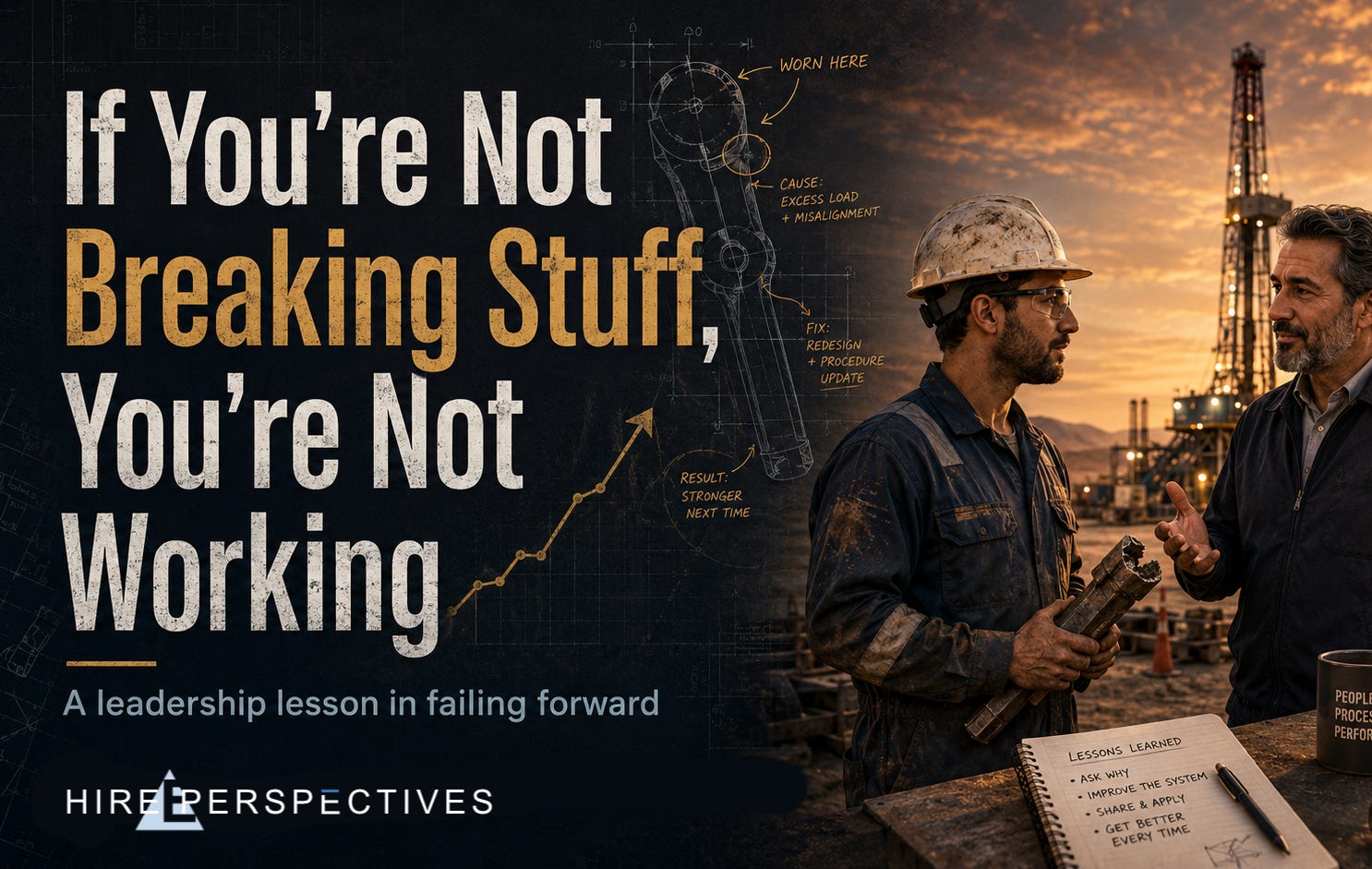
He would look at the situation and say, “If you’re not breaking stuff, you’re not working.”
I would usually answer, “Well, that’s perfect. I’m very good at breaking things.”
At the time, I understood the humor before I understood the leadership. I heard the sentence as a practical field remark. Tools break. Equipment wears out. Work has a cost. Nothing mysterious there. But over time, I realized Kyle was doing something more important than approving the replacement of a wrench, a sensor, a cable, a pump part, or some other piece of equipment that had reached the end of its usefulness.
He was teaching a mindset.
He was telling the people under his leadership that activity leaves evidence. Real work creates friction. Real work exposes weakness. Real work puts pressure on assumptions, systems, tools, judgment, and people. When something breaks in the course of honest effort, it is not always a sign that someone failed. Sometimes it is the first clean piece of evidence that the operation is doing real work.
There is a childish version of “failing forward” that treats failure like a slogan. It makes people reckless. It excuses laziness. It turns poor preparation into a motivational quote. That is not leadership. That is immaturity dressed up as innovation.
Kyle’s statement was not a license to be careless. He was not saying, “Destroy things and call it progress.” He was not saying, “Ignore procedure.” He was not saying, “Mistakes do not matter.”
He was saying that competent people doing meaningful work will eventually encounter failure because reality does not care about our plans, our confidence, or our comfort. Failure is often the point where growth begins.
This is one of the great differences between performative work and real work. Performative work tries to preserve the appearance of competence. Real work produces evidence. Performative work hides weakness until it becomes expensive. Real work exposes weakness early enough to learn from it. Performative work asks, “How do we avoid looking bad?” Real work asks, “What did the situation just teach us?”
A broken tool can mean neglect. It can mean abuse. It can mean poor training. It can mean poor planning. It can mean the wrong tool was selected for the job. It can mean the process is flawed. It can mean the environment is more severe than the office understood. It can mean the crew is working harder than the support system can sustain. It can mean the job is advancing and the operation is finally discovering the true operating limits of the equipment.
A weak leader sees only the cost of replacement. A strong leader asks what the failure revealed.
That was the subtle power in Kyle’s approach. He did not turn every failure into a courtroom. He did not train people to hide problems from him. He did not create a culture where the crew became more skilled at managing perception than managing reality. He made room for progress, and growth.
People talk about innovation, resilience, and continuous improvement as though those ideas live in conference rooms, strategy decks, or carefully designed culture statements. They do not. They live in moments like this. A person walks into a leader’s office or trailer or field location and says, “This broke.” The leader’s response tells everyone what kind of culture actually exists.
Punish the wrong thing, and people learn to hide evidence. Respond with judgment, and people learn to protect themselves.
Respond with curiosity, accountability, and perspective, and people learn to improve.
Kyle’s statement carried all of that in one sentence.
“If you’re not breaking stuff, you’re not working.”
There is a whole philosophy of leadership inside that line. Failing forward is not celebrating failure. Failure is still expensive. Failure still matters. Failure still needs to be investigated. But the point is not to worship failure. The point is to extract the lesson before pride, fear, or bureaucracy wastes the evidence.
The best leaders know how to recognize both a failure of effort and a failure of character.
A failure of effort may happen when a person is working hard, learning fast, operating under pressure, and yet encountering the edge of their current knowledge. That person needs training, direction, correction, and sometimes better tools.
A failure of character is complex and it’s difficult to distinguish from a failure of effort. That is hiding mistakes. That is blaming others. That is refusing to learn. That is repeating the same avoidable error because the person would rather protect their ego than improve their judgment. It is also blaming the environment, which we could do easily in this situation. This is what people do most of the time.
Kyle’s leadership does not remove accountability. It aims accountability at the right target and promotes ownership when possible.
That is rare.
In technical environments, especially in engineering, energy, manufacturing, aerospace, automotive, motorsport, and field operations, there is a dangerous temptation to confuse control with competence. Leaders want clean reports. Teams want predictable outcomes. Professionals want to look capable. Nobody wants to be the person associated with the broken part, the failed design, the delayed test, the missed assumption, or the uncomfortable lesson.
Many environments are brutal. Systems improve only when reality is allowed to speak.
The field teaches this faster than most classrooms. The field does not care how smart you are. The field does not care how confident you are. The field does not care how good your plan is. The field applies pressure, and pressure reveals what is real.
That is why Kyle’s line stays with me. He is not lowering the standard. He is raising it.
A low standard says, “Do not break anything, because I do not want problems.”
A higher standard says, “Work hard enough, honestly enough, and close enough to reality that the weak points become visible. Then bring me the evidence so we can make the operation better.”
That is a completely different kind of leadership.
