


I remember sitting in an interview a long time ago when a technical question came up and I was not completely sure of the answer. Like many people, my first instinct was to keep digging for the answer, to see if I could reason my way through it in real time.
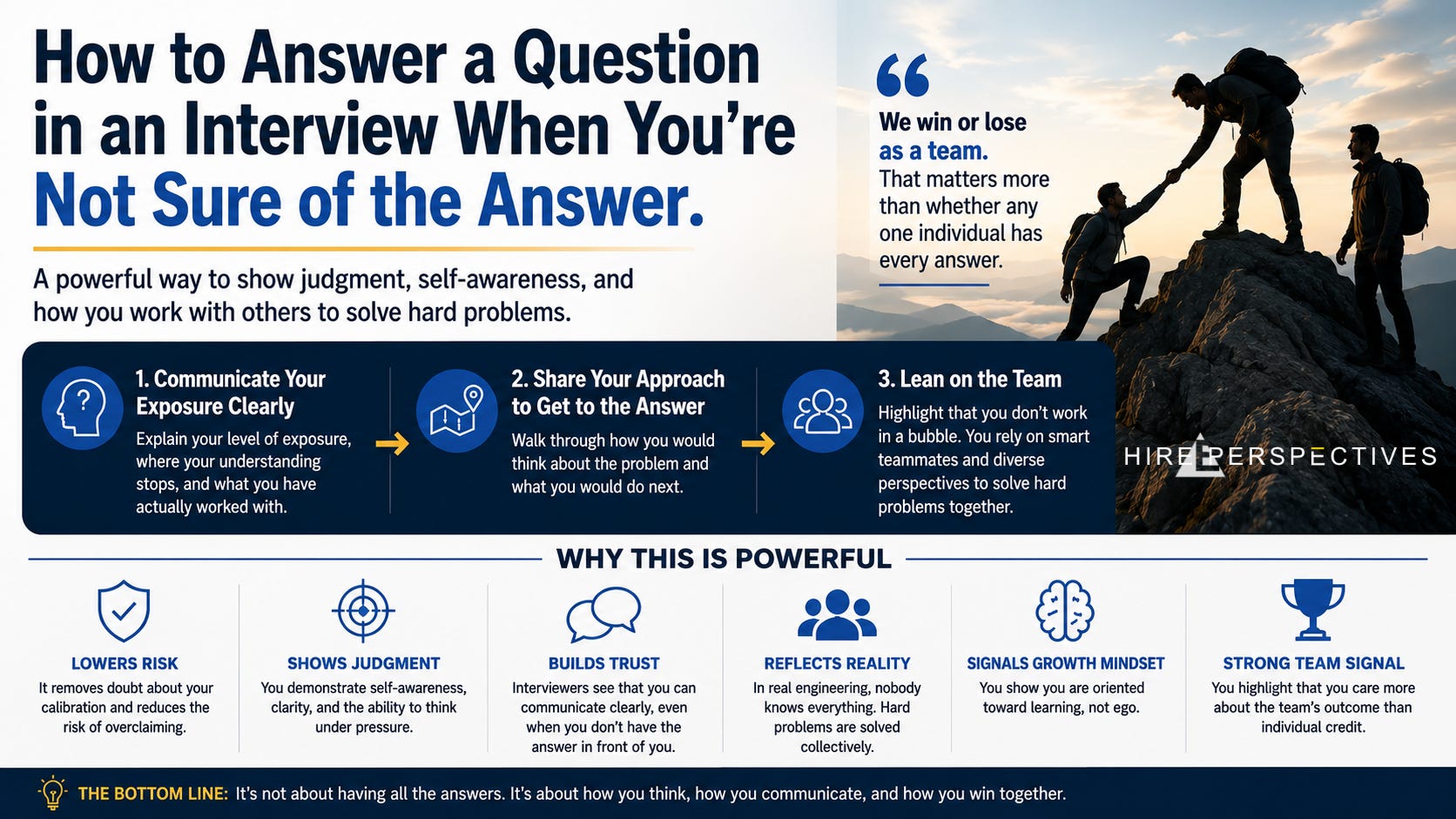
Then it occurred to me that the better move was to communicate clearly. I explained my level of exposure to the subject, where my understanding stopped, and how I would approach getting to the right answer.
I also shared something I genuinely believe about engineering. Engineering is a team sport.
One of the things I admire about great engineering organizations is that nobody is expected to know everything. The best teams are full of people with different experiences, different strengths, and different perspectives.
When someone gets stuck, they should not have to disappear into a corner and struggle in isolation. They should be able to rely on the team.
There is a difference between not knowing something and not being able to solve it.
Most meaningful engineering problems are solved collectively.
At the end of the day, we win or lose as a team. That matters more than whether any one individual has every answer.
Why this works
This is powerful because it lowers the risk in the conversation.
Most technical interviews are designed to challenge the engineer’s knowledge. It is a common misconception that hiring teams expect engineers to get every answer right. Some technical interviews are intentionally progressive. The questions become increasingly difficult so the team can understand where the candidate’s knowledge is strong, where it is developing, and where it stops.
In engineering, this matters because strength in one area does not automatically mean strength in every area. A candidate can be highly capable and still encounter a question outside their direct exposure.
When a candidate struggles to admit they do not have the answer, the interviewer now has to evaluate both the answer and the person’s calibration.
That creates doubt.
When a candidate can clearly describe what they know, where their exposure stops, and how they would use the team to get to the right answer, they demonstrate judgment.
That matters because engineering organizations are not only hiring technical ability. They are hiring calibration, self-awareness, communication under pressure, and the ability to operate inside a team.
A candidate who can say, “Here is what I know, here is what I do not know yet, and here is how I would close the gap,” is not giving a weak answer.
They are showing how they think when the answer is not immediately available.
In real engineering work, that moment happens all the time.
Have a blessed day!
James Beine
#TopEngineer #HirePerspectives #EngineeringCareers #EngineeringLeadership #EngineeringTeams #EngineeringCulture #CareerManagement
