


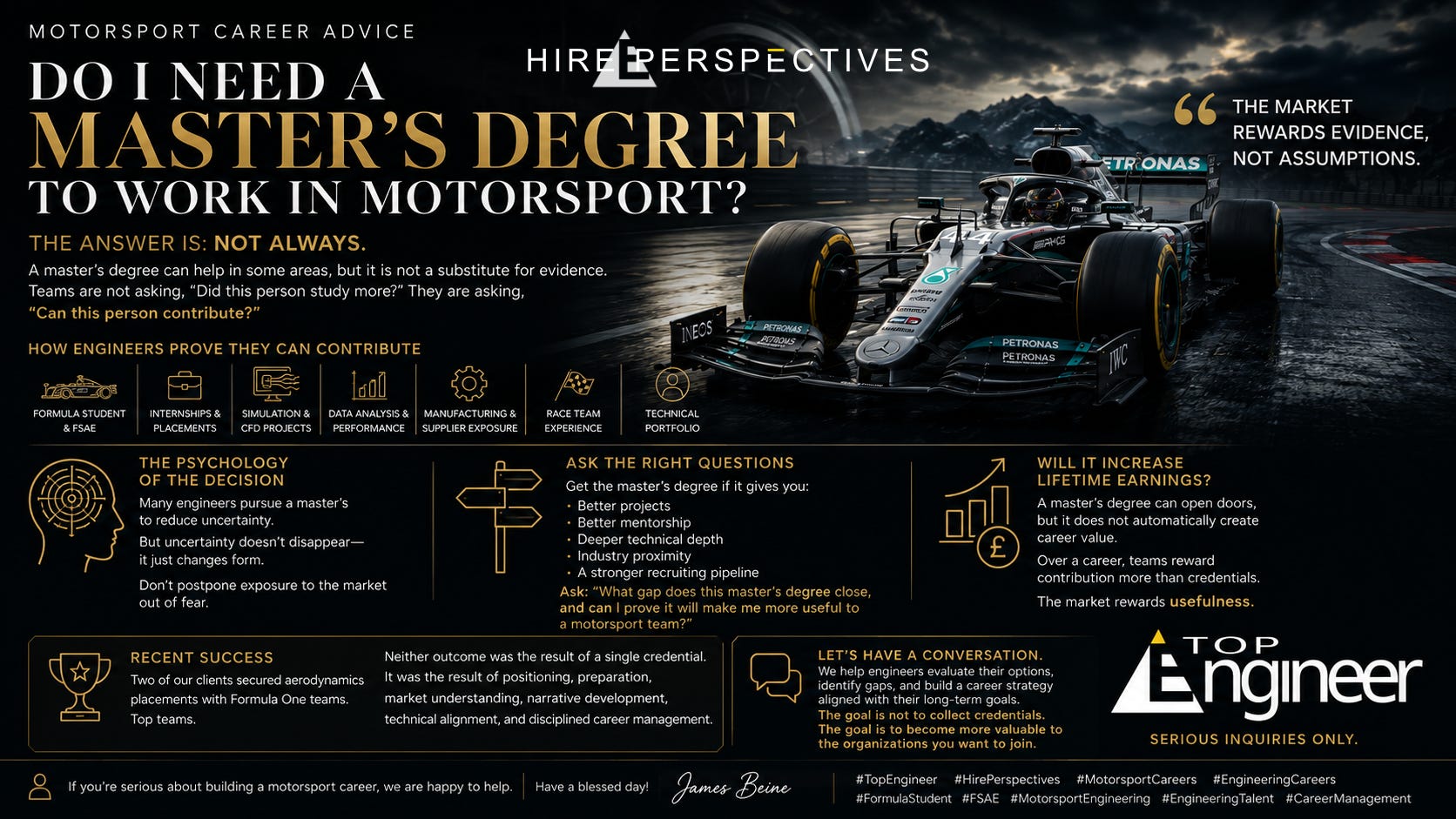
Do I need a master’s degree to work in motorsport?
The answer is: Not always.
A master’s degree can help. In some areas, especially aerodynamics, vehicle dynamics, simulation, controls, data science, and advanced performance engineering, it can give you deeper technical exposure and a stronger route into the industry.
But a master’s degree is not a substitute for evidence. Motorsport teams are not just asking, “Did this person study more?” They are asking, “Can this person contribute?”
That contribution might be proven through Formula Student, FSAE, internships, placements, simulation work, CFD projects, data analysis, manufacturing exposure, supplier experience, race team experience, or a focused technical portfolio.
The psychology behind the decision matters.
A lot of engineers consider a master’s degree because they are trying to reduce uncertainty. That is understandable. Motorsport is competitive, and the path can feel unclear.
But there is a difference between making a strategic investment and postponing exposure to the market.
Get the master’s degree if it gives you access to better projects, better mentorship, better technical depth, better industry proximity, or a stronger recruiting pipeline.
Do not get the master’s degree just because you are afraid your current profile is not enough.
Ask: “What gap does this master’s degree close, and can I prove that it will make me more useful to a motorsport team?”
That question will simplify the decision quickly.
There is another question hiding behind the master’s degree question:
Ask: Will it increase my lifetime earnings?
The answer is probably not in the way most engineers think.
A master’s degree can absolutely help you enter motorsport. It can strengthen your technical foundation, expand your network, improve access to internships and graduate programs, and position you for highly specialized disciplines such as aerodynamics, simulation, controls, vehicle dynamics, and performance engineering.
What it does not do is automatically create career value.
Over the course of a career, motorsport teams tend to reward contribution more than credentials. The engineer who consistently solves difficult problems, improves performance, reduces risk, and earns increasing responsibility will usually outperform the engineer who simply accumulated more education.
Again this is where the psychology becomes important.
Again most graduate engineers pursue additional education because they believe it will eliminate uncertainty. They hope one more qualification will finally make them competitive enough, prepared enough, or worthy enough.
Unfortunately, uncertainty does not disappear. The market does not reward education, experience, or credentials equally. It rewards usefulness.
The engineers who build the strongest careers are usually the ones who bring clarity and a solid narrative that communicates the real value they bring to teams.
If you’re trying to build a career in motorsport and you’re unsure whether a master’s degree, Formula Student, industry experience, or another path is the right next move, let’s have a conversation.
At Top Engineer, we help engineers evaluate their options, position their experience, identify gaps, and build a career strategy aligned with their long-term goals.
The goal is not to collect credentials.
The goal is to become more valuable to the organizations you want to join.
Most recently, two of our clients secured aerodynamics placements with Formula One teams. Neither outcome was the result of a single credential. It was the result of positioning, preparation, market understanding, narrative development, technical alignment, and disciplined career management.
The market rewards evidence, not assumptions.
If you’re serious about building a motorsport career, we are happy to help.
Serious inquiries only.
https://topengineer.us
Have a blessed day!

James Beine
#TopEngineer #HirePerspectives #MotorsportCareers #EngineeringCareers #FormulaStudent #FSAE #MotorsportEngineering #EngineeringTalent #CareerManagement
