


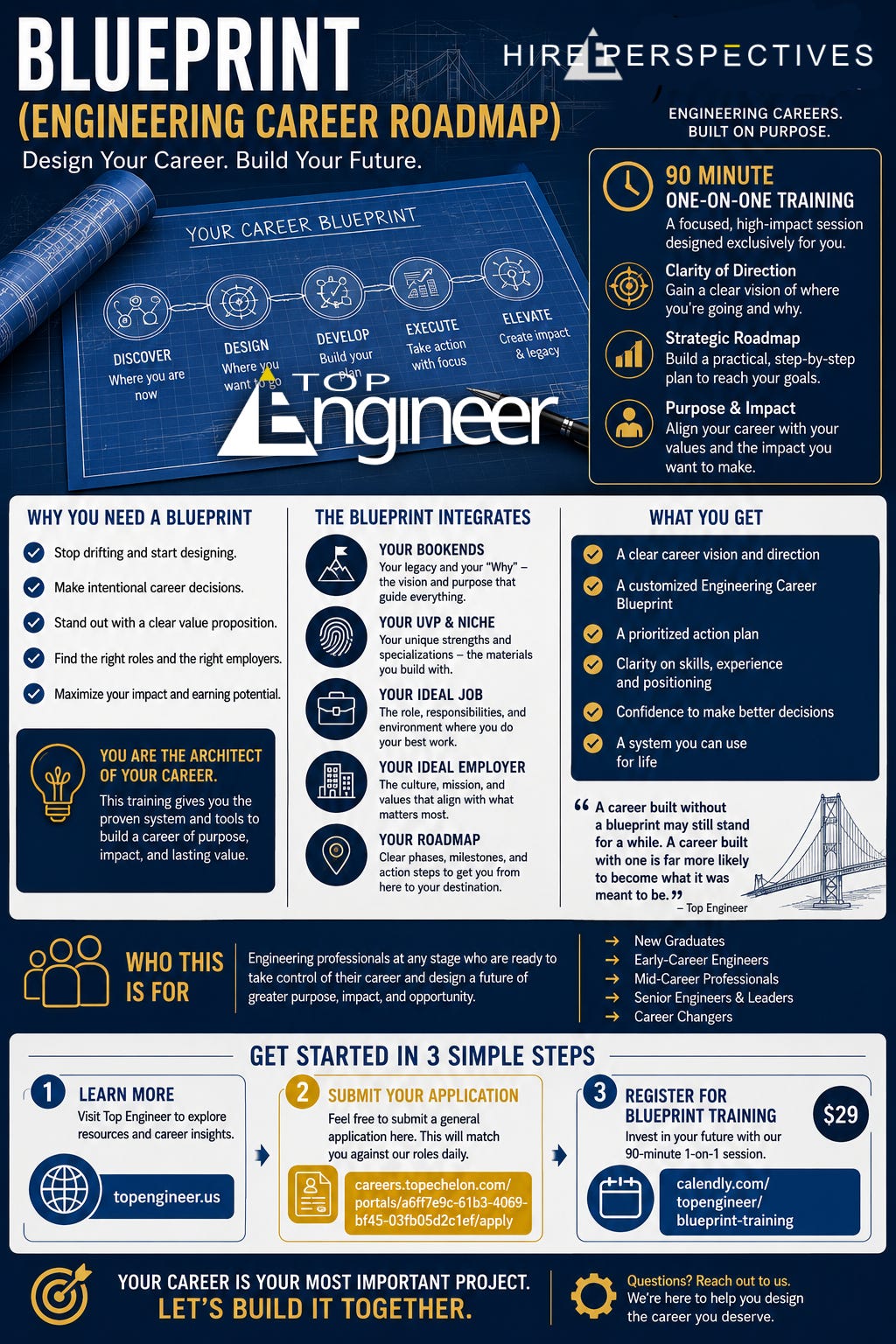
No serious engineering system is built without a blueprint. A skyscraper, a bridge, a turbine, a vehicle platform, a manufacturing line, or a control architecture all require a governing design. The blueprint is not decoration. It is the source of truth. It clarifies intent, aligns components, reduces waste, exposes weak assumptions, and makes coordinated execution possible.
And yet many engineers attempt to build the most important long term project of their lives, their career, without one. That is the problem this training addresses.
The Engineering Career Blueprint is a 90 minute one on one working session designed to move a career from drift to design. It is not motivational fluff. It is not generic coaching. It is a deliberate planning exercise that helps the engineer step back, clarify direction, organize signal, and build a practical roadmap for forward motion.
Why this matters
A surprising number of capable engineers are operating inside what can only be described as a default career. They did well in school, entered a role, moved into another, took opportunities as they appeared, solved real problems, and kept working hard. But underneath all that activity, something is often missing.
Clear direction.
They are moving, but not always intentionally.
They are working, but not always strategically.
They are accumulating experience, but not always building toward a clearly chosen destination.
That pattern is common, and it is expensive.
Without a blueprint, the career becomes reactive. Decisions are made locally instead of strategically. Opportunities are evaluated loosely instead of rigorously. Energy gets spent on things that may be good in the moment but do not actually support the larger life and work the person is trying to build.
The most powerful thing about a blueprint is that it can be created at any point.
It can help a student shape an early path.
It can help a mid career engineer correct drift.
It can help a senior engineer redesign the next chapter.
It can help someone in transition stop reacting and start choosing.
What the Engineering Career Blueprint actually is
The Engineering Career Blueprint is the master planning document for your career.
It is where the major components of your professional identity, goals, constraints, and target direction are brought together into a coherent design. Instead of keeping your values in one place, your resume in another, your ambitions in another, and your day to day decisions in yet another, the blueprint helps unify them.
In practical terms, the blueprint integrates several critical elements.
Your bookends define the long horizon. They clarify your deeper why, your larger direction, and the legacy or outcome you actually want your career to contribute toward.
Your Unique Value Proposition and niche define the core design specifications. They help identify what you do well, what kind of value you bring, and where that value is strongest in the market.
Your ideal job and ideal employer profiles define the environment. They help answer where this career should be built, under what conditions, with what kind of team, culture, mission, and business case.
Your current position, constraints, and opportunities define the starting coordinates. A blueprint is only useful if it is honest about the actual ground you are standing on.
From there, the blueprint becomes a roadmap with phases, milestones, targets, and practical objectives. It stops being a collection of disconnected thoughts and starts becoming a designed path.
What happens in the 90 minute session
This is a structured one on one session, not a vague conversation.
The goal is to move quickly toward clarity. We examine the engineer’s current trajectory, how they are currently positioned, where friction exists, what they actually want, and what has not yet been articulated clearly enough. Then we begin organizing those pieces into a stronger framework.
In many cases, the first real value of the session is diagnostic. It exposes the mismatch between what the engineer says they want and how they are currently operating. That mismatch is often where wasted years live.
Some people say they want leadership but are still presenting themselves only as executors.
Some say they want more meaningful work but cannot define what meaningful means.
Some say they want better opportunities but have not clarified their niche strongly enough for the market to understand where they actually fit.
Some are chasing too many paths at once and diluting their own signal.
The session helps pull that into focus.
From there, the work becomes architectural. We begin to define the roadmap in a way that supports decision making. Not just abstractly, but concretely. What matters now. What must be built next. What should be stopped. What needs to be sharpened. What has to be true for the next phase of the career to make sense.
What the blueprint is not
It is important to be clear about what this is not.
It is not a personality exercise.
It is not vague encouragement.
It is not a resume rewrite disguised as strategy.
It is not random brainstorming.
It is not a promise of immediate placement.
It is design work.
The purpose is to create order, coherence, and direction so that future decisions can be made against a stronger framework. A good blueprint does not eliminate uncertainty, but it dramatically improves how uncertainty is handled.
Why Top Engineers especially benefit from this
Engineers understand systems. They understand the value of sequence, structure, dependencies, inputs, outputs, and design logic. But many do not apply that same rigor to their own career.
They tolerate ambiguity in themselves that they would never tolerate in a critical design review.
They would never say, “We are just going to build and hope it works,” on an important engineering system. But many are doing exactly that in their professional life.
The blueprint closes that gap by treating the career like the serious project it actually is. Not in a mechanical or soulless way, but in a disciplined way. It honors the reality that meaningful careers are not usually built by accident. They are shaped by thought, clarity, and repeated decisions made against a real design.
What a strong blueprint helps you do
A strong Engineering Career Blueprint improves far more than immediate clarity.
It helps you evaluate opportunities with better judgment.
It helps you stop chasing roles that do not fit.
It helps you present your value more coherently.
It helps you identify what skills, experiences, or positioning gaps actually matter next.
It helps you align your day to day work with your longer horizon.
It helps you move from passive reaction to active architecture.
It also creates a useful reference point. When the market becomes noisy, when a new opportunity appears, when a role looks attractive but feels slightly off, when frustration rises, the blueprint gives you something stable to measure against.
The larger standard
The deeper purpose of the Engineering Career Blueprint is not merely efficiency. It is alignment.
The goal is to reduce the distance between the engineer you are today and the engineer you are trying to become. That requires more than hard work. It requires a map. It requires sequence. It requires a governing logic strong enough to connect your values, your strengths, your ambitions, and your real world decisions.
You are the architect of your career.
This training helps provide the design discipline, the planning structure, and the roadmap logic needed to build that career with greater intention.
A career built without a blueprint may still stand for a while.
A career built with one is far more likely to become what it was meant to be.
To learn more about Top Engineer, visit:
https://topengineer.us
Feel free to submit a general application here. This will match you against our roles daily:
https://careers.topechelon.com/portals/a6ff7e9c-61b3-4069-bf45-03fb05d2c1ef/apply
To register for Blueprint Training, use the link below. The session is $29:
https://calendly.com/topengineer/blueprint-training
Have a blessed day!
James Beine
