



Hire Perspectives helps top engineers and engineering employers understand the hidden signals behind hiring, career movement, technical credibility, and talent decisions across automotive, aerospace, energy, and motorsports.
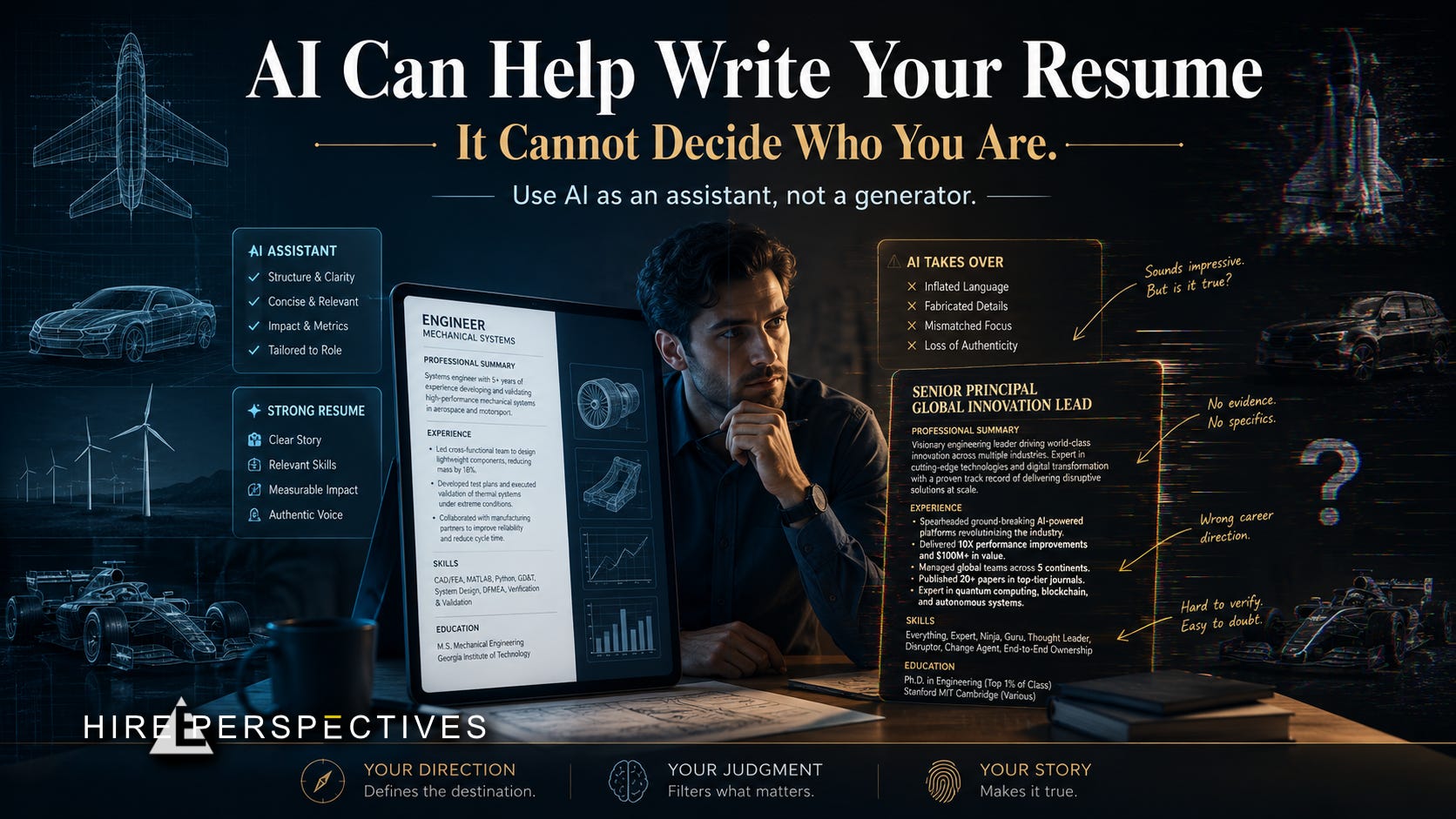
Artificial intelligence can improve a resume.
Claude or ChatGPT, even Deepseek will definitely organize information, tighten language, remove repetition, identify weak descriptions, and help explain technical work more clearly. Top Engineers sometimes struggle to translate complex experience into plain language, that utility is real.
But there is an important distinction between using AI as a resume assistant and allowing it to become the resume generator.
An assistant works with the substance you provide. A generator attempts to create the substance for you.
Your resume is not simply a technical record of your employment history. It is your professional narrative. It explains how one role led to another, what kinds of problems you learned to solve, where your judgment became stronger, what responsibilities you earned, and what direction your career is now prepared to take.
So let’s be clear, AI does not know which experience mattered most. It does not know which assignments changed your thinking. It does not know why you stayed, why you left, what frustrated you, what motivated you, what kind of work gives you energy, or what kind of work you never want to do again.
It does not know how you communicate, how you make decisions, how you respond under pressure, or how other people experience working with you. Those are not decorative details. They are part of the professional identity that separates one qualified engineer from another.
Does your resume look polished, contain the right terminology? Does it resemble the language used by strong candidates in the market and still sound like no particular person? If so you may want to better understand the real risks pointed out in the rest of this article.
Misrepresentation
AI does not understand the boundary between what you personally accomplished, what your team accomplished, and what the broader organization accomplished. Unless that boundary is carefully defined, it may attribute ownership where there was participation, leadership where there was support, or direct technical responsibility where there was only exposure.
The resulting statement may not be completely false. That is what makes it dangerous. It can be accurate enough to survive a casual reading but inaccurate enough to collapse during a serious interview.
Exaggeration and Inflation
AI is designed to produce stronger language. Stronger language often means larger scope, greater authority, more sophisticated expertise, and more measurable impact.
A contribution becomes an initiative. A responsibility becomes ownership. Working knowledge becomes advanced expertise. Participation becomes leadership. A positive outcome becomes a quantified achievement, even when no reliable measurement was ever recorded.
The resume gradually becomes more impressive than the career behind it.
For Top Engineers, that is especially risky because technical interviews expose inflated claims quickly. A hiring manager can ask how a system was designed, how a result was measured, why a particular standard applied, what tradeoffs were considered, or what failed during implementation.
At that point, polished language has no value. So you must be able to explain your work from direct experience.
Hallucination
AI can add information that appears reasonable but was never provided. This may include software, standards, methodologies, certifications, project scope, leadership responsibilities, financial impact, or performance metrics. You have definitely heard the terms. Admire the accomplishment. It makes sense that that’s something you are exposed to. Maybe you actually even did it once or twice in your entire career. So why not just leave it in?
The most dangerous hallucinations are not dramatic or absurd. They are small, believable additions that fit the role and escape notice.
An engineer may read the statement and think, “That sounds good!”
A resume is a representation of professional fact. Every technical claim creates an expectation. Every listed skill suggests competence. Every stated result implies evidence.
Career Misalignment
AI optimizes resumes everyday. Hundreds of thousands, in fact. And it has been determined that many of them are complete fabrications. Costing businesses and employers thousands of dollars in incorrect hiring decisions. Yes, sometimes a fabricated resume lands a role. but not only is this an expense to the employer, it’s an expense to the engineer as well. What ends up happening is the engineer finds himself back on the job market only days or weeks later. This then just expands the discrepancies that need to be explained on the resume. The gaps no one wants.
It’s a common practice to give the AI a job role that you are targeting. and ask the AI to adjust your resume to be more appropriate for the role. And yes, this may in fact help you land an interview. But that’s not going to ultimately help you secure and manage a role that you are not otherwise qualified for. this is the convolution of the real idea that we recommend a top engineer. Instead of using the AI to adjust your resume to fit a role, you should use it in the opposite direction as a way to filter out roles that you should not apply for. instead, prompt like this.. how well does my resume match this particular role? What gaps exist in my resume that would prevent me from being selected to interview for this role? When you ask these questions, you may learn that you omitted something that was absolutely true about you. or you may learn that this role is not quite right for you.
The engineer may end up with a resume that is highly effective at attracting opportunities he does not actually want or not qualified for.
The resume succeeds as a marketing document and fails as a career document.
The central limitation of AI is that It can recognize patterns in language while It cannot decide what your career means. AI cannot determine which parts of your experience are moving your career forward. Only you can supply your personality and explain your professional motivations. A model struggles to know which opportunities represent progress and which merely repeat the past under a different title.
Used correctly, AI is highly valuable. It can help test whether a statement is clear. It can identify missing context. It can show where the resume is too technical, too vague, too repetitive, or too difficult for a recruiter to understand. It can help improve grammar, structure, consistency, and presentation.
But the engineer must remain the source. The experience must be real. The claims must be defensible. The language must still come from your heart. Your intentional career decision must come through.
Gold plated garbage.. well it’s still garbage….
From the beginning of time computers have always been subject to the garbage in garbage out problem. AI is no different. In fact, it’s not even close to the same problem. It’s now worse. Here’s why, gold plated garbage.. well it’s still garbage.
Take a gold-plated necklace to the pawn shop, they will not have any interest at all in this kind of jewelry. Because the value… the profit is in solid gold.
This metaphor sums it up very nicely. Only you can create the gold that is needed on your resume. Show which experiences shaped you, which problems you are best equipped to solve, what kind of work gives you purpose, or what you want the next stage of your career to become. Those decisions require YOU to bring judgment, reflection, and personal ownership. Use AI to sharpen the language, organize the evidence, and improve the presentation, but keep the meaning, direction, and narrative in your hands.
Actions and Outcomes
Action: Write the first version of your career narrative yourself.
Outcome: AI works from your experience instead of replacing it with a generic version of what an engineer is supposed to sound like.
Action: Use AI to improve clarity, structure, grammar, and organization.
Outcome: The resume becomes easier to understand without changing the substance of your experience.
Action: Review every sentence for ownership, scope, authority, and technical depth.
Outcome: Participation is not presented as leadership, exposure is not presented as expertise, and team results are not claimed as individual accomplishments.
Action: Verify every skill, standard, software platform, methodology, metric, and result introduced by AI.
Outcome: Hallucinated details are removed before they become claims you are expected to defend in an interview.
Action: Challenge every inflated word.
Outcome: “Led,” “owned,” “expert,” “transformed,” and “optimized” remain only when the experience supports them.
Action: Explain every resume statement in your own words.
Outcome: The person presented on paper is the same person who appears in the interview.
Action: Define the work you want to do next before tailoring the resume.
Outcome: AI helps position you toward your actual career goals instead of simply matching you to the nearest available job description.
Action: Keep your personality, judgment, motivations, and professional decisions inside the process.
Outcome: The resume communicates a real engineer with a coherent career narrative, not a polished collection of technical keywords.
AI should make your resume clearer, not less accurate. It should help you communicate your value, not manufacture it. A stronger resume is not the one with the most impressive language. It is the one that presents your experience with precision, supports every claim, and points deliberately toward the work you want next.
Use AI to refine the message, test the evidence, and expose the gaps. Do not hand it authority over your professional identity. The best use of AI is not to make you appear qualified for more roles. It is to help you recognize the roles for which your experience, ability, and direction are genuinely aligned.
Your resume should survive more than an applicant tracking system. It should survive technical scrutiny, direct questioning, and the daily reality of the position it helps you secure.
AI can polish the surface. The substance still has to come from you.
Do not build a resume that merely wins the interview. Build one that accurately introduces the engineer who will arrive on the first day.
Have a blessed day!

James Beine
#TopEngineer #HirePerspectives #EngineeringRecruitment #TalentAcquisition #EngineeringLeadership #RecruitingStrategy #EngineeringTalent
